
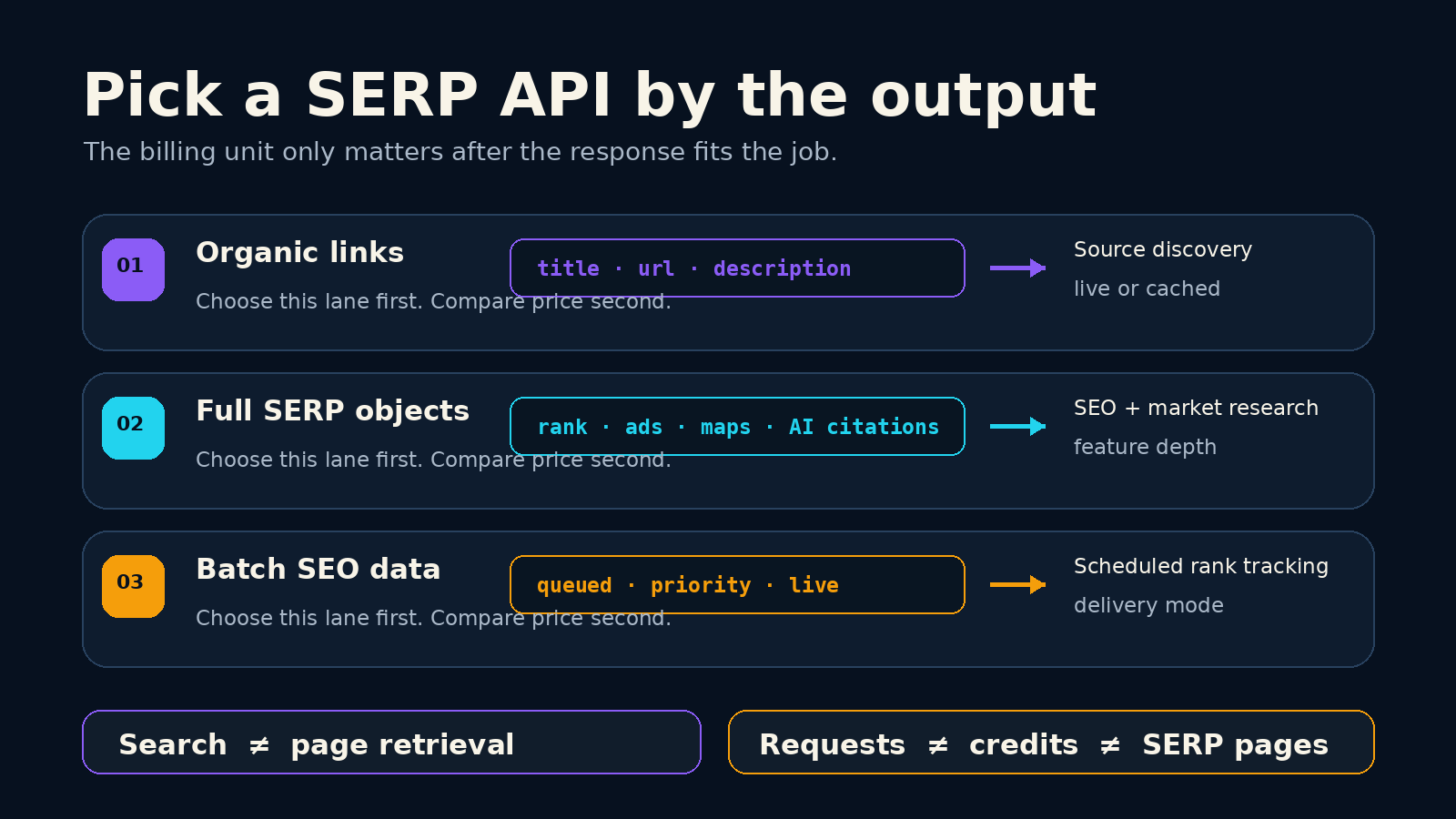
There is no universal best SERP API. Use SerpApi when you need the broadest set of search engines and parsed Google features. Use DataForSEO for large queued SEO batches. Use Serper for a small, fast Google integration. Use Scrape Creators only when basic organic Google results are enough and you also need public social data.
I run Scrape Creators, so that last recommendation is not neutral. It is also deliberately narrow. Scrape Creators is not a replacement for a full SERP platform with Maps, Shopping, ads, knowledge panels, or AI Overview parsing.
Prices and product claims below were checked against primary sources on August 29, 2026. I called the Scrape Creators Google endpoint during this update. I did not run a ten-provider reliability benchmark, and this article does not pretend otherwise.
Quick answer
| If your job is… | Start with | Why | Main tradeoff |
|---|---|---|---|
| Many search engines and deeply parsed Google features | SerpApi | Broad engine catalog, playground, libraries, and mature feature parsing | Higher entry price than narrow Google-only APIs |
| Large SEO batches that can wait | DataForSEO | Queued, priority, and live delivery with explicit per-SERP pricing | More endpoints and task mechanics to learn |
| Simple Google JSON for an application | Serper | Small request contract and 2,500 free queries | Narrower than a full multi-engine SERP platform |
| Google plus AI search surfaces | SearchAPI | Google, Bing, YouTube, ChatGPT Search, Perplexity, and AI Overview endpoints | Monthly bundles and an hourly usage limit |
| Enterprise search collection | Bright Data or Oxylabs | Procurement support, global infrastructure, and high-volume controls | More product and contract than a small project may need |
| Google results plus public social data | Scrape Creators | One key for basic Google organic results and supported social endpoints | Google organic links only, not a full SERP parser |
| A configurable scraper job | Apify | Actors, schedules, datasets, proxies, and custom code | Actor inputs, outputs, and charges vary by developer |
A SERP API comparison becomes misleading when it treats every returned JSON object as the same product. Some APIs reproduce a search page. Some return only organic links. Others retrieve and rerank web pages for an AI model. Decide which output you need before comparing price.
Compare SERP APIs by the output you need
Organic links are the smallest contract
A basic search endpoint returns a ranked list of titles, URLs, and descriptions. That is enough for source discovery, lead finding, or a lightweight research agent that fetches pages separately.
It is not enough for a rank tracker that needs pixel position, ads, local packs, shopping results, People Also Ask, or AI Overview citations. A cheap request can become expensive engineering if your team has to reconstruct every missing block.
Full SERP objects serve SEO and market research
A full SERP provider parses the parts of the results page into named objects. The useful details depend on the workflow:
- an SEO tool may need rank, result type, location, device, language, and timestamp
- a local product may need Maps or local pack fields
- an ecommerce monitor may need Shopping results
- an AI visibility tracker may need AI Overview text and citations
- an ad workflow may need paid results kept separate from organic rankings
YouTube comments reviewed for this update had the same practical questions. Buyers asked whether city targeting also applied to ads, how CAPTCHAs were handled, whether results could trigger an automated workflow, and whether links came with the underlying data. Those are contract questions, not marketing-page questions.
AI web search is a neighboring category
Tavily, Exa, Brave Search, and other web search products often appear beside SERP APIs in AI-agent discussions. They can be useful, but the output is different.
A SERP API preserves the search page and its positions. An AI search or grounding API may choose sources, fetch page text, rerank it, and return answer-ready context. A Reddit discussion about SerpApi alternatives reviewed on August 29 put the distinction plainly: raw SERP data is useful for positions, ads, and search-page objects; grounding products are useful when the agent needs selected sources and cleaned text.
An agent may need both. Search identifies sources. Retrieval gets the page content. A model then evaluates the evidence. Do not pay for full-page text when the agent only needs ten links, and do not buy ten links when the agent needs cited page content.
Pricing compared
The prices below are published starting points, not a normalized performance score. They were verified on August 29, 2026. A search, request, credit, SERP page, Actor run, and successful result are different billing units.
| Provider | Published starting point | Billing detail that changes the math |
|---|---|---|
| SerpApi | Free: 250 searches/month; Starter: $25 for 1,000; Developer: $75 for 5,000 | Successful searches count; cached, failed, and errored searches do not |
| DataForSEO | $0.60 per 1,000 queued SERP pages; $1.20 priority; $2 live | One priced SERP page contains ten search results; some extra parameters cost more |
| Serper | 2,500 free queries; Starter: $50 for 50,000 credits | Check the credit cost for the endpoint and result depth you use |
| SearchAPI | $40/month for 10,000 searches; $100 for 35,000 | Only successful 200 searches are billed; hourly use is capped at 20% of plan credits |
| Scrapingdog | 200 free credits; Lite: $40/month for 200,000 request credits | Failed requests are not charged; endpoint features can use different credit amounts |
| Bright Data | 5,000 free requests/month; pay as you go at $1.50 per 1,000 | Pay only for successful requests; larger commitments publish lower unit prices |
| ScraperAPI | 7-day trial with 5,000 credits; first paid plan: $49/month for 100,000 | Rendering, premium proxies, and other options can use more credits per request |
| Oxylabs | Product pricing varies by plan and result volume | Verify the current plan, result definition, and target features with the live calculator or sales quote |
| Apify | Free plan with $5 platform usage; Starter: $29/month plus usage | Actor compute, proxy traffic, storage, and an Actor’s own pricing can all apply |
| Scrape Creators | 100 free credits; $47 for 25,000; $497 for 500,000 | Most endpoints cost one credit; the Google endpoint returns ten organic results per page; valid cache hits cost zero |
The cheapest row is not automatically the cheapest workload. A five-minute queue can be fine for a nightly rank check and useless for an interactive agent. Full-page content can look expensive next to links, then save a second retrieval call. A provider that returns the wrong locale has a low invoice and a high cost per usable result.
The 10 SERP APIs
1. SerpApi for broad search coverage
SerpApi is the safe first shortlist when the application needs more than ordinary Google organic results. Its product covers Google Search, Maps, Images, Shopping, News, and many non-Google engines. It has a playground, engine-specific documentation, client libraries, search history, account usage APIs, and team keys.
Choose it when parsed feature coverage matters more than the lowest entry rate. The pricing page currently lists 250 free searches per month, then $25 for 1,000 monthly searches. Only successful searches count. That is a clean contract, but a large Google-only batch can be cheaper elsewhere.
2. DataForSEO for queued SEO batches
DataForSEO separates standard queue, priority queue, and live delivery. That is useful because freshness has a price. A nightly rank tracker does not need to pay the same rate as a user waiting on a button click.
The current SERP pricing page lists $0.60 per 1,000 standard SERPs, $1.20 for priority, and $2 for live mode. It also says one SERP contains ten results and calls out extra charges for some parameters. There is no monthly subscription, but the normal minimum payment is $50 after the trial credit.
Choose it for bulk SEO infrastructure when your team can handle an asynchronous task API and wants other SEO datasets from the same vendor.
3. Serper for a small Google integration
Serper keeps the Google request and response easy to understand. Its homepage offers 2,500 free queries and lists a $50 Starter purchase with 50,000 credits.
Choose it when an application needs fast Google JSON without a large catalog of engines or enterprise procurement. Before committing, test the exact verticals and fields you need. A simple organic search call and an image, news, or maps call should not be treated as interchangeable just because they share an account.
4. SearchAPI for search engines and AI surfaces
SearchAPI covers Google and Bing plus YouTube, ChatGPT Search, Perplexity, and AI-oriented Google surfaces. Its current Developer plan is $40 per month for 10,000 searches. Production is $100 for 35,000.
The pricing page says failed requests are not charged and limits hourly usage to 20% of plan credits. That hourly rule matters for bursty launches. Choose SearchAPI when the added engines and AI-search endpoints fit the product. Choose a simpler Google-only API when they do not.
5. Scrapingdog for a budget subscription
Scrapingdog offers Google SERP data alongside its broader scraper catalog. The current pricing page gives 200 free credits, then lists Lite at $40 per month for 200,000 request credits. It says failed requests are not charged.
This is worth testing when you want a lower-priced monthly bundle and a vendor that also exposes other scraping endpoints. Confirm the credit cost for your exact SERP options. A big credit number is not meaningful until you know how many credits the real request consumes.
6. Bright Data for enterprise collection
Bright Data’s SERP API targets larger collection programs. Its public pricing page lists a 5,000-request monthly free tier and pay-as-you-go pricing at $1.50 per 1,000 successful requests, with lower published rates on larger commitments.
Choose it when global targeting, procurement, support, and a larger scraping stack matter. A small developer only collecting one Google page may find the platform broader than necessary. Bright Data is also a better fit than Scrape Creators for non-social targets and large general web programs.
7. ScraperAPI for Google plus general page fetching
ScraperAPI combines structured Google endpoints with proxy-backed page fetching, JavaScript rendering, and asynchronous collection. Its current trial includes 5,000 credits for seven days. The first paid plan is $49 per month for 100,000 credits and 20 concurrent threads.
The important detail is the multiplier. Premium proxies, rendering, and other options can consume more credits. Choose ScraperAPI when the same team needs Google data and an any-URL scraping layer. For social profiles or comments as ready-made objects, use a social-specific API instead of adding a parser to this stack.
8. Oxylabs for managed search infrastructure
Oxylabs sells a managed SERP Scraper API as part of a broader proxy and scraping product line. It supports localized search collection and structured delivery for teams that do not want to manage blocking, retries, and parser changes themselves.
Choose it for an enterprise shortlist where support, global infrastructure, and contractual fit matter. Pricing depends on the live plan and result volume, so use the current calculator or quote rather than copying a stale number from a roundup.
9. Apify for configurable Actors
Apify is not one uniform SERP API. It is a cloud platform and marketplace of Actors. That flexibility is the reason to use it. An Actor can accept many queries, run on a schedule, store a dataset, call a webhook, or combine search with another crawl.
The platform currently has a free plan with $5 of usage and a $29 Starter plan plus usage. The final bill depends on compute, proxies, storage, and the selected Actor’s pricing. Choose Apify when you want to configure or own the job. Choose a fixed API when you want one stable contract and fewer moving pieces.
10. Scrape Creators for basic Google plus social data
Scrape Creators returns ten organic Google results per page with title, url, and description. It accepts a two-letter region and pages 1 through 11. The same account also exposes public-data endpoints for YouTube, Instagram, TikTok, Facebook, Reddit, X, LinkedIn, ad libraries, and other supported platforms.
That combination is useful for research agents that discover sources on Google, then inspect public social posts, transcripts, or comments. It is not useful when the product needs ads, Maps, Shopping, knowledge panels, or AI Overview citations. Use SerpApi, SearchAPI, DataForSEO, Bright Data, or another full SERP provider for those jobs.
Pricing is pay as you go. New accounts get 100 credits. The $47 pack contains 25,000 credits and the $497 pack contains 500,000. Purchased credits do not expire. A valid cache hit costs zero credits; a live cache miss uses the endpoint’s normal price.
A real Google Search request
I ran this request against the public Scrape Creators API on August 29, 2026:
curl --get 'https://api.scrapecreators.com/v1/google/search' \
  --header 'x-api-key: YOUR_API_KEY' \
  --data-urlencode 'query=best serp api' \
  --data-urlencode 'region=US' \
  --data-urlencode 'page=1'
It returned HTTP 200 in 1.56 seconds with ten organic results. The first result in that dated snapshot was:
{
  "title": "10 Best SERP APIs in 2026 to Scale Data Extraction from Google ...",
  "url": "https://www.scrapingdog.com/blog/best-serp-apis/",
  "description": "Jan 22, 2026 ... TL;DR ..."
}
That call proves the documented basic contract for one query at one moment. It is not a reliability benchmark. Search rankings change, location can change the order, and one successful request says nothing about a million-query workload.
The Google Search endpoint docs show the supported parameters. If you need a general any-site scraper instead, compare the products in the web scraping API guide. If uneven usage is the main buying constraint, the pay-as-you-go scraping guide owns that decision. For public social objects, use the social media scraping API comparison.
What buyers keep asking
Five full YouTube transcripts, 12 unique YouTube comments, eight YouTube reply rows, five Reddit threads with 46 returned comments and replies, and 24 TikTok comments were read for this update. The comment samples are qualitative, not representative polling.
The recurring questions were specific. Several came from comments under an Apify Google SERP walkthrough, where viewers asked about city-level ad targeting, automation, output fields, and CAPTCHA handling.
- Does the API return plain links, full SERP objects, or fetched page content?
- Can I target the city, device, and language I actually need?
- Are ads, Maps, Shopping, and AI Overviews included or separate?
- Is the result live, queued, or cached?
- Does one request consume one unit when rendering or premium routing is enabled?
- Can an agent call the API directly, or do I want an MCP wrapper?
- What happens when Google returns a challenge page or unusable HTML with status 200?
A TikTok discussion about search cost added another useful constraint: the cheapest search route can be too slow for an interactive product, while a local cache or database can remove repeated searches entirely. Price the whole workflow. Search, page retrieval, model tokens, retries, and cache misses can cost more than the initial SERP call.
How to test before you commit
Use a fixture set that matches the product instead of copying a provider’s homepage benchmark.
- Save 100 to 500 queries across the actual categories you serve.
- Fix country, city, language, device, depth, and time window.
- Send the same request set to every shortlisted provider.
- Validate the fields your application uses, not just HTTP status.
- Record useful-result rate, missing blocks, location mistakes, latency percentiles, billed units, and support response for one real issue.
- Repeat the run for several days if freshness and parser drift matter.
For an AI agent, add page retrieval and model-token cost. For a rank tracker, compare the exact position and result type. For local search, verify the location in the returned metadata and the actual businesses shown. For ads, confirm paid and organic blocks are separated.
A commenter in a Reddit discussion about buying or building a SERP API summarized the right denominator: cost per usable parsed row, not cost per request. That is the benchmark worth keeping.
Sources checked
Primary product and pricing pages checked August 29, 2026:
- SerpApi product and pricing
- DataForSEO SERP API and pricing
- Serper product and pricing
- SearchAPI product and pricing
- Scrapingdog Google SERP API and pricing
- Bright Data SERP API and pricing
- ScraperAPI product and pricing
- Oxylabs SERP Scraper API
- Apify Store and platform pricing
- Scrape Creators pricing and Google Search documentation
Prices, feature names, and limits change. Recheck the live provider page and run your own fixtures before signing a large contract.