
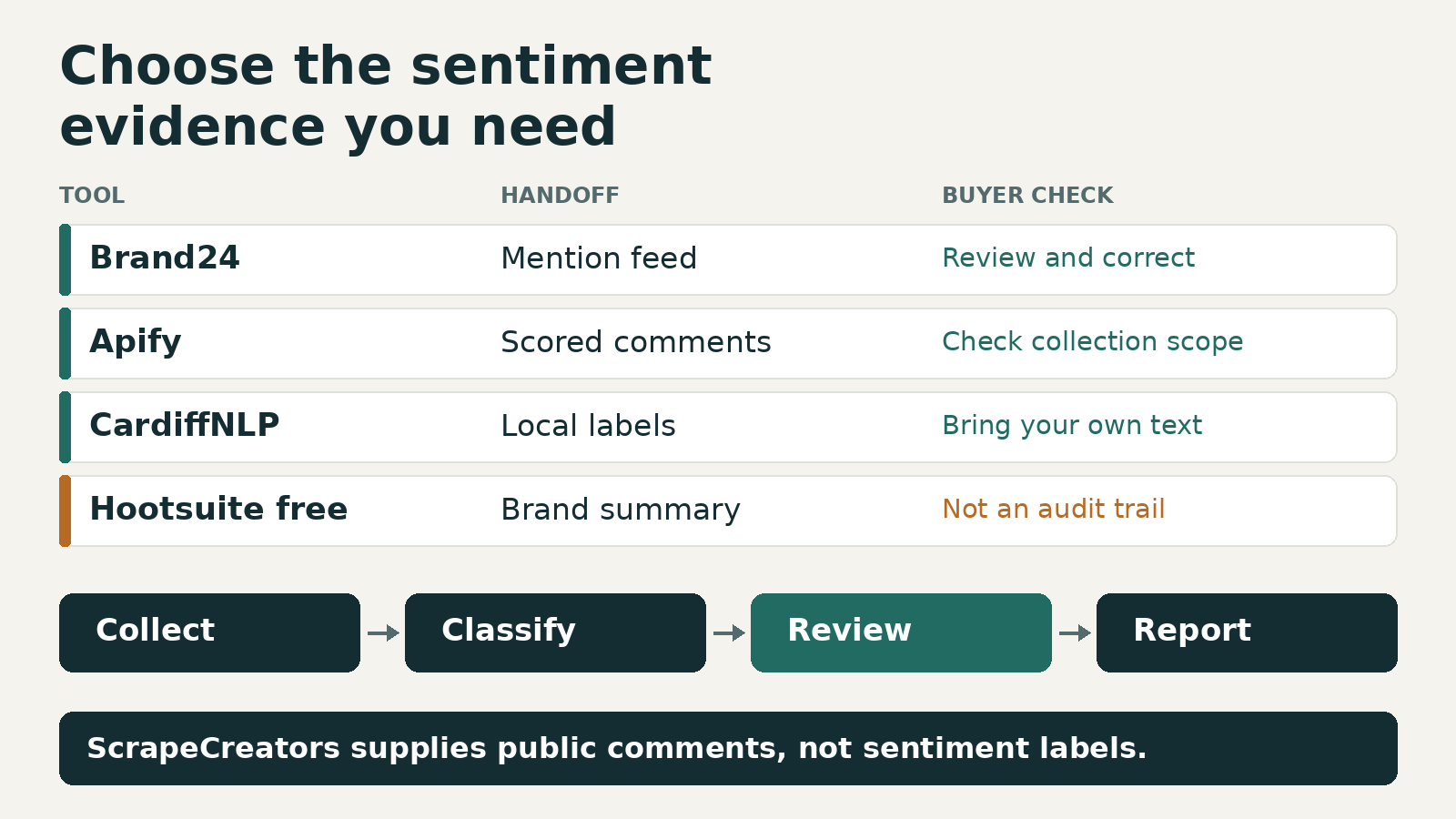
For a team buying social media sentiment analysis tools, I would shortlist Brand24 for an ongoing mention feed you can review, Apify’s Social Media Sentiment Analysis Tool for profile-comment datasets, and CardiffNLP’s sentiment model for text you already have. Hootsuite’s free brand analyzer is a quick starting point, but I would not use its result as an auditable campaign measurement. Choose by the evidence you need back: individual mentions, scored comments, local model output, or just an initial summary.
I run ScrapeCreators. It can supply public comments for your own workflow, but it does not classify their sentiment. I checked the sources and prices below on November 9, 2026. I ran the free Hootsuite lookup and the ScrapeCreators collection example, not a paid-vendor accuracy benchmark.
Quick comparison
These tools do different jobs. A monthly monitored-mention allowance is not the same thing as a price per analyzed comment.
| Tool | Choose it when | Current cost or billing unit | Important boundary |
|---|---|---|---|
| Brand24 | Your team needs collected mentions, sentiment filters, and manual corrections | Individual: $249 monthly, or $199/month billed annually; 2,000 mentions/month | Individual updates every 12 hours. PDF and Excel reports start at Pro, not Individual |
| Apify sentiment Actor | You want a dataset from Facebook, Instagram, and TikTok profile comments | Free-plan event rate: $4/1,000 comments; Starter: $3.35/1,000, plus $0.001 per Actor start | Starter is $19/month with spend included. This is a collection job, not a staffed monitoring workspace |
| CardiffNLP model on Hugging Face | You already have text and want to operate classification yourself | Downloadable weights under CC BY 4.0; budget for compute, integration, and maintenance | English, tweet-trained model. It neither collects social posts nor supplies a reporting dashboard |
| Hootsuite free brand analyzer | You want a quick initial brand/topic summary | Free browser tool | Our returned summary showed no source URLs, collection dates, or sample count |
If your question is where to find mentions and route alerts, use our separate brand monitoring tools comparison. This guide is about choosing and checking sentiment output, including what to do when you already have the text.
1. Brand24 for monitored mentions with manual review
Brand24 is the most straightforward shortlist here when a marketer wants to work inside a mention feed rather than build a classifier. Its sentiment help page describes positive, negative, and neutral labels, sentiment filtering, and manual correction on individual mentions. That correction path matters more to me than an impressive-looking accuracy number.
The same help page warns that sarcasm, context, and language can affect results. Treat multilingual support as something to validate in each language you use, not proof that the same error rate applies everywhere.
The current pricing grid has some consequential gates:
- Individual includes three keywords, one user, 2,000 monthly mentions, and updates every 12 hours.
- Team updates hourly. Pro advertises real-time updates.
- PDF and Excel reports are marked unavailable on Individual and Team, then included from Pro. Pro is $499 monthly, or $399/month billed annually.
- API access is separate from entry-plan dashboard access. The grid marks Pro and Business as an extra-fee option.
Choose Brand24 if someone on your team will review a continuing stream of mentions and correct the labels that matter. Choose another approach if you already own the dataset, only need a one-off classification pass, or need exports on a much smaller budget. Ask for known examples from your actual sources during the trial; a supported-platform logo does not establish complete comment coverage.
2. Apify for collecting and scoring profile comments
Apify’s Social Media Sentiment Analysis Tool combines profile discovery, post/comment collection, and classification for Facebook, Instagram, and TikTok. Its documented output includes comment text, post URLs, and a sentiment object with finalClassification and class scores. This is a useful handoff when the end product needs to be a dataset.
Be specific about the input. The current schema accepts platform-specific profile identifiers, or a person/brand name for profile discovery. It also has post/comment limits and a sentimentAnalysis switch. Prefer known handles when identity matters; automatically finding someone with the same name is not enough.
Date controls have a documented exception: dateTo does not affect Instagram posts. Check the returned dates instead of assuming a configured end date was enforced. A requested comment limit is also not a guarantee that every thread reply was included.
Read the live event-pricing tab, not just the README’s older subscription recommendation. Today, the comment rates are $4/1,000 on Free, $3.35 on Starter, $2.70 on Scale, and $2.05 on Business. Actor start is another $0.001; platform usage is marked included. The lowest headline rate belongs to the $999/month Business plan, not a new Free account. Starter is $19/month with $19 of spend included, then pay as you go.
Choose this Actor if its three-platform, profile-centered collection job matches your inputs. Choose another tool if you need a managed keyword-monitoring operation, a different platform, or a classifier for text already in your database. I reviewed its docs and pricing; I did not run this Actor or verify its classification quality.
3. CardiffNLP for classifying text you already have
The CardiffNLP model card describes twitter-roberta-base-sentiment-latest as an English sentiment model trained on Twitter material and fine-tuned with TweetEval. Its labels are negative, neutral, and positive. The repository declares CC BY 4.0, so review the attribution requirements before distributing a product around it.
This is a model, not a social-data service. You supply the text, runtime, batching, storage, and evaluation. Hugging Face’s text-classification documentation explains the surrounding Transformers workflow.
Choose it if an engineer needs a local baseline and can check performance on representative examples. A local deployment can also keep inference on your own infrastructure, provided you do not send the text to a hosted inference service. Downloadable weights do not mean free hosting.
Choose another approach if you need a no-code team workflow or multilingual coverage without additional model selection. English tweet training is not evidence of quality on every language, niche community, or long reply thread. Pin a model revision in production rather than allowing the word latest to silently determine your evaluation target.
I did not run this model. It is a documented engineering option, not the winner of an accuracy test performed for this article.
4. Hootsuite’s free analyzer for an initial summary
The free Hootsuite tool takes a brand name, topic, or creator. Its input is not a file of comments you upload and audit row by row. The page also warns that generated material can be inaccurate.
I entered Nike on November 9. It returned a Positive label and a short brand summary. In that result, I could not see cited source URLs, a collection window, a mention count, or an export of labeled examples. That is an observation about one lookup, not a claim that I verified public opinion about Nike.
Choose the free tool if you want a quick prompt for further investigation. Choose a traceable dataset or managed mention feed if you have to defend the result to a client, compare campaigns, or reproduce a trend next month. A positive paragraph without its underlying sample cannot establish that sentiment improved.
The free analyzer and Hootsuite’s paid listening product are different buying decisions. Do not assume that trying the free page verifies paid-plan source coverage, exports, or historical access.
Build a reviewable comment sample before scoring it
A classifier cannot repair a badly defined collection sample. For a custom workflow, start by retaining stable comment IDs, the source video, collection method, and observation time. Keep the original text separate from both model output and a human review label.
Here is a small collection example using the ScrapeCreators YouTube API and the documented comments endpoint. It fetches the first top and newest pages for IBM Technology’s public sentiment-analysis video, deduplicates comments by ID, and saves which selection each comment appeared in. It does not classify anything.
Install requests, set SCRAPE_CREATORS_API_KEY in your environment, and run this as a Python script:
import json
import os
from datetime import datetime, timezone
from pathlib import Path

import requests

video_url = "https://www.youtube.com/watch?v=5HQCNAsSO-s"
endpoint = "https://api.scrapecreators.com/v1/youtube/video/comments"
rows = {}
responses = []
for order in ("top", "newest"):
    response = requests.get(
        endpoint,
        headers={"x-api-key": os.environ["SCRAPE_CREATORS_API_KEY"]},
        params={"url": video_url, "order": order},
        timeout=60,
    )
    response.raise_for_status()
    data = response.json()
    if data.get("success") is not True or not isinstance(data.get("comments"), list):
        raise RuntimeError("Expected a successful comment page")
    responses.append({
        "order": order,
        "status": response.status_code,
        "elapsed_seconds": response.elapsed.total_seconds(),
        "observed_at": datetime.now(timezone.utc).isoformat(),
        "data": data,
    })
    for comment in data["comments"]:
        comment_id = comment.get("id")
        text = comment.get("content")
        if not comment_id or not isinstance(text, str) or not text.strip():
            continue
        if comment_id not in rows:
            rows[comment_id] = {
                "comment_id": comment_id,
                "source_url": video_url,
                "text": text,
                "seen_in": [],
                "model_label": None,
                "review_label": None,
            }
        rows[comment_id]["seen_in"].append(order)
packet = {
    "observed_at": datetime.now(timezone.utc).isoformat(),
    "scope": "First top and newest pages; top-level comments only",
    "unique_rows": len(rows),
    "more_pages": any(bool(x["data"].get("continuationToken")) for x in responses),
    "comments": list(rows.values()),
}
Path("sentiment-input.json").write_text(json.dumps(packet, ensure_ascii=False, indent=2))
print(json.dumps({k: v for k, v in packet.items() if k != "comments"}))
# Keep the exact source bodies private for this example's verification.
Path("example-source-responses.json").write_text(json.dumps(responses, indent=2))
In the exact execution for this article, the two calls each returned 20 parent comments and charged one credit. Their union contained 27 unique comments, so 13 rows overlapped. A continuation token remained. This is a bounded, non-random sample, not every comment and not an estimate of audience-wide sentiment. Replies were not fetched by this script. The blank labels are intentional: missing analysis is not neutral sentiment.
The endpoint supports order=top and order=newest. For more parent pages, pass the returned continuationToken and repeat the source URL and intended order; for replies, use the separate replies endpoint with a parent’s repliesContinuationToken. Our YouTube comment scraper comparison covers collection choices in more detail.
ScrapeCreators pricing currently starts at $47 for 25,000 prepaid credits. That buys collection, not a sentiment engine or human review. These two requests consumed two credits; they did not buy a 25,000-comment export. If you need this input layer, create an account and try a small public fixture first. If you need someone else to run the whole analysis operation, choose a finished tool instead.
A trial that catches misleading sentiment reports
Before paying for a larger dataset or annual plan, build a small review set from the actual communities and languages you care about. This is a proposed evaluation method, not a benchmark I ran across the four tools.
| Check | What to ask for | What would make me pause |
|---|---|---|
| Collection coverage | Source URLs, dates, filters, fetched parent/reply counts, and pagination state | A public comment counter presented as the number analyzed |
| Target of the opinion | A separate field for the brand, product, or feature being discussed | A complaint about delivery treated as a complaint about product quality |
| Difficult language | Reviewed examples of negation, sarcasm, mixed opinions, and each important language | One overall accuracy claim with no relevant examples |
| Corrections and exports | Original text, model label, human correction, and an allowed export path | Only an aggregate chart, or exports locked behind an unbudgeted tier |
| Trend comparability | The same query, sources, ordering, inclusion rules, and classifier revision | Comparing top comments this week with newest comments last week |
The audience research for this guide changed that checklist. In Kevin Stratvert’s Excel walkthrough, viewers and replies raised both sarcasm and access-to-the-demonstrated-feature questions. That is a reason to check the exact capability in your account, not current proof of Microsoft’s licensing rules. A multilingual social-listening discussion also raised cleanup and cultural-context problems. Those are qualitative questions, not a comparative accuracy study.
For your own review set, write an explicit labeling rule. Consider this invented example: “The app looks good, but checkout froze twice.” A single positive/negative label loses the difference between design and checkout. Either retain separate aspects or mark the overall item as mixed in your review layer. Do not silently replace mixed, missing, and uncertain cases with neutral.
When reporting a negative share, state the denominator: reviewed, relevant, deduplicated items in a declared collection sample. Keep rejected spam, uncertain cases, unavailable text, and unfetched replies visible as exclusions. A model’s confidence score is not proof that its label is correct, and a comment’s sentiment is not proof that the writer bought anything.
My buying rule is simple: if a vendor cannot show the underlying examples and how you can correct them, I would not use its aggregate sentiment number to make an expensive decision.
Frequently asked questions
What is the best social media sentiment analysis tool?
For ongoing monitored mentions, shortlist Brand24 and verify your report tier. For Facebook, Instagram, and TikTok profile-comment datasets, evaluate the Apify sentiment Actor. For existing English text and engineering control, consider CardiffNLP. Hootsuite’s free analyzer fits an initial summary, not an auditable measurement.
Is there a free social media sentiment analysis tool?
Hootsuite has a free brand/topic analyzer, and CardiffNLP publishes downloadable model weights under CC BY 4.0. They solve different jobs. The former returned a summary in our lookup; the latter needs text and infrastructure. Neither should be confused with free, complete historical social-data collection.
Can ScrapeCreators analyze sentiment?
Not in the example or endpoint covered here. ScrapeCreators retrieves public comments. You add a model or analysis service, retain its output, and review the important labels. Collection cost, classification cost, and review effort are separate parts of that workflow.
Can sentiment analysis reliably detect sarcasm in every language?
Do not buy on that promise. Brand24’s own help documentation acknowledges sarcasm, context, and language variability. Test examples from each important language and community, retain uncertain cases, and check whether the tool lets you correct classifications before those labels reach a report.