
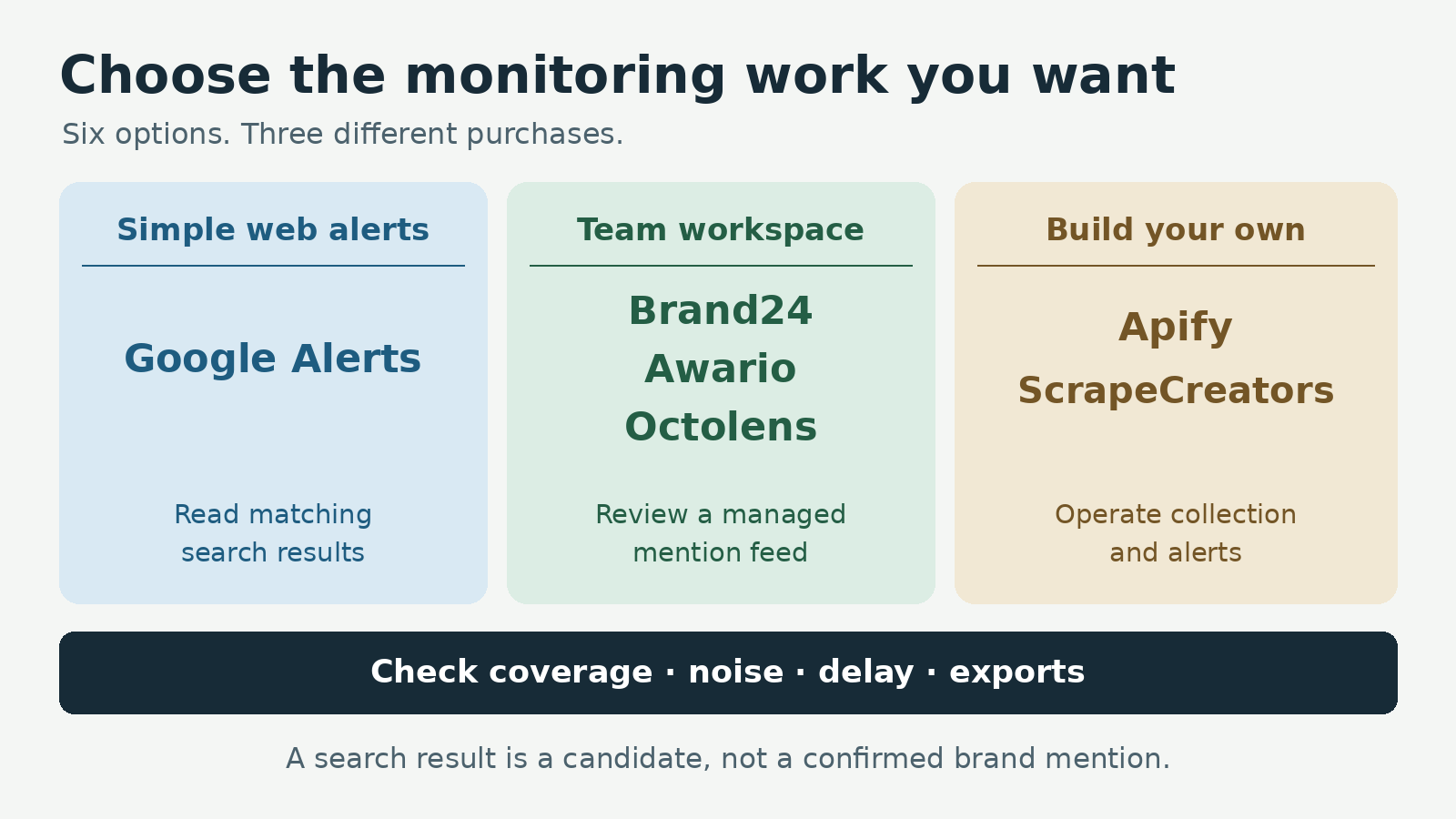
For a marketing team choosing brand monitoring tools, I would shortlist Brand24 for a ready-made listening dashboard, Awario for a smaller budget, and Octolens for routing relevant community conversations to your team. Google Alerts is a useful free web-alert starting point. Apify fits scheduled collection jobs; ScrapeCreators fits a custom public-data workflow. The last two are building blocks, not replacements for a finished monitoring workspace.
I run ScrapeCreators. If you want someone else to operate the monitoring, choose a managed tool. Prices, plan limits, and documentation below were checked on November 2, 2026. I ran the ScrapeCreators example, not a six-vendor accuracy or speed benchmark.
Quick comparison
| Tool | Choose it for | Price and unit checked today | Check before buying |
|---|---|---|---|
| Brand24 | A marketing team’s mention feed and sentiment dashboard | Individual: $249/month, or $199/month with annual billing | Entry-plan updates are every 12 hours, not the Pro plan’s real-time updates |
| Awario | Lower-cost Boolean monitoring | Starter: $49/month, or $29/month with annual billing | CSV export starts at Pro, which is $149/month or $89/month billed annually |
| Octolens | Community mentions routed into Slack or email | Pro: $199/month, or $159/month with annual billing | Pro refreshes hourly; news, web, newsletters, and podcasts start on Scale |
| Google Alerts | Simple notifications about new Google Search results | Free | It is not a complete social conversation feed or sentiment dashboard |
| Apify | Configurable, scheduled datasets | Each Actor has its own billing; the Reddit example below charges for stored results | A finished run still needs matching, review, and notification logic |
| ScrapeCreators | Public source records for a workflow you build | $47 buys 25,000 non-expiring credits | Requests are not verified mentions; you operate the monitor |
These options do not buy the same thing. A monthly workspace includes a human interface and managed collection. A request credit or stored-result event buys part of a workflow. Neither a low request price nor a long source list proves better coverage.
This guide is about choosing a brand-monitoring workflow for a team, not selecting an API contract. If your application already needs programmatic ingestion, use our monitoring API comparison. If the whole job is Reddit notifications, our Reddit keyword monitoring guide is narrower.
1. Brand24 for a ready-made marketing dashboard
Brand24 is the first option I would trial when the team wants to read mentions, inspect sentiment, and understand spikes without maintaining a collector. Its product page describes social listening and analysis; its pricing page makes the entry-plan tradeoff unusually concrete.
Individual includes three keywords, 2,000 mentions per month, and one user. Collection updates every 12 hours. Team moves to seven keywords, 10,000 monthly mentions, unlimited users, and hourly updates at $349/month, or $299/month with annual billing. Pro advertises real-time updates at $499/month, or $399/month billed annually.
That distinction matters more than a generic “real-time monitoring” headline. Brand24’s collection-timing explanation says Pro, Business, and Enterprise typically collect new mentions within minutes, while lower plans have slower intervals. This is the vendor’s description, not latency I measured. It also says content must be public.
Choose Brand24 if the team wants a managed dashboard and can pay for the collection cadence it needs. Choose a different option if a 12-hour entry-plan interval would defeat the purpose of your alerts. Trial your important content surfaces rather than treating a platform logo as proof that every post, comment, video, and language is covered.
One useful caution came from a Brand24 walkthrough: the presenter inspected a negatively classified mention and recognized it as their own comment, not a brand crisis. Read the underlying text before escalating. The same demo also encountered noise around a conversational brand phrase. It informed the trial checklist below, not a claim about overall accuracy.
2. Awario for Boolean monitoring on a smaller budget
Awario is worth shortlisting when you want a listening workspace but cannot start at several hundred dollars a month. Its current plans include Boolean search on Starter, with three monitored topics, unlimited keywords within each topic, 30,000 new monthly mentions, and one team member.
A topic is not the same unit as a keyword. Several spellings and exclusions can belong to one topic. Compare the actual query you need to configure instead of lining up “three topics” against “three keywords” as though they were identical allowances.
The catch is what you can take out. Starter does not include CSV export or PDF reports. I checked the disabled feature markers in the pricing cards and the export FAQ, not just a text list that displays every feature under every plan. Pro includes those exports, 15 topics, and ten team members. API access is a separate Enterprise gate; it is not necessary just to use the dashboard.
History has another boundary. Starter lists 5,000 stored mentions per topic, distinct from its 30,000 new-mention monthly allowance. The FAQ says newly found mentions replace the oldest once storage fills. A collection allowance is not an unlimited archive.
Choose Awario if cost and precise keyword rules matter more than an extensive reporting stack. Budget for Pro if a client expects downloadable reports. Do not discover the export gate at the end of a Starter trial after promising a spreadsheet to someone else.
3. Octolens for actionable community mentions
Octolens fits a team that wants relevant conversations delivered where people already work. Its pricing grid includes Slack and email alerts, AI relevance scoring, sentiment, a daily brief, CSV export, and unlimited seats on Pro. The plan lists ten keywords and 15,000 mentions, with hourly refresh.
Its source packaging is important. Pro covers social and community sources such as Reddit, Hacker News, GitHub, and YouTube. News, general web, newsletters, and podcasts start on Scale, which costs $599/month or $499/month with annual billing. Do not buy Pro for a press-monitoring job because the homepage discusses media coverage elsewhere.
Watch the overage policy too. The page says mentions beyond the allowance continue and are billed at $0.013 each on Pro or $0.01 on Scale. You can set a monthly spend cap or turn flex mentions off. A fixed headline subscription does not necessarily cap the bill.
Choose Octolens if community conversations and routing are the center of the job. Choose a broader media plan or another service when press coverage is essential. During the trial, inspect records rejected by relevance filtering as well as the ones delivered to Slack. A clean inbox can mean useful filtering, but it can also hide a missed relevant conversation.
4. Google Alerts for a free web-alert starting point
Google Alerts is a reasonable first setup for a small brand that mainly wants to know when new search results appear. Google’s official setup guide describes email alerts and controls for frequency, site types, language, region, and result quantity.
I would use it to learn the shape of a brand’s web mentions before committing to a paid workspace. Start with the brand name, a distinctive product phrase, and a founder’s public name if that is part of the monitoring job. Review the results yourself.
Choose Google Alerts if basic web notifications are enough and you can tolerate the uncertainty of search discovery. Choose a listening workspace when you need a shared mention queue, sentiment review, reporting, or specific social-comment coverage.
A new Google Search result is not the same event as a new social post. This guide does not claim Google Alerts measures every conversation or confirms that an AI answer recommends your brand. Those require different evidence.
5. Apify for scheduled collection jobs
Apify fits teams that want to configure extraction jobs and keep datasets rather than buy a conventional listening dashboard. Its schedules run Actors repeatedly, while webhooks can notify your system about run events.
For a concrete example, Trudax’s Reddit Scraper Lite accepts search terms and supports separate post and comment search controls. Its input schema says to remove start URLs when using the search field. That configuration detail can change what the job actually collects.
The Actor’s pricing tab lists $4 per 1,000 stored results on Free, plus an Actor-start event of $0.02 per GB. Higher paid tiers discount the result event. Platform usage is marked included for this Actor, so do not automatically add a second compute-and-proxy bill. Apify’s platform pricing includes a free allowance; this is not a claim that every run requires a subscription.
Choose Apify if configurable datasets and a job-based workflow suit your team. Verify each Actor’s maintainer, inputs, output, event prices, and failure behavior separately. A run completing does not establish that a new record is relevant, newly published, or safe to send as an urgent alert. I did not execute this paid Actor or compare its recall with the other options.
6. ScrapeCreators for a monitor your team operates
ScrapeCreators supplies public social data through an API. It is a useful collection layer when you want to own the workflow, but it does not supply the finished dashboard, sentiment labels, or notification operation described above.
The Reddit search contract has separate post and comment modes. I checked both, then tested a common-word brand to make the relevance problem visible.
On November 2, a Linear post search returned seven records, including unrelated uses such as a non-linear game timeline. A narrower "Linear" "issue" query still returned unrelated discussions. A subreddit:Linear search returned seven records from that community; its next page returned seven more with no overlapping IDs in that bounded sample. Each of those successful search requests cost one credit.
The scoped query improved the source boundary, not brand-wide completeness. It excludes conversations elsewhere. More importantly, timeframe=week did not produce a valid rolling-week dataset: the scoped first page included October 1 and October 16 records, and page two reached September. Check returned dates locally before sending alerts. An HTTP 200 is not proof of freshness or relevance.
A bounded request you can inspect
This request reads one post-search page from a known community. It does not monitor comments, paginate, classify sentiment, or send alerts.
curl --fail-with-body --silent --show-error --get \
  'https://api.scrapecreators.com/v1/reddit/search' \
  --header "x-api-key: $SCRAPE_CREATORS_API_KEY" \
  --data-urlencode 'query=subreddit:Linear' \
  --data-urlencode 'filter=posts' \
  --data-urlencode 'sort=new' \
  --data-urlencode 'timeframe=week'
I ran this exact command separately. It returned seven unique posts, cost one credit, and had another page available. Six of those seven records had dates older than the requested week. The response was usable for inspection, not a verified fresh alert feed.
For pagination, repeat query, filter, sort, and timeframe with the returned after value. Repeat trim too if you use it. A cursor does not preserve stateless options. Comment search uses filter=comments; the timeframe control is for posts, not comments.
Pricing is prepaid: 100 free signup credits, then $47 for 25,000 credits that do not expire. These search calls charge per successful request, not per accepted brand mention, and successful empty searches can also be charged. Storage, repeated pages, matching, human review, and delivery are separate operating costs.
Choose ScrapeCreators if someone on your team will own those layers. Create an account to inspect a small query before scheduling anything. Choose a managed workspace if nobody wants to own it. Do not substitute our Google-indexed X discovery for native X keyword monitoring.
A trial scorecard that catches expensive mistakes
Ask each shortlisted provider to evaluate the same small evidence set. Build it from public URLs you have checked yourself, with several true mentions, several non-brand uses of the name, and more than one language if needed. This is a proposed acceptance test, not a benchmark I ran across these vendors.
| Trial check | Record | What it tells you |
|---|---|---|
| Known relevant URLs | Found, missing, or excluded by documented source scope | Coverage of your selected examples, not the whole internet |
| Common-word collisions | Relevant versus unrelated records in the reviewed sample | How much manual cleanup the query needs |
| Comment-only mentions | Whether the exact comment was found | Whether post discovery is being mistaken for comment coverage |
| Discovery and delivery | Publication, first discovery, and notification times | Where delay occurs; a polling interval is not an end-to-end guarantee |
| Sentiment disagreements | Original text, proposed label, human correction | Whether the report can survive review |
| Export and handoff | A real downloaded file and the person responsible | Whether the chosen plan supports the team’s actual workflow |
A public-relations discussion raised manual sentiment correction, missing context, and disagreement over plan-dependent freshness. Another brand-monitoring discussion mixed mention tracking with legal compliance and attracted substantial vendor promotion. These are useful questions to test, not independent proof that a named vendor succeeds or fails.
Keep marketing mentions separate from trademark enforcement, impersonation detection, and legal compliance. Also keep ordinary web/social mentions separate from AI-answer visibility. To assess the latter, record actual answers to a fixed prompt set, with model, date, citations, and whether the brand was named. A social mention count cannot answer that question.
My practical starting point is a managed tool plus a written acceptance test. Move to collection infrastructure only when the data or workflow needs justify operating it yourself.
Frequently asked questions
What are the best brand monitoring tools for a small team?
Trial Brand24 for a ready-made marketing dashboard, Awario for a lower entry price, and Octolens for community conversations and routing. Google Alerts fits simple web notifications. Apify and ScrapeCreators suit teams building their own monitoring workflow, not teams looking to avoid that work.
Is there a free brand monitoring tool?
Google Alerts provides free notifications about new Google Search results. It is a starting point rather than a complete social listening system. A free API allowance is different: it lets you try collection, but it does not supply the surrounding monitoring operation.
Which brand monitoring tool is real-time?
Check the exact plan. Brand24 Individual updates every 12 hours, Team hourly, and Pro advertises real-time updates. Octolens Pro is hourly, while Scale advertises real-time refresh. Those are current vendor descriptions, not measured end-to-end notification guarantees.
Can one tool find every brand mention?
Do not assume that. Source access, private content, language, date coverage, query matching, and result limits can all affect what you receive. Measure known examples and inspect missed or rejected records. Never describe an incomplete sample as every mention of the brand.