
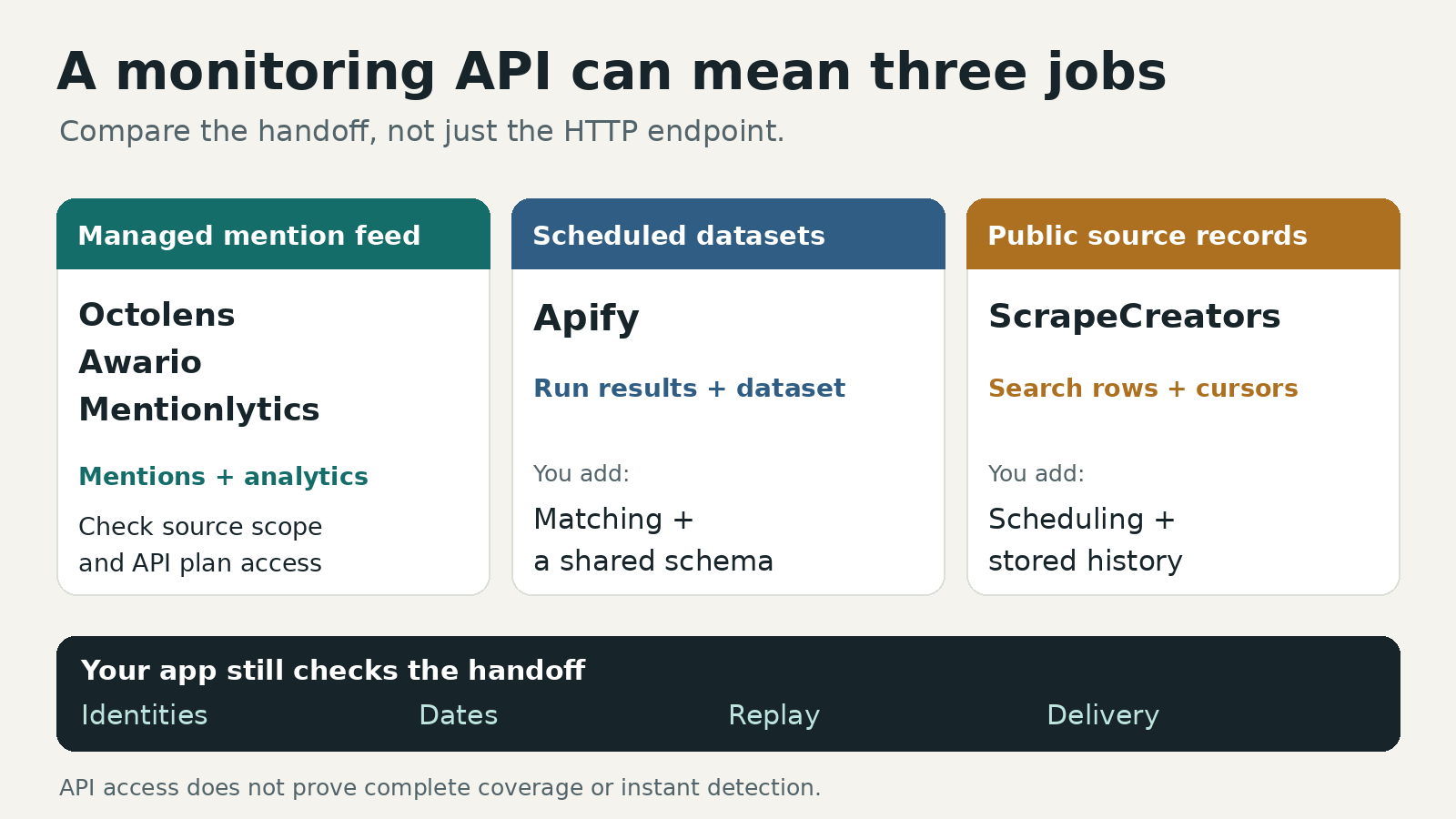
For a social media monitoring API, start with Octolens if you want a managed mention feed with relevance labels and webhooks. Choose Awario for an existing Enterprise listening workflow, or Mentionlytics for reporting plus API access. Choose Apify for scheduled collection jobs. Use ScrapeCreators when you want public source data and will build the matching, storage, and delivery yourself. These are different purchases, not five interchangeable ways to get every mention.
I run ScrapeCreators. A managed listening service is the better starting point if your team does not want to operate a collector. Prices, plan gates, and documentation below were checked on October 29, 2026. I executed the ScrapeCreators requests and Python example, not a five-vendor performance benchmark.
Quick comparison
| Option | Choose it when | Price and unit checked today | Boundary that matters |
|---|---|---|---|
| Octolens | Your application needs collected mentions, labels, and push delivery | Pro: $199/month, or $159/month billed annually; 15,000 mentions and 10 keywords | Pro refreshes hourly; the API reads your workspace’s collected data |
| Awario | You want to integrate a full listening workspace | Enterprise: $399/month, or $249/month billed annually | API requires Enterprise or a custom plan; Twitter data is excluded from its API |
| Mentionlytics | Reports and monitored mentions need to reach your own systems | Pro: $499/month, or $416/month billed yearly | API access starts at Pro, not the cheapest dashboard plan |
| Apify | You want configurable runs and datasets | Actor-specific; the Reddit example is $4/1,000 stored results on Free, plus a start event | Multiple Actors do not automatically become one normalized mention feed |
| ScrapeCreators | You want public-data primitives for your own application | $47 buys 25,000 non-expiring credits; the searches demonstrated here cost 1 credit per request | You own scheduling, relevance checks, history, and notifications |
The first three sell managed monitoring with an API. The last two supply collection building blocks. Compare the work left after the response, not just the lowest number in the pricing column.
For general profile, video, or comment retrieval, use our broader social-data API comparison. This guide is about feeding a recurring monitoring system. If you only need Reddit email alerts, our Reddit monitoring guide is a closer fit.
1. Octolens for a managed mention feed
Octolens is my first shortlist option for a developer who wants the provider to collect mentions and make them available to an application. Its API reference describes workspace-scoped access, scoped keys, and a shared limit of 500 requests per hour per organization. Creating more keys does not create more request allowance.
Its mention-list contract separates collection from retrieval. You query the organization’s mentions, filter them, and page with a cursor. That is not an unrestricted search across every post on each social network. Low-relevance records are excluded by default; the includeAll option matters if you are auditing what the classifier discarded.
The pricing grid includes API, webhooks, and MCP on Pro. Pro has hourly search intervals. Scale advertises real-time refresh, adds media sources such as news and podcasts, and costs $599/month or $499/month with annual billing. I did not measure either plan’s discovery latency.
Choose Octolens if your application needs a managed feed rather than another scraper to run. Check source coverage for your actual keywords, how low-relevance records count toward spend, and whether your integration needs polling, push delivery, or both.
2. Awario for an Enterprise listening workspace
Awario can feed tracked mentions and analytics into your own reporting or product. The important detail is in its API product page: you need Enterprise or a larger custom plan, and Twitter data is not available through the API. A network appearing in the main product does not prove its data can leave through that product’s API.
The Enterprise plan lists 100 monitored topics, one million new mentions per month, and 50,000 stored mentions per topic. Those are different limits. New-mention capacity describes collection volume; stored-mention capacity limits what remains available in a topic’s history. The pricing FAQ says newly found mentions replace the oldest ones once the history limit is reached.
That distinction matters if your application promises a durable archive. Ask what your exporter must save before records roll out, and how deletion or correction requests propagate into your copy.
Choose Awario if its listening workspace and reporting already suit your team and the API’s source restrictions are acceptable. Do not buy Starter or Pro assuming their dashboard access includes API access. I checked the disabled API markers on those two plan cards, not just a text extraction that lists every feature under every plan.
3. Mentionlytics for reports plus programmatic access
Mentionlytics positions its monitoring API for custom dashboards, internal reporting, and applications using its social and web data. That is useful when the human reporting workflow is part of the purchase, not an unwanted extra.
Its comparison grid marks API access unavailable on Basic, Essential, and Advanced, then available on Pro and higher. Pro lists 25 keyword rules and 100,000 monthly mentions. I switched the billing toggle to check the $499 monthly price separately from the $416 monthly equivalent with yearly billing. Those are not the same commitment.
The public API page directs customers to subscribe and get guidance from its team. I did not verify authenticated endpoint schemas or run Mentionlytics requests. Before purchasing for an integration, ask for a real sample showing source IDs, original URLs, sentiment labels, pagination, timestamp definitions, and the exact export restrictions for your plan.
Choose Mentionlytics if your team wants managed listening and reports alongside its integration. Choose another route if public documentation and a self-serve contract are prerequisites you need to validate before a sales conversation. Do not treat a general source list or an accuracy headline as proof of complete coverage or accurate labels for your business.
4. Apify for scheduled collection jobs
Apify makes sense when your workflow is naturally a set of jobs: search a source, collect a bounded dataset, then process it. Its schedules can run Actors repeatedly, and webhooks can notify your integration about run events. A run finishing is not the same event as a new, relevant mention arriving.
For a concrete billing example, Trudax’s Reddit Scraper Lite pricing lists $4 per 1,000 stored results on Free and an Actor-start event of $0.02 per GB. Higher tiers discount the result event. That pricing page marks platform usage included. Do not automatically add a second compute-and-proxy bill to this Actor’s event prices, and do not apply these prices to a different Actor.
A multi-source setup may use that Reddit collector alongside a YouTube Actor. Check each one’s inputs, output, maintenance owner, and billing separately. Apify’s platform pricing includes a free allowance; a paid subscription is not the only possible starting path.
Choose Apify if datasets and configurable collection matter more than a ready-made monitoring contract. You still need cross-source identities, repeat-run deduplication, relevance rules, and delivery logic. This can be a good tradeoff. It is just more work than configuring a mention feed.
5. ScrapeCreators for a collection layer you control
ScrapeCreators fits applications that need public source records without running their own scrapers. It is not a turnkey social listening service. We do not turn every endpoint into one complete, sentiment-scored brand feed.
For example, the Reddit search endpoint can search posts or comments. These are separate collection modes. The YouTube search endpoint returns discovery records, not the speech transcript or every comment under each video. Fetch those separately when the job requires them.
I checked both sources with Notion Calendar. The Reddit post request returned seven rows; its next page returned seven more with no overlapping IDs in that sample. Comment mode returned nine rows. YouTube returned 20 video records. Each successful request cost one credit.
There was a consequential limitation: the Reddit request used sort=new and timeframe=week, but one returned post had a February 2025 timestamp. The YouTube request had no freshness filter and included older tutorials. A successful search response is not proof of a fresh monitoring window. Validate dates locally before creating alerts, and keep a failed or incomplete fetch distinct from a genuinely quiet period.
Pricing is prepaid, with 100 free signup credits and no credit expiry. The search routes used here charge per successful request, not per matched mention; successful empty responses can also cost a credit. Other endpoints have their own documented costs. If you want to try this collection approach, create an account and inspect your own query before scheduling it.
Choose ScrapeCreators if your team wants to own matching, storage, and downstream use. Choose a managed mention provider if you need someone else to operate those layers. Do not use Google-indexed X discovery as a replacement for native X keyword monitoring.
A bounded two-source ingestion example
This Python example uses only the standard library. It reads one Reddit post-search page and one YouTube search page, then emits JSONL candidates with a shared identity envelope. It does not send messages, classify sentiment, or call an LLM.
import json
import os
import urllib.parse
import urllib.request
from datetime import datetime, timezone

QUERY = "Notion Calendar"
BASE = "https://api.scrapecreators.com"
HEADERS = {"x-api-key": os.environ["SCRAPE_CREATORS_API_KEY"]}

def get(path, params):
    request = urllib.request.Request(
        BASE + path + "?" + urllib.parse.urlencode(params), headers=HEADERS
    )
    with urllib.request.urlopen(request, timeout=45) as response:
        data = json.load(response)
    if data.get("success") is not True:
        raise RuntimeError("Search failed; do not advance your checkpoint")
    return data

sources = [
    ("reddit", "/v1/reddit/search", {
        "query": '"' + QUERY + '"', "filter": "posts",
        "sort": "new", "timeframe": "week", "trim": "true"
    }, "posts"),
    ("youtube", "/v1/youtube/search", {
        "query": QUERY, "type": "videos", "region": "US"
    }, "videos"),
]
seen = set()
for platform, path, params, key in sources:
    data = get(path, params)
    if not isinstance(data.get(key), list):
        raise RuntimeError("Unexpected response collection")
    for item in data[key]:
        identity = (platform, str(item.get("id", "")))
        if not identity[1] or identity in seen or not item.get("url"):
            continue
        seen.add(identity)
        candidate = {
            "platform": platform, "source_id": identity[1],
            "source_url": item["url"], "query": QUERY,
            "title": item.get("title"),
            "body": item.get("selftext") if platform == "reddit" else None,
            "observed_at": datetime.now(timezone.utc).isoformat(),
            "published_unix": item.get("created_utc") if platform == "reddit" else None,
            "published_label": item.get("publishedTimeText") if platform == "youtube" else None,
            "sentiment": None,
        }
        print(json.dumps(candidate, ensure_ascii=False))
I ran this exact example on October 29. It emitted 27 unique candidate rows: seven Reddit posts and 20 YouTube videos, using two requests and two credits. Both sources had further pagination available. This is a bounded ingestion check, not a complete export or production monitor.
The source content is deliberately asymmetric. Reddit includes post text; the YouTube rows include titles, not spoken words. The example preserves YouTube’s relative publication label instead of presenting its approximate derived date as an exact timestamp. It also leaves sentiment null rather than inventing a score.
The seen set only deduplicates within this process. For recurring use, persist an identity such as (platform, source_id) and separate first-seen time from later observations. Preserve the query-to-record relationship too: one post matching several alerts is one source record with several matches, not several independent conversations.
When paginating Reddit, repeat query, filter, sort, timeframe, and trim with after; for the YouTube request, repeat query, type, and region with continuationToken. A cursor does not carry your stateless request options forward. Budget extra pages explicitly.
Check the handoff before you buy
A useful trial should answer these questions with actual records:
- What is being searched? A provider’s collected workspace, live platform search, indexed pages, known profiles, video titles, or transcripts are different source surfaces. Test a brand with an ordinary-word name and a product with a distinctive name.
- What becomes a billable unit? Ask about collected, returned, filtered-out, repeated, and empty results. Separate monthly commitments from extra-mention rates, request credits, and Actor events.
- What can leave the dashboard? Confirm API plan access, source exclusions, row caps, history windows, and your intended display or redistribution use. A dashboard screenshot does not answer these questions.
- What happens after interruption? Test an expired credential, a retry, a repeated page, a rate-limit response, and a receiver outage. Decide when to save a cursor and how to replay without sending duplicate alerts.
- Can you audit the interpretation? Keep the original URL and text beside the label. Sample both accepted and rejected records. A relevance classifier can hide a false negative before your application ever sees it.
These checks came from the research, not just a feature checklist. A developer discussion about a listening API asked specifically about embedding data in a paid product. Comments beneath a social listening automation walkthrough raised recurring-run setup, cost, and missing output fields. Those are questions to verify, not evidence that one vendor wins.
Finally, keep public mention text away from instructions that control an AI agent. Octolens’ security guidance explicitly treats mention content as untrusted input. Separate collected evidence from model-generated conclusions, and do not let a post trigger an automatic public reply or other consequential action without the controls your team requires.
Frequently asked questions
What is the best social media monitoring API?
Start with Octolens for a managed, programmatic mention feed. Awario and Mentionlytics fit teams that also want their listening workspace and reports. Apify and ScrapeCreators fit teams that want collection building blocks and accept responsibility for the monitoring system around them.
Is a social listening API the same as a scraping API?
No. A listening API may expose mentions already collected for configured keywords, with labels and delivery options. A scraping API supplies source records. It may help power listening, but search, storage, matching, and notifications do not automatically come with every request.
Does API access mean real-time monitoring?
No. Collection cadence, source discovery, API retrieval, and your delivery worker each affect delay. Octolens Pro’s hourly refresh and its API request allowance are separate limits. Measure the source-to-delivery interval for your selected plan rather than treating a fast HTTP response as a fast detection time.
Can I get every brand mention across all platforms?
Do not assume that any option does. Define the networks, languages, content surfaces, dates, and account restrictions you need, then evaluate those separately. A finite set of search pages cannot establish complete recall. Buy a scope you can verify, and state its gaps in the application you build.