
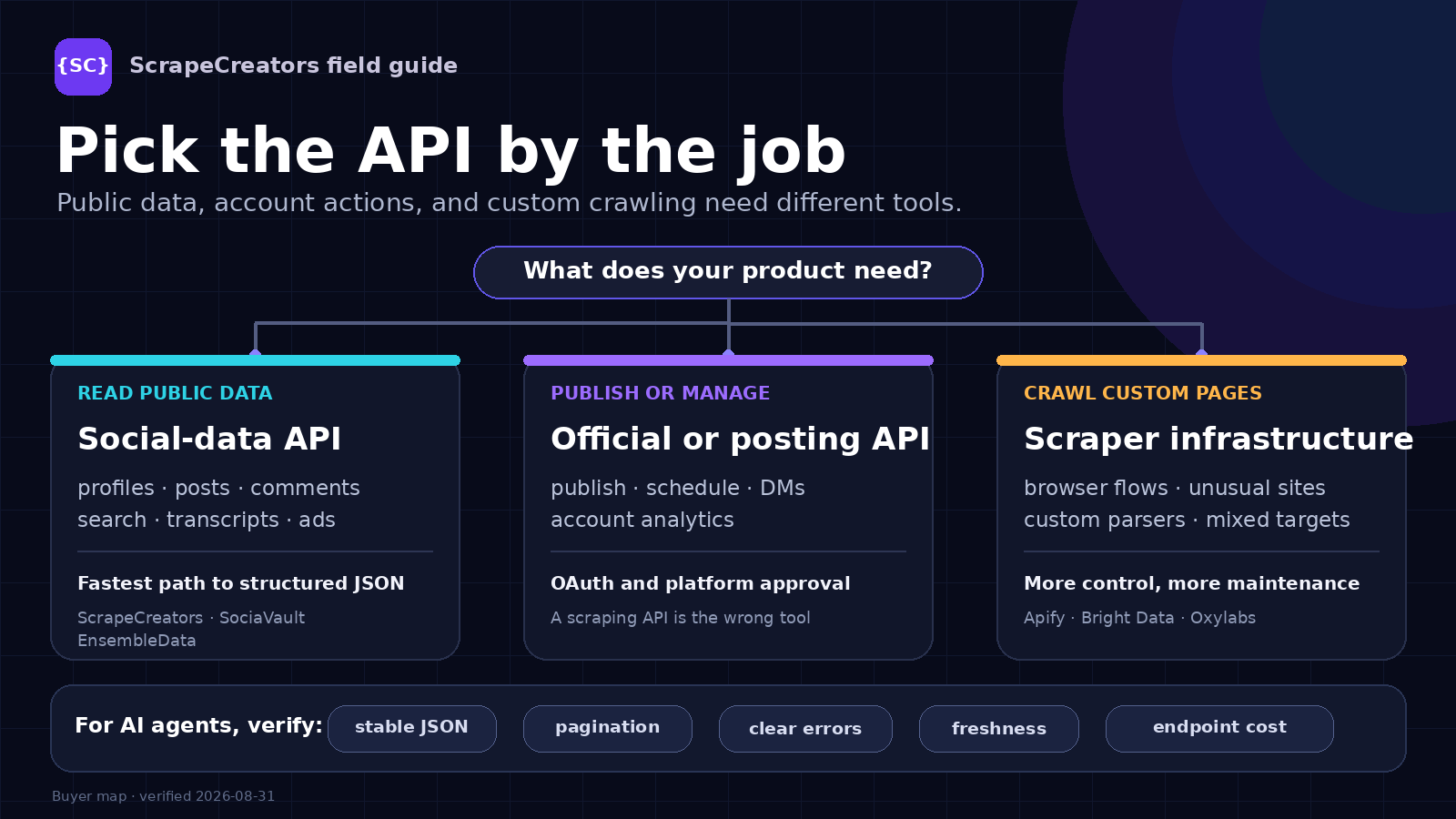
The short answer: ScrapeCreators is the best social media scraping API for most developers and AI agents that need public data from several platforms. It gives you one API for profiles, posts, comments, search, transcripts, and ad libraries without a subscription. SociaVault is the closest pay-as-you-go alternative. Apify is stronger when you want a marketplace and the freedom to run or build custom scrapers.
That verdict applies to reading public data. If your product needs to publish, schedule, send DMs, or manage accounts, use official platform APIs or a posting API instead. I run ScrapeCreators, so the recommendation is not neutral. I have kept the tradeoffs plain and linked every provider’s current page so you can check the details yourself.
I reviewed pricing and product pages again on August 31, 2026. I also searched the live US Google results and used ScrapeCreators to review YouTube videos and transcripts, YouTube comments, Reddit discussions, and TikTok posts around this decision. Across that research, the choice came down to three jobs: reading public social data through a stable contract, publishing through approved account connections, or running custom crawling infrastructure.
I did not run a controlled reliability benchmark across every provider. Anyone claiming hundreds of endpoint tests in a roundup probably did not either. This comparison uses current product coverage, public pricing, one recorded ScrapeCreators request, and the amount of integration work a developer still owns after signing up. A credit, compute unit, record, and successful request can describe very different amounts of work.
Quick comparison
| Rank | API | Best for | Starting point |
|---|---|---|---|
| 1 | ScrapeCreators | Broad public social data through one API | 100 free credits, then $47 for 25,000 credits |
| 2 | SociaVault | A similar pay-as-you-go social API with MCP support | 50 free credits, then $29 for 6,000 credits |
| 3 | Apify | Custom crawlers and a large scraper marketplace | Free plan with $5 usage, then $29/month plus usage |
| 4 | EnsembleData | Daily request allowances across eight social platforms | 50 units per day free, then $100/month |
| 5 | Supadata | Video transcripts, metadata, and AI-ready text | 100 free requests, then $5/month for 300 requests |
| 6 | Bright Data | Enterprise-scale collection and procurement | 5,000 records per month free; paid rates vary by scraper and plan |
| 7 | Oxylabs | Managed web scraping for teams that also target non-social sites | Free trial, with Web Scraper API rates advertised from $0.25 per 1,000 results |
| 8 | ScrapingBee | Headless browser rendering through a simple API | $19/month for 75,000 credits |
| 9 | PhantomBuster | No-code prospecting and social automation | Subscription plans with execution limits |
| 10 | Zyte | Scrapy teams building their own extraction layer | Usage-based pricing by request and website |
Pricing can change, and a “request” does not mean the same thing at every company. Some endpoints use one credit. Others cost more because they return a full search page, transcript, or large result set. Check the exact endpoint before estimating a production bill.
First decide whether you need read, write, or custom crawling
A lot of “best social media API” results compare tools that do different jobs. This is the split I use before looking at vendors:
| Your product needs to… | API category to evaluate | Good starting points | Main tradeoff |
|---|---|---|---|
| Read public profiles, posts, comments, search results, transcripts, or ads | Social-data API | ScrapeCreators, SociaVault, EnsembleData | Fast path to structured social JSON, but public read access only |
| Publish, schedule, send DMs, or manage an account | Official platform API or posting API | The platform’s official API, or a tool built for publishing | OAuth, app review, permissions, and platform-specific contracts |
| Crawl unusual social pages plus ecommerce, SERPs, or arbitrary websites | Scraper marketplace or managed scraping infrastructure | Apify, Bright Data, Oxylabs, ScrapingBee, Zyte | More control, but you own more parsing and schema maintenance |
| Turn social video into text for search, summaries, or RAG | Transcript specialist | Supadata or a social-data API with transcript endpoints | Deep media features, but narrower profile and social-graph coverage |
That distinction showed up repeatedly in the audience research. A recent social API tutorial focused on publishing and account connections, while scraping tutorials focused on public research, monitoring, comments, and trends. A Reddit developer discussion described the cost of maintaining separate official integrations. Another thread asked whether a general scraper or social-specific API made more sense. Those are separate architecture decisions, not small feature differences.
If your product needs both read and write actions, plan for two systems. A scraping API should not impersonate a posting API, and an official posting API may not expose the public discovery data your product needs.
How I ranked these APIs
I care about five things:
- Can it return useful public social data, not just HTML? A proxy that gets through Instagram is helpful, but it is not the same product as an API that returns the profile, post, comments, and pagination cursor as JSON.
- How many separate systems do you have to maintain? One API key and one set of docs is easier than choosing and monitoring ten community scrapers.
- Does pricing fit uneven usage? Social data jobs are often spiky. A monthly allowance is annoying when one customer needs 100,000 requests this week and almost nothing next month.
- How deep is the coverage? Listing Instagram on a homepage is not enough. Profiles, posts, comments, search, transcripts, ad libraries, and pagination matter.
- When is the provider the wrong choice? A useful comparison should tell you when not to buy the product.
That last point changes the ranking more than people expect. Supadata is excellent at transcripts, but I would not choose it for broad Facebook or Reddit research. Bright Data is built for serious enterprise collection, but it can be more platform than a solo developer needs.
If you are still comparing the social specialist lane with general crawling, the broader web scraping API guide covers that split in more detail. For uneven workloads, the pay-as-you-go scraping guide compares products that do not require a fixed monthly allowance.
Best social media scraping APIs
1. ScrapeCreators
ScrapeCreators is my first pick when an app needs public data from several social platforms. It supports Instagram, TikTok, YouTube, Facebook, X, Reddit, LinkedIn, Threads, Pinterest, Snapchat, Truth Social, and more. The catalog includes profiles, posts, videos, comments, search, transcripts, and ad-library data.
The main advantage is boring in a good way: one API key, one set of docs, and JSON responses. You do not have to choose an Actor, configure a proxy, or rewrite CSS selectors when a platform changes its page.
Pricing is pay as you go. New accounts get 100 free credits. The $47 package includes 25,000 credits, which works out to $1.88 per 1,000 one-credit requests. The $497 package includes 500,000 credits, or about $0.99 per 1,000. Credits never expire. A valid cache hit costs zero credits, while a cache miss uses the endpoint’s normal price.
It also has no rate limits. You still need sane retries and timeouts, but you do not have to buy a larger plan just to unlock more concurrency.
ScrapeCreators is not for arbitrary websites. If you need to crawl ecommerce stores, local business directories, and thousands of unrelated sites, Apify or Bright Data gives you more flexibility. It is also a read API for public data, not a tool for posting to accounts or sending automated DMs.
I would use it for social listening, creator research, ad research, enrichment, or AI agent products that need more than one platform.
A real API request
A provider list is not useful if it never shows the contract. This is the exact request I ran on August 31, 2026 against the documented YouTube search endpoint:
curl --get 'https://api.scrapecreators.com/v1/youtube/search' \
  --header 'x-api-key: YOUR_API_KEY' \
  --data-urlencode 'query=creator economy' \
  --data-urlencode 'region=US' \
  --data-urlencode 'type=videos' \
  --data-urlencode 'sortBy=relevance' \
  --data-urlencode 'includeExtras=false'
The recorded call returned HTTP 200 in 1.49 seconds with 29 video rows. Here is a representative excerpt from that response, trimmed to fields that matter for the example:
{
  "videos": [
    {
      "id": "dsP9jL_SJn8",
      "url": "https://www.youtube.com/watch?v=dsP9jL_SJn8",
      "title": "The ENTIRE Creator Economy, Explained",
      "viewCountInt": 2361,
      "publishedTime": "2025-08-31T10:26:11.734Z"
    }
  ]
}
That is the basic integration test I would repeat at each shortlisted provider: one exact request, the fields you need, pagination, an invalid input, and a rate or timeout failure. A pretty playground does not tell you how those edge cases behave.
2. SociaVault
SociaVault is the closest product in this list to ScrapeCreators. It advertises public data from 25+ platforms through a REST API, including Instagram, TikTok, YouTube, Facebook, X, LinkedIn, Threads, Reddit, Pinterest, and Snapchat.
The pricing is also friendly to small projects. You get 50 free credits. Its Starter Pack is a one-time $29 purchase for 6,000 credits, and the credits do not expire. SociaVault also has an MCP server, which is handy if your main use case is giving Claude or another agent access to social data without writing the tool wrapper yourself.
SociaVault earns the second spot because it is actually a social data API, not a generic proxy service wearing a social-media landing page. The tradeoff is track record. It is a newer and smaller provider, so I would test the exact endpoints you need before moving a large production workload.
I would shortlist it for an indie project that needs pay-as-you-go social data and can benefit from the built-in MCP option.
3. Apify
Apify is a marketplace and cloud runtime for scrapers called Actors. Its store has social scrapers for Instagram, TikTok, YouTube, Facebook, Reddit, LinkedIn, X, and plenty of smaller targets. If an Actor is close but not quite right, you can modify it or build your own with Crawlee.
That flexibility is why Apify ranks this high. It can handle jobs that a fixed REST API does not expose. You can build a multi-step crawl, visit a list of pages, run browser automation, store a dataset, and schedule the whole workflow in one place.
The downside is consistency. Different developers maintain different Actors. Inputs, output schemas, pricing, and reliability vary. Apify itself offers a free plan with $5 of platform usage. Its Starter plan is $29 per month plus usage, but an Actor may also charge per result, per event, or for compute and proxy traffic.
If you want a custom scraper marketplace, Apify is probably the best option here. If you want one predictable API contract across social platforms, it creates more decisions than ScrapeCreators or SociaVault.
Choose it when you need custom crawling logic, browser workflows, or a niche target that no fixed endpoint catalog covers.
4. EnsembleData
EnsembleData offers APIs for TikTok, Instagram, YouTube, Threads, Reddit, Twitch, Twitter, and Snapchat. It is a straightforward social-data product with a mature endpoint catalog and daily unit allowances.
The free plan includes 50 units per day. The first paid plan is $100 per month for 1,500 units per day, followed by larger daily plans. That works well when usage is steady and predictable. It is less appealing for a bursty project because unused daily capacity does not move to the day when you need it.
EnsembleData is worth testing if its endpoint shapes already match your product or you prefer a fixed monthly plan. It is also one of the more established direct alternatives in this category.
Its plans make the most sense for a team with steady daily volume across those eight platforms.
5. Supadata
Supadata is narrower than the other services here, but very good at its niche. It turns YouTube, TikTok, Instagram, X, and Facebook videos into transcripts, metadata, and structured output for AI applications.
You get 100 free requests. The monthly Basic plan is $5 for 300 requests, the Pro plan is $17 for 3,000, and larger plans raise both volume and requests per second. It also has integrations for n8n, Make, Zapier, and MCP.
Pick Supadata when the content of the video matters more than the surrounding social graph. It is a natural fit for summarization, retrieval, research, and video analysis. I would not pick it as the only data provider for a product that needs broad profile, follower, comment, ad, and discovery endpoints.
This is the one I would pick for a transcript-heavy AI product or video-to-text pipeline.
6. Bright Data
Bright Data’s Social Media Scraper covers public data from Instagram, TikTok, Facebook, X, YouTube, LinkedIn, Reddit, and other large platforms. It offers APIs and no-code collectors, then charges by successful record rather than handing you failed requests and asking you to pay anyway.
The current entry offer includes 5,000 records per month with no card. Bright Data says it charges only for successfully delivered results, but paid rates vary by the scraper and plan. Check the exact collector you intend to run before comparing its record price with another provider’s request or credit price.
Bright Data is the safer shortlist choice for a large company that needs vendor reviews, support, and serious volume. For a small app, the dashboard and product range may be more than you need.
It belongs on the shortlist for enterprise collection, large datasets, and buyers with procurement or compliance requirements.
7. Oxylabs
Oxylabs Web Scraper API is a managed web scraping service rather than a fixed social-data catalog. It handles fetching, retries, proxies, JavaScript rendering, and blocking. The current product page advertises a free trial and rates starting at $0.25 per 1,000 results.
That starting price needs context. The actual cost depends on the target and features you use, and you may still need to turn a page response into the social object your application expects. Oxylabs makes more sense when social sites are one part of a wider collection job and your team is comfortable owning the parsing layer.
I would not choose it ahead of a social specialist for a small app that just needs an Instagram profile or TikTok comments. I would consider it when the same pipeline also collects ecommerce, search, travel, or other web data.
8. ScrapingBee
ScrapingBee wraps headless browsers, proxy rotation, JavaScript rendering, screenshots, and extraction behind an API. Its current Hobby plan is $19 per month for 75,000 credits. The Freelance plan is $49 for 250,000 credits.
It is easy to understand and pleasant to integrate. The catch is that credits are not the same as successful social records. Rendering JavaScript, using premium proxies, and other options can consume more credits. You also own the social-specific parsing and the schema your product depends on.
ScrapingBee is a good middle ground when your team already has parsers but does not want to operate browsers and proxies. It is less attractive when the goal is to call one endpoint and immediately receive a normalized profile, post, or comment thread.
9. PhantomBuster
PhantomBuster is closer to a no-code automation tool than a conventional scraping API. Its “Phantoms” can collect social data and run prospecting workflows, especially around LinkedIn. That makes it useful for a marketer who wants to assemble a workflow without building an application.
The same design makes it a weaker fit for pure data infrastructure. Pricing is tied to plans and execution capacity, workflows may need account sessions, and automating actions on a logged-in account carries a different risk profile than reading public data.
Choose PhantomBuster for a lead-generation workflow with a human operator. I would not make it the data layer for a high-volume developer product.
10. Zyte
Zyte API combines unblocking, browser rendering, and automatic extraction in one general web scraping API. Zyte also maintains Scrapy, so it is a natural option for teams that already use the Python framework and want managed fetching underneath it.
Zyte prices requests by the website and features involved. That can be efficient because an easy request should not cost the same as a difficult browser-rendered page, but it also means you should test your real target list before forecasting spend.
Like Oxylabs and ScrapingBee, Zyte gives you strong scraping infrastructure rather than a ready-made social schema. Use it when you want to build the parser. Skip it when you just want the JSON object.
What an AI agent needs from a social API
An MCP server is convenient, but it does not rescue a vague or unstable API. The agent still needs a contract it can reason about without guessing.
| Check | Why it matters in an agent loop |
|---|---|
| Stable field names and compact JSON | The model should not reinterpret raw HTML or a new community scraper schema on every run. |
| Explicit cursors and stop conditions | Search, comments, and profile-post jobs can loop forever or stop too early without clear pagination. |
| Useful errors and partial-result rules | An agent needs to know whether to retry, skip one item, ask for a better input, or stop spending credits. |
| Freshness that is stated, not assumed | ”Latest” can mean the source’s newest post, the provider’s cache, or whatever the upstream search returned. |
| Endpoint-level cost | One user request can fan out into dozens of API calls. Plan pricing around the workflow, not the homepage headline. |
| A direct REST path | MCP, n8n, or an SDK can speed up setup, but a plain HTTP contract keeps the integration portable and testable. |
These checks came directly from the research. Comments on a recent n8n social scraping workflow asked about country-specific trends, the newest posts, comments, and collecting more than one post. Comments on a social scraping tool comparison asked how services differ, how to calculate the real bill, and what happens when a tool stops working. A TikTok thread about a creator scraping and analyzing her own videos drew practical questions about the code and the agent workflow rather than the chart itself.
None of those threads proves which API is most reliable. They do show the questions a buyer will hit after the demo: freshness, result depth, schema stability, retries, and cost inside a multi-step workflow.
ScrapeCreators has a documented MCP server for Cursor, Claude, Claude Code, VS Code Copilot, and compatible clients. I would still test the REST endpoint first. If the raw response is awkward, the agent wrapper will be awkward too.
Which API should you pick?
Use ScrapeCreators if you want the simplest route to profiles, posts, comments, search, transcripts, and ads across many platforms. It is the best overall fit for a developer who wants to send a request and get useful JSON back.
Use SociaVault if you want a similar pay-as-you-go model and its MCP server fits your agent workflow.
Use Apify if the job needs custom crawling logic or an unusual target. The marketplace is the point, not a drawback, when no fixed endpoint does exactly what you need.
Use EnsembleData if your workload is steady enough to fit a daily allowance. Use Supadata when transcripts are the product. Use Bright Data when enterprise scale and procurement matter more than keeping the setup small.
Use Oxylabs, ScrapingBee, or Zyte when social sites are part of a broader web scraping system and your team wants to own the parser. Use PhantomBuster when the end user is a marketer building a no-code prospecting workflow rather than a developer building a data product.
The best way to choose is not reading another 3,000 words. Take three real URLs from your workload, call the matching endpoint at two providers, and compare:
- whether both return the fields you need
- the time to a usable response
- pagination and error behavior
- the cost of that exact endpoint
- how quickly support answers a specific technical question
A homepage can claim anything. Three real inputs will tell you more. If public social data is your lane, inspect the API docs or start with 100 free credits and use those inputs before buying a pack.
Scraping API vs official API
A scraping API and an official platform API solve different jobs.
Use an official API when you need to publish content, manage an account you own, read private account data with permission, work with ads you control, or act on behalf of an authenticated user. That usually means OAuth and platform approval.
Use a social media scraping API when you need public profiles, public posts, comments, search results, transcripts, ads, or engagement data from accounts you do not manage. You trade official platform access for broader public-data coverage.
Neither option gives you permission to ignore privacy law, copyright, contracts, or platform rules. Keep the dataset narrow, avoid private information, and talk to a lawyer if the product affects employment, credit, housing, health, or another sensitive area.
Sources and pricing checked
I checked these official pages on August 31, 2026:
- ScrapeCreators homepage and pricing
- ScrapeCreators API documentation
- ScrapeCreators MCP integration
- SociaVault pricing
- Apify pricing
- Apify social media scraper marketplace
- EnsembleData pricing
- Supadata pricing
- Bright Data Social Media Scraper
- Oxylabs Web Scraper API
- ScrapingBee pricing
- PhantomBuster
- Zyte API
Prices and endpoint catalogs move. Verify the provider’s current page before buying a large credit pack or committing to a yearly plan.