
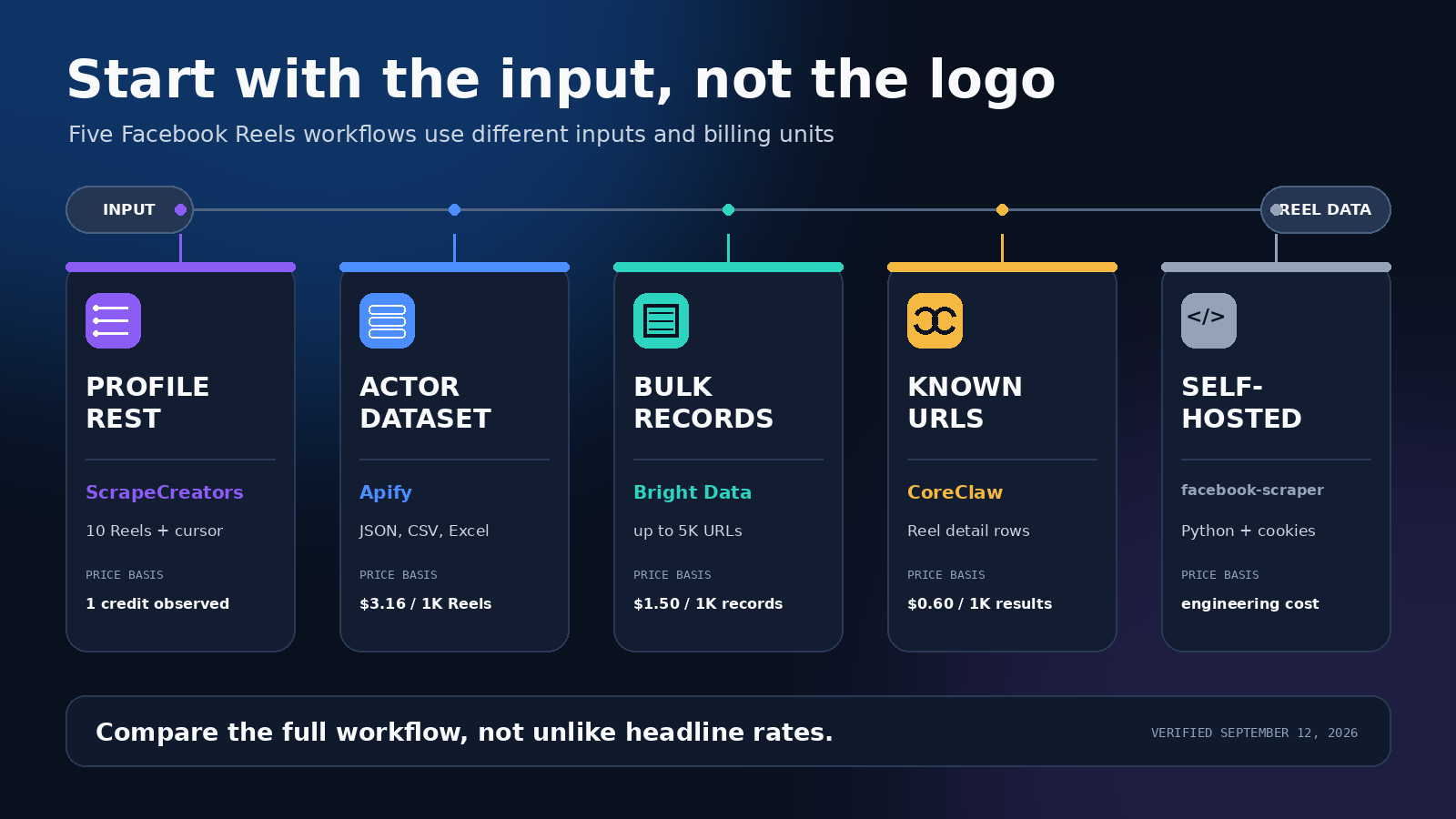
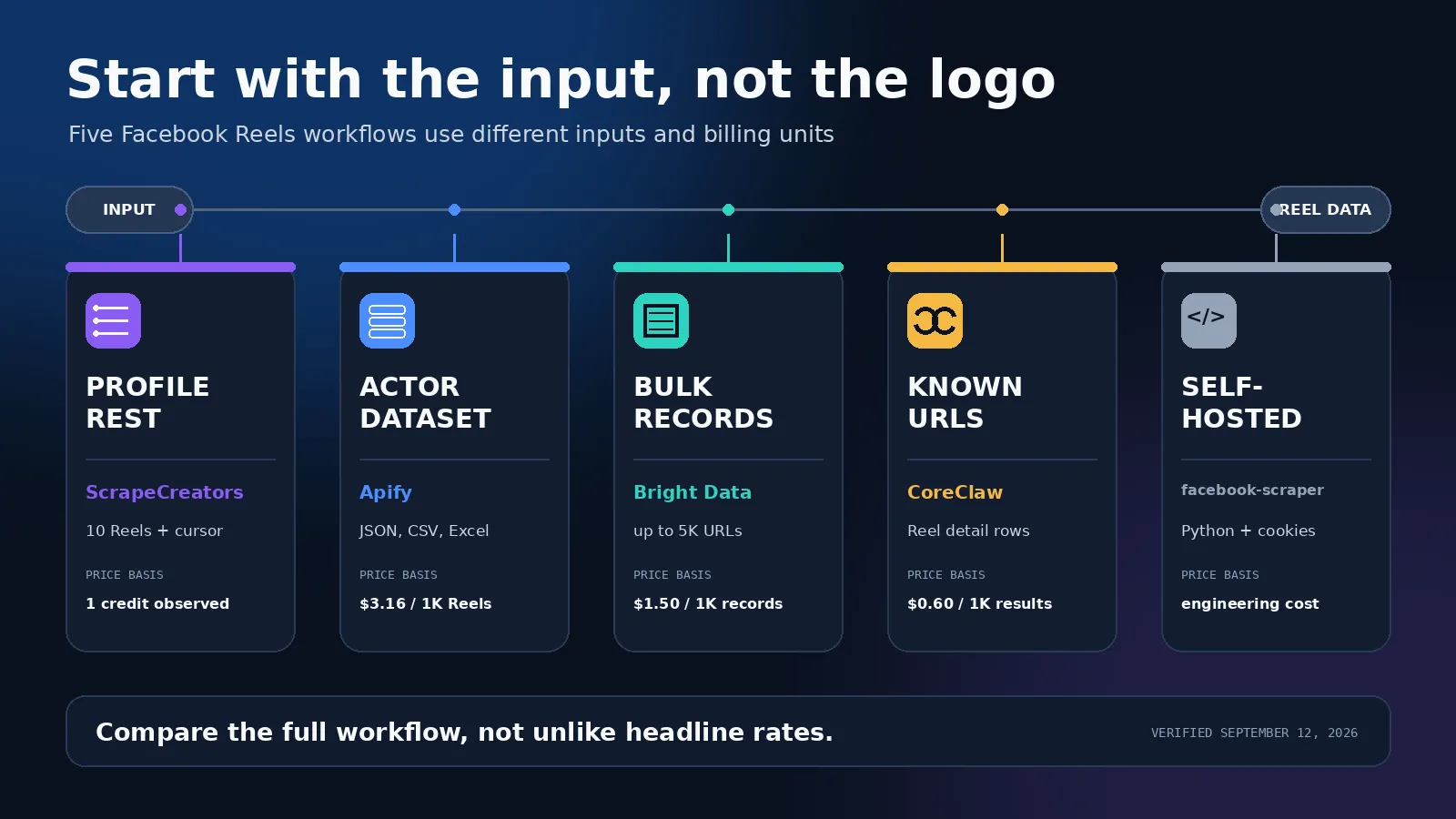
The best Facebook Reels scraper depends on the input you have. Use ScrapeCreators when an app needs a public profile’s Reels through one REST endpoint. Choose Apify for Actor runs and downloadable datasets, Bright Data for bulk record delivery, CoreClaw for a batch of known Reel URLs, or facebook-scraper when you are willing to maintain Python code yourself.
I run ScrapeCreators, so take the ranking with that disclosure. I checked each provider’s own product, pricing, and documentation pages on September 12, 2026. I also called the ScrapeCreators profile Reels endpoint across two pages. I did not run a controlled reliability benchmark across all five tools.
Quick comparison
| Rank | Tool | Best for | Published price basis checked September 12, 2026 | Main tradeoff |
|---|---|---|---|---|
| 1 | ScrapeCreators | Public profile Reels inside an app | 100 free credits; $47 for 25,000 credits; the live profile request used 1 credit | Fixed public-data endpoints rather than a custom browser |
| 2 | Apify | Actor runs, schedules, exports, and datasets | From $3.16 per 1,000 Reels; Apify says its free plan includes $5 monthly usage | Your app has to work with Actor runs and datasets |
| 3 | Bright Data | Large batches and delivered records | 5,000 records monthly free; $1.50 per 1,000 successful records pay as you go | A record is not the same billing unit as an API request |
| 4 | CoreClaw | Enriching Reel URLs you already have | From $0.60 per 1,000 successful results | It starts from Reel URLs, so discovery is a separate job |
| 5 | facebook-scraper | Self-hosted experiments and custom Python | MIT-licensed software; you pay for infrastructure and maintenance outside the code | Not a dedicated profile-Reels API, and some fields need cookies or extra requests |
The table does not make the prices directly comparable. ScrapeCreators charges credits per endpoint request, Apify displays a per-Reel Actor rate, Bright Data and CoreClaw price successful records or results, and open-source code shifts the bill to infrastructure and engineering.
How I compared these tools
I used a practical question first: what does the buyer already have?
- A Facebook page or profile URL needs a tool that can discover its public Reels and paginate.
- A list of individual Reel URLs needs detail extraction, not another discovery feed.
- A recurring app integration needs stable JSON and a clear pagination contract.
- A one-off research job may be easier as an export or hosted dataset.
- A self-hosted job only saves vendor fees if the team can handle blocks, cookies, selectors, retries, and breakage.
The live US Google results reflected that split. facebook reels scraper was led by dedicated Apify and Bright Data product pages. best facebook reels scraper mixed listicles with those product pages. facebook reels scraper api showed ScrapeCreators’ existing Profile Reels page in the top three, so this new article keeps buyer-comparison intent and links to that endpoint instead of trying to replace it.
I also researched how people describe the job away from Google. Four US-context YouTube searches returned 80 rows across 42 unique videos. I read five available transcripts, plus top and newest comments. Those videos centered on competitor research, finding content ideas, bulk downloads, transcript pipelines, and scheduled automation. The comments were sparse, but one viewer specifically asked how to turn extracted links into a file and reuse them in a Shorts or TikTok workflow.
Reddit searches and four relevant threads added a less polished version of the same problem. People asked whether any Facebook scraper is reliable, how to download a whole profile’s Reels, whether audio could be saved separately, and what a workflow costs. LinkedIn results leaned toward feeding scraped short-form video into n8n, AI analysis, and content research. That evidence changed this comparison in two ways: I separated profile discovery from known-URL enrichment, and I made pagination, source URLs, video delivery, and billing units part of the decision instead of comparing field counts alone.
The five best Facebook Reels scrapers
1. ScrapeCreators
ScrapeCreators’ Facebook API is my pick for developers who want public Facebook data in the same REST style as their Instagram, TikTok, YouTube, Reddit, and LinkedIn calls.
The Profile Reels endpoint accepts a public Facebook page URL. It returns up to 10 Reels per request with fields including post_id, url, view_count, description, creation_time, video_url, thumbnail, play_time_in_ms, music, and author details. To continue, send back both cursor and next_page_id from the previous response.
That is a good fit for a product that monitors public creator pages, stores Reel IDs, compares performance, or passes new videos into a transcript or analysis workflow. The same API also has separate endpoints for a single public post or Reel, Reel comments, and short video transcripts. Keep those as explicit calls instead of assuming one profile request includes every comment and transcript.
New accounts get 100 free credits. The $47 pack has 25,000 credits and the $497 pack has 500,000. Credits do not expire. The pricing page says most endpoints use one credit per request, while some cost more and should be checked in the docs. Both profile Reels requests I ran used one credit each.
Choose another tool if you need arbitrary logged-in browser actions, private profiles, or a visual no-code job. ScrapeCreators reads supported public data. It is not a Facebook account automation product.
2. Apify
Apify’s Facebook Reels Scraper is a maintained Actor for people who want a hosted run, dataset, schedule, webhook, or export.
You can provide one or more Facebook page or profile URLs and set the number of Reels to collect. The Actor page lists Reel and post URLs, text, creation time, play count, video duration and resolution, caption availability, owner information, and related video fields. Results can be downloaded in JSON, CSV, Excel, XML, or HTML, or accessed through the API.
The page displayed pricing from $3.16 per 1,000 Reels when checked. It also said Apify’s free plan includes $5 of monthly usage, enough for up to 1,000 Reels under the page’s stated rate, and listed a $49 monthly Starter plan. Check the current pricing tab before a large run because Actor rates and platform-plan details can change independently.
Apify is the better choice when the Actor model is useful rather than annoying. Schedules, datasets, and the wider Actor marketplace can save time. A synchronous application still has more moving parts: start or call the Actor, watch the run, then read its dataset.
3. Bright Data
Bright Data’s Facebook Reels Scraper API is aimed at record collection and delivery. Its current collector accepts Facebook profile or Reels URLs and returns fields such as content, date, hashtags, engagement counts, audio, creator identity, and source URLs.
The page says one API call can contain up to 5,000 target URLs. Output can be delivered as JSON, NDJSON, or CSV through the API, a webhook, or cloud storage. That makes sense for a data team already working in batches and measuring work in delivered records.
The free tier listed 5,000 records per month. Pay as you go was $1.50 per 1,000 successful records. The $499 Scale plan included 384,000 records, then $1.30 per 1,000 additional records. Bright Data says failed deliveries are not charged.
This is a larger data platform than many small apps need. It is also important to inspect the selected collector: a profile-Reels collector and a known-URL detail collector do different jobs even when they appear under one Facebook product page.
4. CoreClaw
CoreClaw’s Facebook Reel Detail Scraper is the narrow option for a list of Reel URLs.
Its required input is an array of URLs. The output page lists title, caption, publish date, duration, author profile, follower count, views, likes, comments, shares, hashtags, language, IDs, and error information. It supports batch input, several export formats, an adjustable timeout, and an optional proxy setting.
Pricing started at $0.60 per 1,000 successful results when checked. That headline is attractive, but it covers extraction after you already know which Reels to request. If the real job begins with “find every Reel from these 5,000 profiles,” add the discovery step and its cost before comparing CoreClaw with a profile-feed scraper.
Use it for enrichment or a contained export. I would test a sample containing old, new, deleted, and restricted Reel URLs before treating every listed field as guaranteed.
5. facebook-scraper
Kevin Zakka’s facebook-scraper is an MIT-licensed Python project for public pages, profiles, groups, and individual posts. It can return text and media-related fields, request comments, and use youtube-dl for higher-quality video extraction.
This is not a polished Facebook Reels product. The README is built around get_posts(), page names, post URLs, optional extra requests, and cookies. It warns that some functions require login cookies, and its own examples cover post and comment extraction rather than a stable, dedicated public profile-Reels contract.
That limitation is exactly why it belongs here. A team that wants control can fork it, inspect each request, choose storage, and add Reel-specific filtering. There is no per-record vendor bill.
The cost appears somewhere else: proxies, cookie handling, monitoring, retries, Facebook changes, and developer time. Use it for experiments or as a starting point when self-hosting is a requirement. Do not choose it because “open source” sounds automatically cheaper.
A real Facebook Reels API request
I ran this request against ScrapeCreators on September 12, 2026. The secret stays in an environment variable:
curl --get "https://api.scrapecreators.com/v1/facebook/profile/reels" \
  -H "x-api-key: $SCRAPE_CREATORS_API_KEY" \
  --data-urlencode "url=https://www.facebook.com/pacemorby"
The first request returned HTTP 200 in 2.51 seconds, charged one credit, and included 10 Reels plus cursor and next_page_id. I passed both pagination values into a second request. It returned HTTP 200 in 3.22 seconds with 10 more Reels.
A shortened response looked like this:
{
  "success": true,
  "credits_charged": 1,
  "reels": [
    {
      "post_id": "1593991512733150",
      "url": "https://www.facebook.com/reel/1634870324219177",
      "view_count": 23000,
      "creation_time": "2026-03-08T15:55:57.000Z",
      "play_time_in_ms": 31033,
      "description": "...",
      "video_url": "...",
      "author": { "name": "..." }
    }
  ],
  "cursor": "...",
  "next_page_id": "..."
}
This proves the observed request and pagination contract, not long-term uptime. Counts change. Video URLs can expire. Store stable Reel or post IDs, retain the public source URL, and deduplicate after pagination.
What the pricing numbers mean
A cheap number with the wrong denominator is not a cheap workflow.
| Provider | Published unit | Question to answer before buying |
|---|---|---|
| ScrapeCreators | Credits per endpoint request | How many Reels arrive per page, and what do detail, comment, or transcript calls add? |
| Apify | Reels returned by an Actor | How many Actor runs and dataset reads does the workflow require? |
| Bright Data | Successfully delivered records | Does one target produce one record or a page of records for the chosen collector? |
| CoreClaw | Successful known-URL results | Where will the input Reel URLs come from? |
| Self-hosted code | Infrastructure and engineering time | Who fixes it when cookies, markup, or blocks change? |
For 1,000 profiles, model the full path: profile discovery, every pagination request, per-Reel enrichment, comments or transcripts, retries, storage, and refresh frequency. Do not divide one vendor’s request price by another vendor’s record count and call that a fair benchmark.
Which Facebook Reels scraper should you choose?
Choose ScrapeCreators if your application needs a normal REST endpoint for public profile Reels and may later add Facebook posts, comments, transcripts, or other social platforms.
Choose Apify if you already use Actors or want schedules, exports, datasets, and marketplace integrations.
Choose Bright Data if the project works in large URL batches and needs delivery pipelines, spend controls, and procurement-friendly platform features.
Choose CoreClaw if you already have Reel URLs and want inexpensive detail enrichment without building the extractor.
Choose facebook-scraper if self-hosting is required and your team accepts the maintenance work. Start with a small fixture set rather than promising broad coverage from the README alone.
The broader social media scraping API comparison is useful if Facebook is only one platform in the roadmap. For other Facebook data shapes, compare the Facebook Marketplace scraper options or the Facebook Ad Library scraper workflows.
Limits to plan for
Facebook Reels are not a stable database export. A public profile can change, remove videos, restrict content, or expose different fields across surfaces.
Build for these cases:
- pagination can repeat or skip items, so deduplicate by a stable ID
- view counts and other engagement fields can be missing or differ between an individual Reel and a profile Reels grid
- direct media and thumbnail URLs can expire
- comments and transcripts may require separate requests
- captions, music, author fields, and descriptions can be null
- deleted, private, age-gated, and region-limited content should not become fake empty successes
- retries must stay inside your own job deadline
A scraper also does not give you unlimited rights to reuse what it returns. Check Meta’s terms, collect only public data you need, and define retention and deletion rules. Get legal advice before using personal data for high-risk profiling, employment, credit, insurance, or another regulated decision.
Sources checked
I checked these primary pages on September 12, 2026:
- ScrapeCreators Facebook API, Profile Reels endpoint, documentation, and pricing
- Apify Facebook Reels Scraper and its current pricing, input, output, and API tabs
- Bright Data Facebook Reels Scraper API
- CoreClaw Facebook Reel Detail Scraper
facebook-scraperrepository and README- Meta terms
For audience research, I reviewed Apify’s Facebook Reels workflow video, Proxyway’s broader Facebook scraper comparison, an n8n Reels and transcript workflow, and relevant Reddit threads about scraper reliability and bulk Reel downloads.
Prices, fields, access rules, and provider behavior can change. Recheck the provider page with your own representative inputs before committing a production budget.