
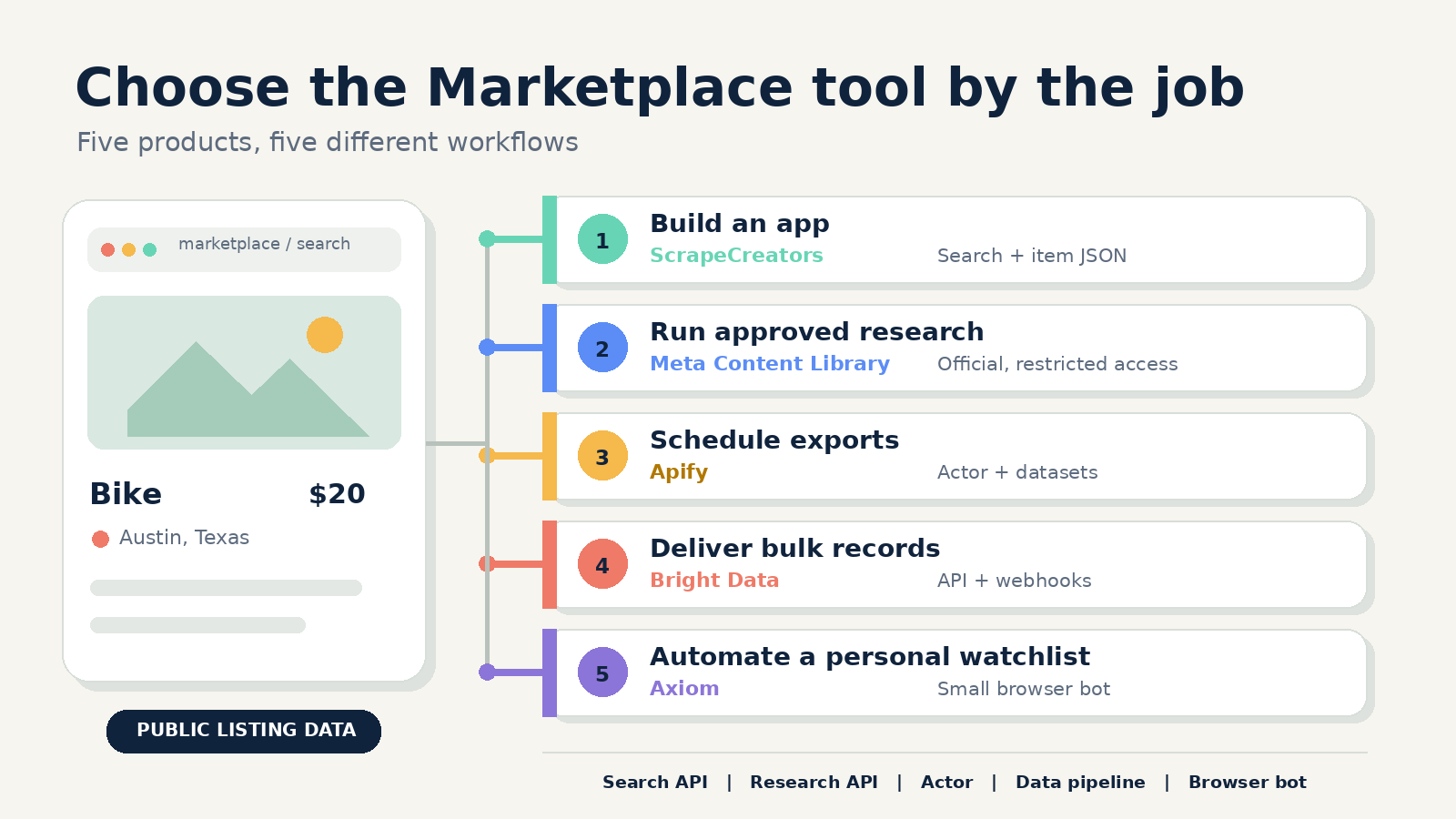
The best Facebook Marketplace API depends on the job. Use ScrapeCreators when you need listing search and item details inside an app. Use Meta Content Library API if you qualify for academic or public-interest research. Apify is a good fit for scheduled exports, Bright Data for bulk data delivery, and Axiom for a small no-code workflow.
I run ScrapeCreators, so treat the ranking with that disclosure in mind. I checked each provider’s own product, documentation, access, and pricing pages on August 16, 2026. I also called the ScrapeCreators search endpoint. I did not run a controlled reliability benchmark across all five products, and this article does not pretend otherwise.
Quick comparison
| Rank | Tool | Best for | Access and price checked August 16, 2026 | Main tradeoff |
|---|---|---|---|---|
| 1 | ScrapeCreators | Adding Marketplace search to an app | 100 free credits; search and item endpoints cost 1 credit per request | Read-only and focused on public data |
| 2 | Meta Content Library API | Academic and public-interest research | No access or compute fee for approved researchers | Restricted eligibility and a research application |
| 3 | Apify | Scheduled runs and downloadable datasets | Actor page displays pricing from $2.60 per 1,000 listings | You work inside the Actor and dataset model |
| 4 | Bright Data | Bulk item records and delivery pipelines | 5,000 free records monthly, then $1.50 per 1,000 records pay as you go | A heavier data platform than many small apps need |
| 5 | Axiom | Personal, small no-code browser jobs | Two free runtime hours; Starter is $15 monthly for five hours | Axiom says this workflow should run small and slow |
These prices are not perfectly comparable. ScrapeCreators charges per API request, Apify’s page quotes a listing-based rate, Bright Data charges per delivered record, and Axiom sells browser runtime. Compare the cost of your actual workflow instead of choosing the smallest number in the table.
Does Facebook Marketplace have an official API?
Yes, but the useful answer needs a qualifier.
Meta Content Library API now includes Facebook Marketplace search. Its facebook/marketplace-listings/preview path can query listing titles and descriptions, categories, countries, dates, prices, view ranges, and selected fields. That makes it a real official Marketplace data API.
It is not a public developer API that any SaaS can add at signup. Meta’s access page says applicants must be affiliated with a qualified academic institution or a qualified nonprofit research institution. Access is reviewed through the Research Tools Manager and the Secure Data Access Center. Approved access and computation in Meta’s Secure Research Environment have no fee.
Meta also documents Marketplace partner APIs for approved sellers and commerce partners. Those APIs solve listing distribution and partner operations. They do not give every developer a general local-listing discovery API.
- Use Meta’s API for eligible research or an approved commerce partnership.
- Use a managed scraper API when a regular app needs public search and item data.
- Use a browser or Actor workflow when you want exports or a custom automation rather than a fixed REST response.
How I compared these tools
I looked for five practical things:
- Can the tool search listings, fetch an item, or both?
- Does it return structured data without forcing you to maintain selectors?
- Can a normal developer get access, or is approval required?
- Is the pricing unit clear enough to estimate a real job?
- What work still belongs to you after signup?
I also separated search from item extraction. A tool that accepts a known listing URL is useful, but it does not automatically replace a location-based search API. That distinction gets blurred on a lot of scraper pages.
The five best Facebook Marketplace APIs and scrapers
1. ScrapeCreators
ScrapeCreators’ Facebook Marketplace API is my pick for developers building monitoring, pricing, inventory, or alerting features into an application.
It has three endpoints:
- Location search turns a place name into coordinates.
- Marketplace search accepts a keyword, latitude, and longitude. Optional filters cover radius, price, sort order, delivery, condition, date listed, availability, and pagination. The docs also list a
countparameter, but my first live call withcount=3still returned 24 listings. Do not assume that parameter caps the page size without checking your own response. - Marketplace item accepts a listing ID or URL and returns item fields such as title, description, price, photos, attributes, status, location, delivery types, and seller data when Facebook exposes it.
The output is JSON, and both the search and item docs list a cost of one credit per request. New accounts get 100 free credits. Credits do not expire. ScrapeCreators does not enforce a hard API rate limit, although the docs currently recommend staying below 500 concurrent requests for the best reliability.
I called the search endpoint on August 16 with bike, Austin coordinates, newest-first sorting, and available listings. It returned HTTP 200, 24 listings, a pagination cursor, and has_next_page: true in 1.32 seconds. That is one observed request, not an uptime benchmark.
It is a read API for public Marketplace data. It does not create listings, send messages, buy items, or access private account data. If you need arbitrary websites too, a broader platform may make more sense.
2. Meta Content Library API
Meta’s own API belongs near the top because it is the authoritative research route. It supports keyword and Boolean queries, categories, content type, countries, selected fields, sort order, price ranges, view buckets, and date windows. Meta says Marketplace view counts refresh every two to three days.
For an approved university team studying housing listings, fraud patterns, or marketplace activity, this is the obvious first choice. There is no provider markup and the data comes through Meta’s documented research system.
Most commercial builders cannot use it. The eligibility rules require a qualified academic institution or a nonprofit whose primary purpose is scientific or public-interest research. The application, collaborator review, and secure environment are part of the deal. A startup building local deal alerts should not assume it qualifies.
3. Apify
Apify’s maintained Facebook Marketplace Scraper fits teams that already use Actors, datasets, schedules, or Apify integrations.
You supply one or more Marketplace URLs and choose how many listings to collect. The Actor page says it can extract listing titles, URLs, prices, location, photos, seller details, video, status, and delivery type. Results can be downloaded as JSON, CSV, Excel, XML, or HTML, and the Actor can run through Apify’s API.
The page displayed pricing from $2.60 per 1,000 listings when checked. It also showed a 3.7 rating from 28 reviews, which is worth checking before you commit a production workflow. I would choose Apify when schedules, datasets, and many other store Actors matter more than having one purpose-built REST contract.
The tradeoff is extra surface area. Your code needs to start or call the Actor, wait for a run, and read its dataset. That is flexible, but it is not as direct as one synchronous search request.
4. Bright Data
Bright Data’s Facebook Marketplace Scraper is built for bulk data collection and delivery. Its page advertises API and no-code collection, JSON or CSV output, webhook or API delivery, scheduling, and batch requests of up to 5,000 URLs.
The free tier includes 5,000 records each month. The displayed pay-as-you-go price is $1.50 per 1,000 successful records, with higher-volume plans available. Bright Data says it charges for successfully delivered results.
This is a sensible option when you already have item URLs or need a data pipeline with delivery, spend controls, and large batches. It can be more product than a small alerting app needs. Also check the exact collector input before buying: bulk item extraction and keyword-plus-location discovery are different jobs.
5. Axiom
Axiom’s Facebook Marketplace guide is the odd one out, in a useful way. It is a browser automation workflow rather than a managed Marketplace data API.
Axiom’s page is candid: Facebook Marketplace sits behind a login, Facebook fights scraping, and this should run small and slow for your own research. Its bot can read listing title, price, location, and link into a sheet. You build the steps with a Chrome extension, code tools, or Axiom’s browser infrastructure.
New accounts get two free hours. The Starter plan was $15 per month for five runtime hours when checked. Axiom is a reasonable pick for a personal watchlist or a one-off local research task where you want to see and adjust the browser steps.
I would not use it as the backend for a high-volume customer-facing API. You own the login, workflow behavior, and the risk that a page change breaks a step.
A real Facebook Marketplace API request
This is the exact ScrapeCreators request I ran, with the secret replaced by an environment variable:
curl --get "https://api.scrapecreators.com/v1/facebook/marketplace/search" \
  -H "x-api-key: $SCRAPE_CREATORS_API_KEY" \
  --data-urlencode "query=bike" \
  --data-urlencode "lat=30.2677" \
  --data-urlencode "lng=-97.7475" \
  --data-urlencode "sort_by=creation_time_descend" \
  --data-urlencode "availability=available"
The response included this shape:
{
  "success": true,
  "credits_charged": 1,
  "listings": [
    {
      "id": "...",
      "title": "...",
      "price": { "amount": 20, "formatted_amount": "$20" },
      "location": { "city": "San Antonio", "state": "TX" },
      "is_sold": false,
      "url": "https://www.facebook.com/marketplace/item/.../"
    }
  ],
  "cursor": "...",
  "has_next_page": true
}
Do not treat page one as a permanent database snapshot. Save listing IDs, follow the cursor, and deduplicate across runs. If you are building alerts, compare current IDs and fields with your stored baseline rather than trusting that two identical searches will always arrive in the same order.
Which option should you pick?
Choose ScrapeCreators if you need a normal REST API for keyword and location search, pagination, and item details inside a product.
Choose Meta Content Library API if your institution qualifies and the work is academic or public-interest research. Apply there before paying another provider.
Choose Apify if you already run Actors or want schedules, datasets, and exports alongside a large scraper marketplace.
Choose Bright Data if you need high-volume record delivery, batches, webhooks, and procurement controls.
Choose Axiom if the job is personal, small, visual, and easier to maintain as a browser bot than as code.
If none of those descriptions matches, the job may be a poor fit for automation. A workflow that requires private profiles, automated messaging, purchases, or account actions has different technical and policy risks than reading public listings.
Limits to plan for
Facebook Marketplace data changes constantly. Listings sell, disappear, move, or show different fields by category and location. A production system needs to handle null values and stale records without turning them into bad alerts.
- Search results and item details are separate calls in most systems.
- Seller fields are not guaranteed on every listing.
- A displayed listing date or mileage may be absent even when the Facebook page shows other item details.
- Localized results depend on coordinates, radius, and what Facebook makes visible in that session.
- Reading public data does not grant permission to republish personal data without limits.
For broader social data work, compare the options in our social media scraping API guide. If the project also watches community posts and comments, the Facebook Groups API guide explains a different data source. Our web scraping legal guide covers the main court and compliance questions, but it is not legal advice.
Sources checked
I checked the following primary pages on August 16, 2026:
- Meta’s Facebook Marketplace Content Library guide and access rules
- ScrapeCreators Facebook Marketplace API, search documentation, and item documentation
- Apify Facebook Marketplace Scraper
- Bright Data Facebook Marketplace Scraper
- Axiom Facebook Marketplace guide and pricing
Prices, access rules, and endpoint fields can change. Recheck the provider page before you estimate a production bill or promise a field to a customer.