
Web scraping legality in the U.S. increasingly favors public data—when you skip login walls and honor contracts that apply.
Recent cases against LinkedIn, Meta, and X clarified boundaries. Your playbook still starts with what users can see without authenticating.
In this guide, you’ll learn:
- The golden rule of scraping
- hiQ v. LinkedIn foundations
- Meta and BrandTotal precedent
- Bright Data rulings through 2024
Use the sections below as your playbook.
The Golden Rule of Web Scraping
Rule of thumb: If you can access the data in an incognito browser, you can scrape it.
Why do I feel confident saying that?
Because multiple court rulings have consistently supported this principle. Let me break down the key cases that established this precedent.
Case 1: hiQ Labs vs. LinkedIn - The Foundation Case
This is probably the OG web scraping lawsuit that set the legal foundation we rely on today.
The Setup: LinkedIn tried to sue hiQ Labs under the Computer Fraud and Abuse Act (CFAA), which prohibits accessing protected computer systems without authorization.
The Ruling: The Ninth Circuit Court ruled against LinkedIn, stating that the CFAA did not apply to the automatic collection of publicly accessible data. The court found that platforms like LinkedIn and Meta could not designate portions of their public platforms as “off limits” to only certain individuals or companies.
Key Quote from the Ruling: The court noted that interpreting the CFAA so broadly would allow “companies like LinkedIn free rein to decide, on any basis, who can collect and use publicly available data, which would risk possible creation of information monopolies that would disserve the public interest.”
Important Exception: hiQ did get in trouble for one specific activity - hiring contractors to create fake LinkedIn accounts for the explicit purpose of collecting logged-in data (what the court called the “turkers” conduct).
This reinforces that creating fake accounts crosses the legal line.
Case 2: Meta Platforms vs. BrandTotal Ltd. - Reinforcing the Precedent
In another important summary judgment ruling in the scraping space, the court refused to grant summary judgment to Meta Platforms on CFAA claims related to two categories of data collection, further supporting the principle that public data scraping is generally permissible.
Case 3: Bright Data vs. Meta - 2024 Confirmation
The Setup: Meta sued Bright Data for web scraping activities.
The Outcome: Meta lost because they couldn’t prove that Bright Data was scraping data behind login walls.
Key Insight: This 2024 ruling reaffirmed that scraping publicly available data remains legally defensible, while accessing data that requires authentication does not.
Case 4: Bright Data vs. Twitter/X - The Judge’s Scathing Ruling
A few months after the Meta lawsuit, Twitter (now X) sued Bright Data, arguing that the company violated Twitter’s copyright.
The Judge’s Response: The court delivered a particularly pointed ruling against Twitter, noting that giving social networks complete control over public web data “risks the possible creation of information monopolies that would disserve the public interest.”
The judge added that Twitter was not “looking to protect users’ privacy,” and was “happy to allow the extraction and copying of users’ content so long as it gets paid.”
What This Means for You
Based on these court rulings, here are the key takeaways:
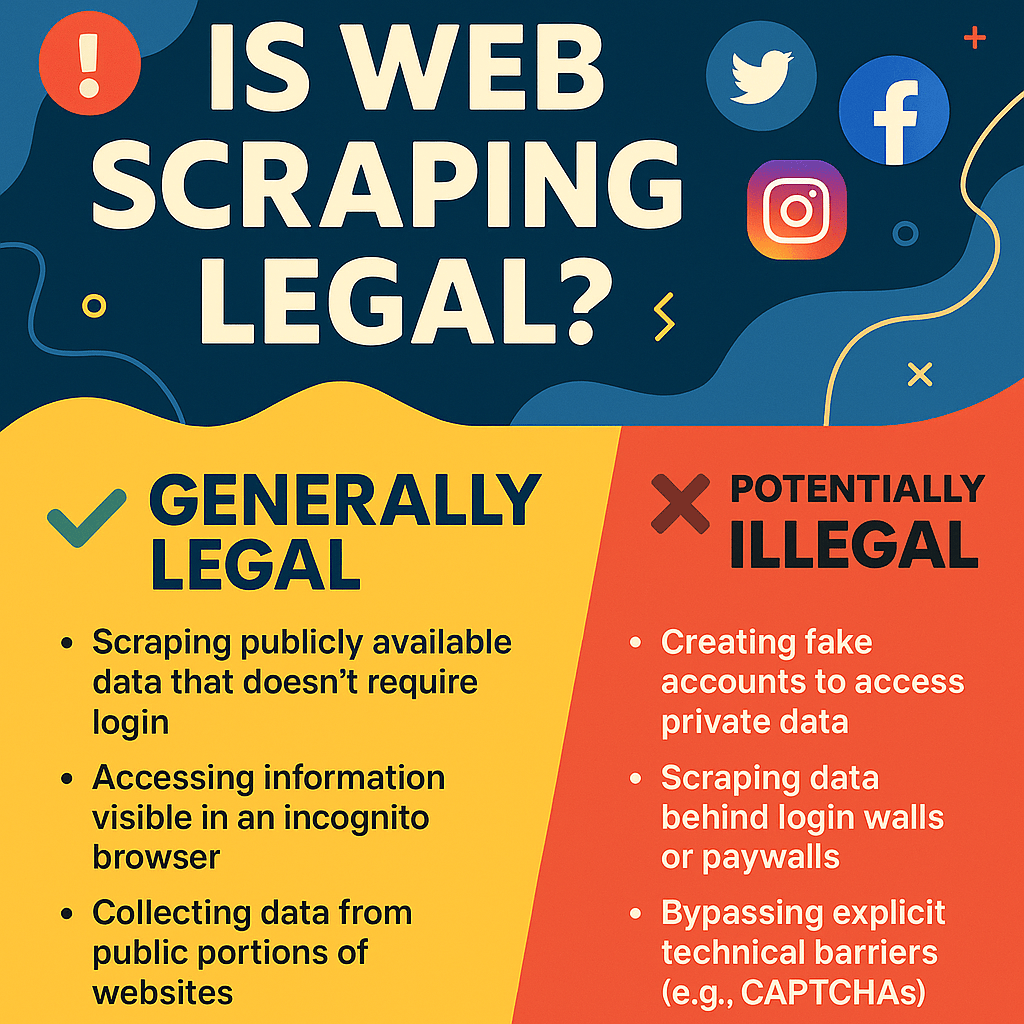
Generally Legal:
- Scraping publicly available data that doesn’t require login
- Accessing information visible in an incognito browser
- Collecting data from public portions of websites
Potentially Illegal:
- Creating fake accounts to access private data
- Scraping data behind login walls or paywalls
- Violating explicit technical barriers (like CAPTCHAs designed to prevent automated access)
Gray Areas:
- Terms of Service violations (courts have generally not treated these as criminal violations)
- Rate limiting and server load considerations
- Copyright implications for specific types of content
The Bottom Line
The legal precedent is clear: only scrape public data - data that you can access in an incognito browser without being logged in.
Multiple courts have consistently ruled that publicly accessible web data can be scraped, while creating fake accounts or bypassing authentication measures crosses legal boundaries.
These rulings serve to reaffirm the broad general ability to web scrape publicly available portions of websites where an account login/password has not been utilized, while making it clear that accessing private or authenticated data remains legally risky.