
The quick answer
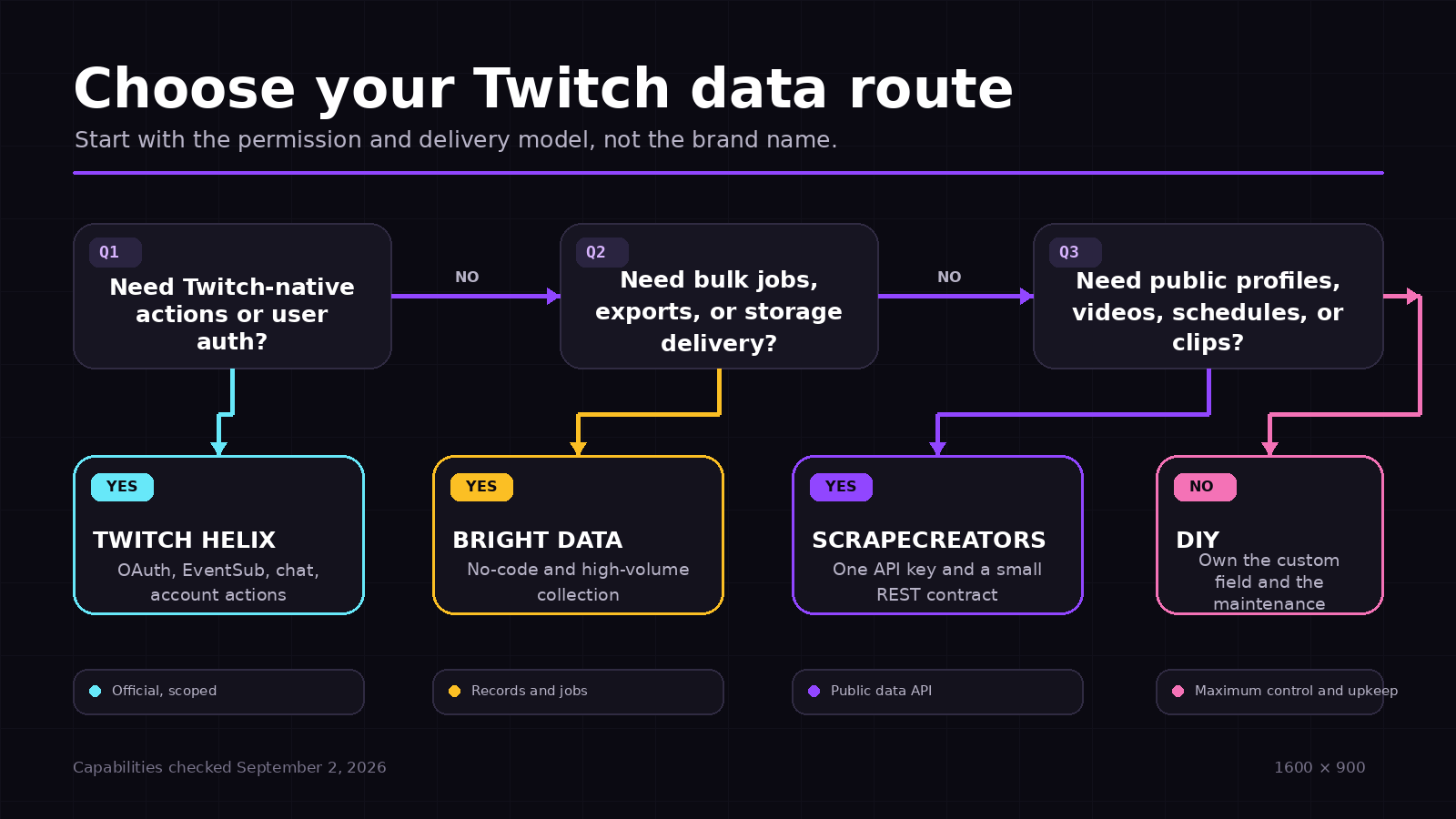
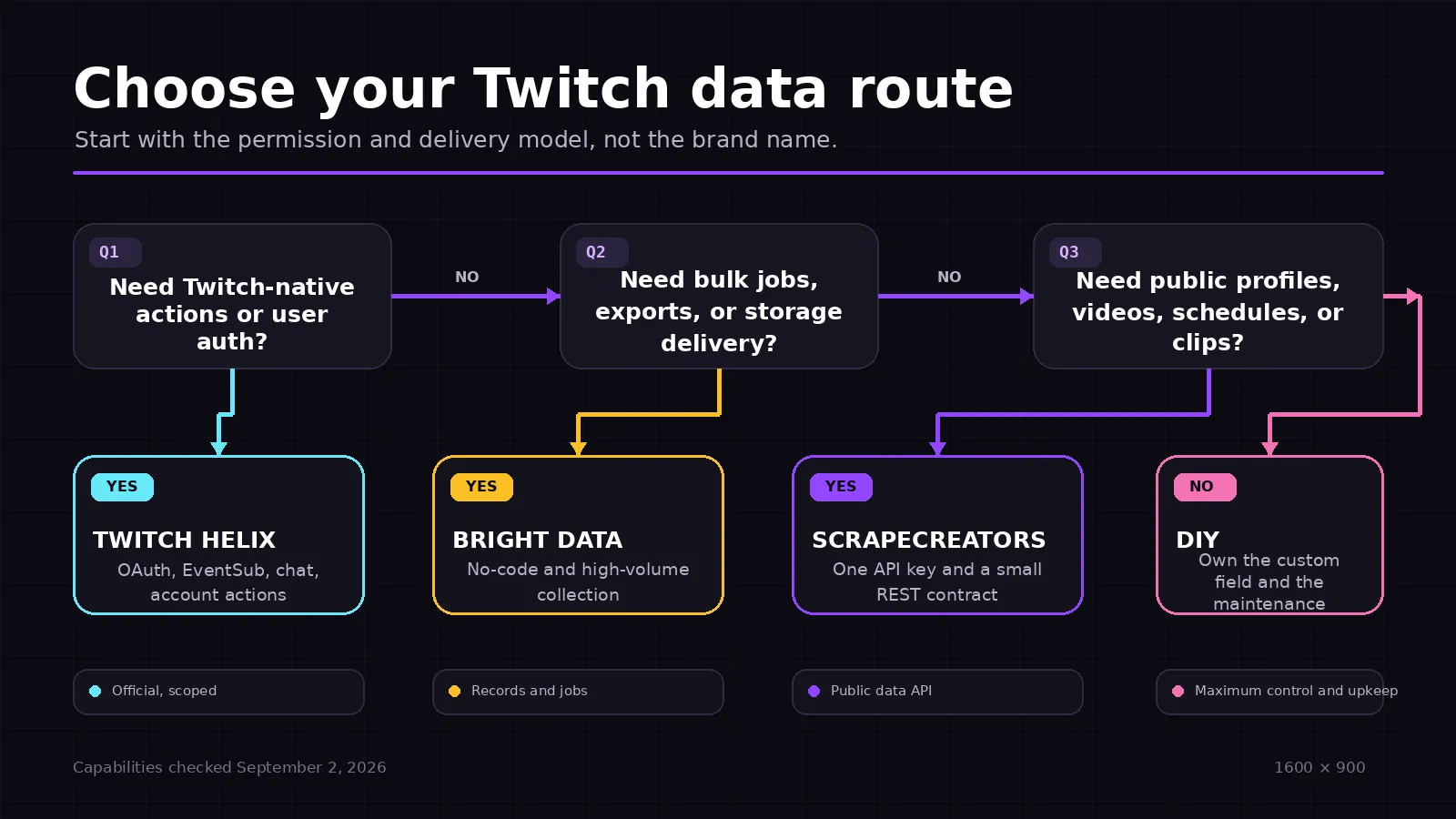
The best Twitch scraper depends on the job. Use Twitch’s official Helix API when you are building a Twitch app, need user-authorized data, or want EventSub and chatbot features. Use a managed public-data API when you want profile, stream, video, schedule, or clip metadata without registering a Twitch app and maintaining OAuth. Use a bulk collector when you need no-code jobs and file exports. Build the scraper yourself only when its upkeep is part of the product.
For a quick public profile lookup, ScrapeCreators is the shortest path: one GET request with a handle and one API key. It is an unofficial API, so it is not a replacement for Twitch’s authenticated developer platform.
Choose a Twitch data route
Prices, limits, and product pages in this table were checked on September 2, 2026. The units are not interchangeable. ScrapeCreators charges endpoint credits, while Bright Data describes successfully delivered records.
| Route | Best for | Setup | Price or limit checked September 2, 2026 | Main limitation |
|---|---|---|---|---|
| ScrapeCreators | Public profile, recent video, schedule, and clip data inside an app or agent | One API key | 100 free credits; $47 for 25,000 credits; the profile request I ran charged 1 credit | Unofficial public-data API, not Twitch account automation |
| Twitch Helix | Twitch apps, OAuth permissions, EventSub, chatbots, and official platform actions | Register an app, get a client ID, then manage app or user tokens | Twitch documents point-based rate buckets and HTTP 429 responses, not a public per-request dollar price | Some data requires the broadcaster or user to authorize your app |
| Bright Data Twitch Scraper | Bulk collection, scheduled jobs, no-code runs, and storage delivery | Account plus an API or control-panel job | Product page says 5,000 records per month free and bulk requests up to 5,000 URLs | A delivered record is not the same billing unit as one profile API request |
| DIY page or GraphQL scraper | A narrow custom field or experiment that managed products do not expose | Proxies, request logic, parsers, monitoring, and repairs | Infrastructure and engineering time | Internal operations and response fields can change without notice |
My bias is obvious: I built ScrapeCreators. It is the option I would start with for public Twitch data across a broader social-data product. Twitch Helix is the better choice when your product needs Twitch-native authorization or actions. Bright Data makes more sense when a data-collection job, export, and delivery workflow matter more than a small REST contract.
What data do you actually need?
“Twitch data” is too broad to choose a tool. Write down the object and freshness requirement first.
- A profile lookup usually needs the channel ID, handle, display name, description, follower count, social links, live status, and recent content.
- Stream monitoring needs live status, viewer count, category, title, and a polling or event strategy.
- Video and clip work needs IDs, titles, dates, durations, view counts, thumbnails, broadcaster data, and pagination.
- Account features may need a user access token, explicit scopes, and Twitch’s official API.
- Chat automation belongs in Twitch’s supported chat and EventSub tools, not a profile scraper.
That boundary matters. A public Twitch page does not expose every metric Twitch keeps internally. Community discussions about follower lists, brand-safety scores, and broadcaster analytics repeatedly run into the same problem: seeing that a field exists somewhere does not mean an unauthenticated profile scraper can return it reliably.
A second trap is assuming that today’s response will stay stable. In the public Reddit discussions reviewed for this guide, developers compared older following-data behavior with newer endpoints that require user scopes. That is a good reason to define allowed fields before you build a database around them.
Option 1: ScrapeCreators
The ScrapeCreators Twitch API currently documents four endpoints:
| Endpoint | Input | Useful output |
|---|---|---|
GET /v1/twitch/profile | handle | Identity, live state, description, followers, social links, recent videos, featured clips, and similar streamers |
GET /v1/twitch/user/videos | handle, optional cursor and trim | Up to 100 videos per page, with metadata and pagination |
GET /v1/twitch/user/schedule | handle, optional cursor and trim | Scheduled events with start time, end time, title, description, and thumbnail |
GET /v1/twitch/clip | Twitch clip URL | Clip metadata, broadcaster details, thumbnails, and video-quality URLs |
The request is deliberately small:
curl --get 'https://api.scrapecreators.com/v1/twitch/profile' \
  --header 'x-api-key: YOUR_API_KEY' \
  --data-urlencode 'handle=ninja'
I ran that exact request on September 2, 2026. It returned HTTP 200, charged one credit, and identified the handle as ninja. The response included a follower count, 12 recent videos, and 12 featured clips. Here is a shortened excerpt with changing values omitted:
{
  "success": true,
  "credits_charged": 1,
  "id": "19571641",
  "isLive": false,
  "handle": "ninja",
  "displayName": "Ninja",
  "isPartner": true,
  "allVideos": [
    {
      "id": "2862926638",
      "lengthSeconds": 5883,
      "title": "BLEV BROS SPORTS SHOW IS BACK!!!! WEEK 3! NFC PREDCTIONS!"
    }
  ]
}
One successful fixture is a contract check, not a reliability benchmark. Live status, follower counts, video lists, and signed media URLs can change after the request. Store timestamps with any snapshot, and do not treat it as permanent ground truth.
The current homepage pricing is pay as you go. New accounts get 100 credits. The $47 pack contains 25,000 credits, or $1.88 per 1,000 one-credit requests. The $497 pack contains 500,000 credits, or about $0.99 per 1,000. Credits do not expire. Check the live pricing section and the Twitch API documentation before budgeting because endpoint costs can change.
Choose another route if you need to act as a Twitch user, send chat messages, subscribe through EventSub, manage a channel, retrieve private account data, or guarantee access to a field Twitch does not publish. ScrapeCreators does not turn a public-data request into user authorization.
Option 2: Twitch Helix
Twitch Helix is the official choice for products that participate in the Twitch ecosystem. The setup has more moving parts than a managed scraper:
- Register an application in the Twitch developer console.
- Keep the client secret on your server.
- Get an app access token for public, server-to-server work or a user access token for scoped user data.
- Send the client ID and bearer token with each API request.
- Track the rate-limit headers and refresh tokens when required.
The official OAuth guide says app access tokens cover non-sensitive resources. User access tokens let an app access a user’s sensitive data with permission. Each endpoint’s reference identifies which token and scopes it needs.
Twitch uses token buckets for rate limiting. The default endpoint cost is one point unless the endpoint says otherwise. Twitch returns HTTP 429 when a bucket runs out within a minute, and responses include Ratelimit-Limit, Ratelimit-Remaining, and Ratelimit-Reset headers. Do not hardcode one global request number from a screenshot or old tutorial. Read those headers and the current endpoint reference.
The official route is worth the extra setup when OAuth is a product feature rather than a nuisance. A chatbot, authorized dashboard, channel-management tool, or EventSub listener should use Twitch’s supported contracts.
Option 3: Bright Data
Bright Data’s current Twitch Scraper page positions the product around three scraper workflows: API collection, a no-code control panel, and dataset-style delivery. The page lists streamer names, stream IDs, viewer counts, tags, follower data, bulk jobs, and storage delivery. It also advertises 5,000 records per month on the free tier and says bulk requests can contain up to 5,000 URLs.
That shape fits analysts and data teams that want a run, a dataset, and a delivery destination. It can also be easier than writing a pagination worker when the input is already a large URL list.
Compare output and price with a sample job before buying. “One record” may mean a streamer, stream, or another returned object depending on the scraper. It is not automatically equivalent to one ScrapeCreators credit or one Helix request. Confirm the selected scraper, input schema, delivered record shape, retries, and paid price in Bright Data’s dashboard.
Option 4: Build it yourself
A DIY scraper can be the right answer when one unusual public field is the whole product. It is also easy to underestimate.
You need to discover the request, reproduce its headers and variables, parse the response, paginate it, handle blocks, watch latency, detect empty-but-broken responses, and repair the integration when Twitch changes a persisted operation or page structure. If you download clips or VODs, bandwidth and expiring media URLs become part of the job too.
The social research for this guide had a useful split. Tutorial videos concentrate on obtaining client credentials and wiring individual calls. Their comment threads ask why credentials are required, why expected fields are missing, and whether there is a newer shortcut. In a separate scraper discussion, some developers argued that open-source code is easy enough, while others said proxy changes and parser upkeep erased the savings. Both can be true. A weekend script and a production dependency have different costs.
Do not copy an internal request merely because it works once. Check Twitch’s Developer Agreement, protect personal data, use conservative collection, and give your application a failure mode that does not turn a blocked page into valid empty data.
Production checklist
Before shipping, test the object your application really needs rather than a convenient celebrity profile.
- Record the exact endpoint, parameters, status, response time, and response keys for several public profiles.
- Test a live channel, an offline channel, a small channel, and a missing handle.
- Validate pagination for videos or schedules. First-page success does not prove later cursors work.
- Distinguish
null, an empty array, a private field, and an upstream failure. - Cache stable profile fields, but timestamp follower counts, live state, schedules, and engagement metrics.
- Avoid storing signed video URLs as permanent media links.
- Add a retry budget that finishes before your own request timeout.
- Monitor field presence, not only HTTP 200 responses.
- Keep user-authorized Twitch features on Helix even if a public scraper covers profile metadata.
If you are evaluating ScrapeCreators, start with one profile call and inspect the JSON. Then test the separate Twitch video endpoint with a real cursor. The best social media APIs guide covers broader platform choices, while the guide to avoiding Puppeteer and Selenium covers the managed-versus-DIY tradeoff.
FAQ
Can I scrape Twitch without OAuth?
Yes, for some public data. A managed unofficial API can accept a public handle or clip URL without asking you to register a Twitch app. It cannot grant access to private, scoped, or user-authorized data. Use Twitch Helix when OAuth permission is part of the feature.
Is there a Twitch profile API?
Twitch Helix exposes official user, channel, stream, video, and clip resources. ScrapeCreators also exposes an unofficial GET /v1/twitch/profile endpoint that combines public profile data, live state, recent videos, featured clips, and related fields in one response.
Should I use Twitch Helix or a Twitch scraper API?
Use Helix for Twitch-native applications, user permissions, EventSub, chat, and account actions. Use a scraper API for public-data retrieval when you want less authentication and maintenance. Some products need both: Helix for authorized features and a public-data API for research or enrichment.
Can a Twitch scraper return every follower or internal metric?
No tool should promise every Twitch field. Official endpoints can require user scopes, internal GraphQL operations can restrict pagination, and some internal metrics are not exposed to creators or the public. Verify the exact field and depth before choosing a provider.
Is scraping Twitch legal?
There is no universal yes-or-no answer. It depends on what you collect, how you collect it, your purpose, the applicable law, and the platform terms. Use official APIs for authorized features, collect only data you have a legitimate reason to process, and get legal advice for sensitive or high-risk use cases.