
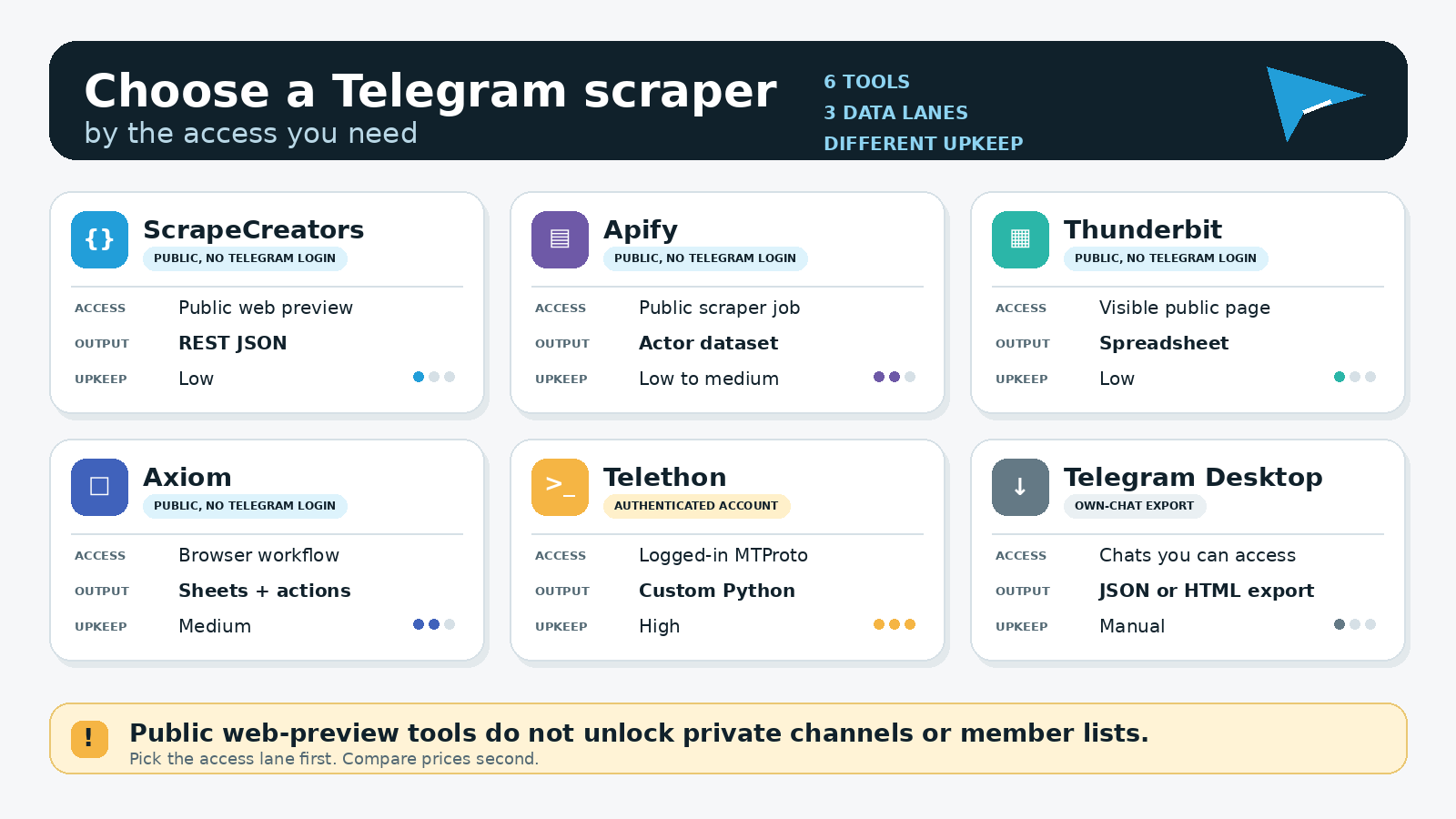
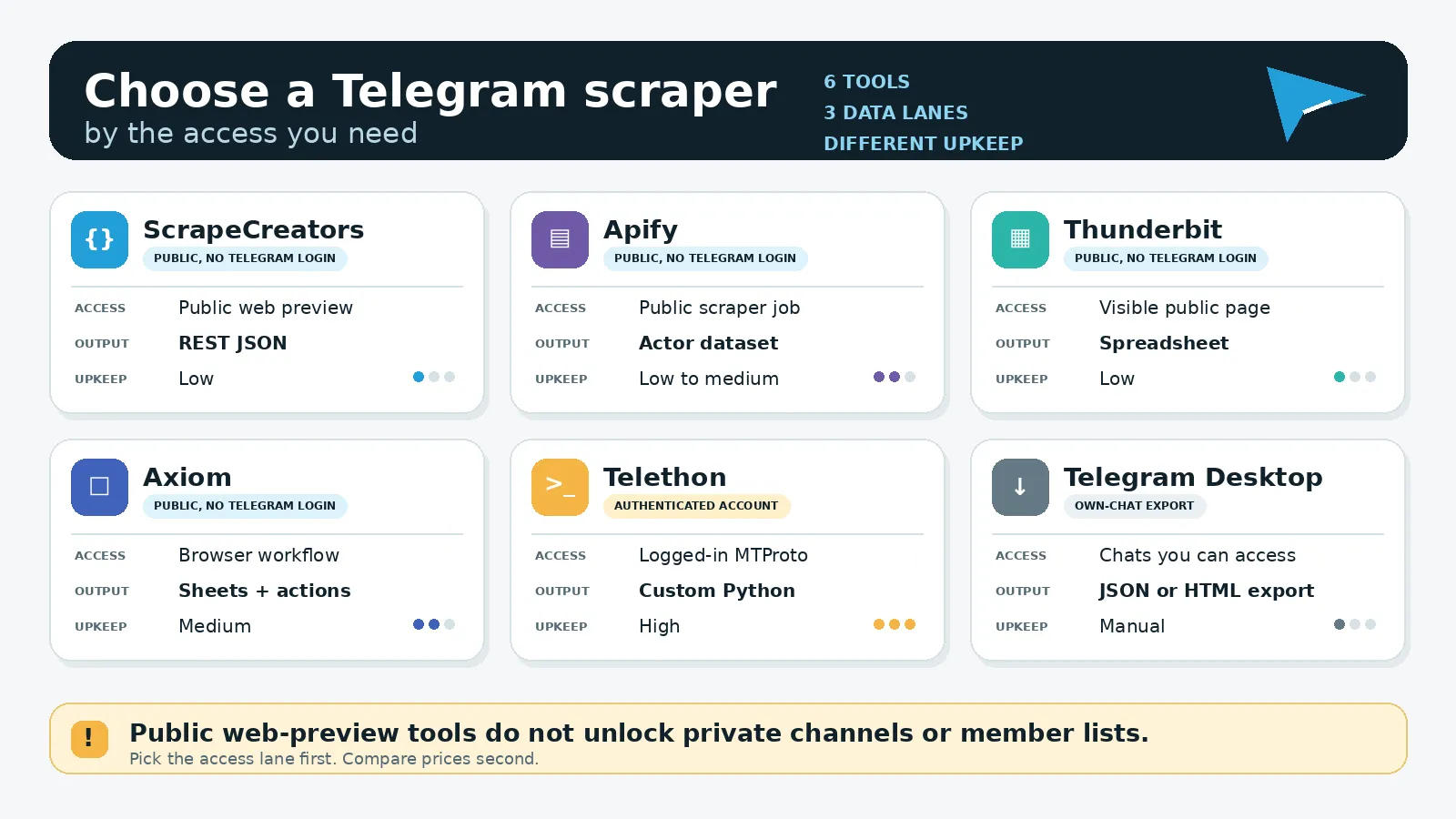
ScrapeCreators is my pick for developers who need public Telegram channel details and posts through a REST API without a Telegram login. Choose Apify for Actor runs and datasets, Thunderbit or Axiom for visual browser workflows, Telethon for a logged-in Python client, or Telegram Desktop for a one-off export of chats you can access. No tool in this list is the best choice for every Telegram job.
I run ScrapeCreators, so my first-place recommendation comes with an obvious bias. I checked the product pages, prices, docs, and limits below against primary sources on September 21, 2026. I also ran eight live ScrapeCreators requests. I did not run a controlled reliability benchmark across all six options.
Quick comparison
| Rank | Telegram scraper | Choose it if | Published starting point checked September 21, 2026 | Main limitation |
|---|---|---|---|---|
| 1 | ScrapeCreators | Your app needs recent public channel posts and metadata through REST | 100 free credits; $47 for 25,000 credits; tested calls used 1 credit each | No private channels, member lists, or guaranteed full history |
| 2 | Apify Telegram Scraper | You want Actor runs, datasets, schedules, and exports | From $1.25 per 1,000 results; Apify also lists $5 monthly platform usage on Free | Actor jobs and result billing are different plumbing from a direct endpoint |
| 3 | Thunderbit Telegram Scraper | A non-developer wants public posts in a spreadsheet | Free plan shows 6 pages per month; annual Starter shows $9/month and 5,000 credits/year | Browser-visible pages and page credits are not the same as API requests |
| 4 | Axiom.ai | You want a custom browser bot with steps, Sheets, and schedules | 2 free runtime hours; Starter is $15/month for 5 runtime hours | You own the browser workflow and selector maintenance |
| 5 | Telethon | You need a Python client, account session, and deeper Telegram control | Open-source library; you pay for hosting and engineering | Requires an API ID, API hash, login session, and careful rate-limit handling |
| 6 | Telegram Desktop export | You need a one-time JSON or HTML export of chats you can access | Free desktop app | Manual export, not an unattended monitoring API |
Do not divide these prices into one fake cost per message. ScrapeCreators bills endpoint requests. Apify bills Actor results plus platform usage. Thunderbit uses page credits. Axiom sells runtime hours. Telethon moves the cost into infrastructure and engineering. Telegram Desktop costs operator time.
What Telegram scraper means here
The search query mixes several different jobs:
- Read recent posts from a public channel without a Telegram account.
- Monitor one or more public channels and send new rows into a database or sheet.
- Export the history of a chat that your own account can access.
- Use a logged-in Telegram client to work with deeper history, media, replies, or joined groups.
- Harvest member lists and add people to another group.
This guide covers the first four. It does not recommend the fifth. Member harvesting and automatic adding are tied to spam, personal-data risk, account bans, and permissions that a public-post scraper does not need.
That split matters for search ownership too. The existing Telegram API page explains ScrapeCreators’ three endpoints. This new article answers a separate buyer question: which access model should you choose across hosted APIs, job runners, browser tools, self-hosted code, and Telegram’s own export feature? It does not replace the product page or the broader social media scraping API comparison.
ScrapeCreators had no top-ten result in the September 21 live US search for telegram scraper, telegram channel scraper, best telegram scraper, or telegram scraping api. Apify ranked second for all four variants. The results otherwise mixed Chrome extensions, no-code tools, GitHub projects, tutorials, Reddit threads, and member-export products. That mixed SERP is a sign that buyers need a task-based decision table, not another generic feature list.
The six best Telegram scrapers
1. ScrapeCreators for a focused public Telegram API
ScrapeCreators’ Telegram API separates three input shapes:
- Channel Details accepts a public handle,
@handle, ort.meURL and returns channel metadata. - Channel Posts returns one page of recent public posts plus a cursor.
- Post Details accepts one public post URL.
Choose it when your product wants JSON from a normal request. You do not need a Telegram account, phone number, API ID, API hash, browser session, or Actor dataset. The posts endpoint can expose text, publication time, views, reactions when Telegram shows them, forwards, media previews, and link previews.
The limits are just as important. These endpoints use Telegram’s public web preview. They do not support private channels, invite-only groups, numeric IDs without a public preview, member lists, or account actions. Media download URLs and reaction fields can also be absent when Telegram does not expose them.
Pricing showed 100 free credits and a $47 pay-as-you-go pack with 25,000 credits on September 21. Credits do not expire. The site says most endpoints cost one credit and cache hits cost zero only when the result is actually in cache. Each fresh Telegram request in my check reported credits_charged: 1.
Choose another tool if you need a visual export, a programmable browser, a private chat that your account can access, full history, or member-level operations.
2. Apify for Actor jobs and datasets
Apify’s Telegram Scraper accepts Telegram profiles and can optionally collect messages. Its page lists text, replies, polls, date filters, profile fields, views, and media-related output. Runs write items to an Apify dataset, which can then feed exports or integrations.
The Actor model is the reason to choose it. A team already using Apify can configure runs, call the Actor through an API, store datasets, and connect the result to the rest of the Apify platform. It is also the strongest current search competitor. The Actor ranked second in every live query checked for this article, including telegram scraper and telegram scraping api.
The public page listed pricing from $1.25 per 1,000 results, a 2.8 rating from 17 reviews, 4,600 total users, and 156 monthly active users. It also said Apify’s Free plan includes $5 in monthly usage and recommended the $49 monthly Starter plan for regular data collection. Those units can stack, so run your own representative input and inspect the final cost.
Apify is the better fit when you want a job runner and dataset ecosystem. ScrapeCreators is simpler when an application wants a focused request and immediate response.
3. Thunderbit for spreadsheet-first monitoring
Thunderbit’s Telegram template is built for people who want visible public-channel data without writing selectors. Its page says the scraper can recognize message text, usernames, timestamps, reactions, and media details. It can export to spreadsheets and schedule repeated channel snapshots.
This is the approachable choice for an analyst who lives in Excel, Google Sheets, Airtable, or Notion. The user describes or selects the fields, reviews the output, and schedules another capture when needed. There is no API client to build for the basic workflow.
Thunderbit’s live pricing page showed a free tier with six pages per month. With yearly billing selected, Starter showed $9 per month and 5,000 credits per year; Pro showed $16.50 per month and 30,000 credits per year. The pricing table also listed one-day minimum monitoring on Free, one hour on Starter, and five minutes on Pro.
Page credits do not map cleanly to messages or API calls. Test a long Telegram channel and confirm how pagination, media posts, and repeated snapshots consume credits before treating the headline price as a production estimate.
4. Axiom.ai for a custom no-code browser bot
Axiom’s Telegram guide takes a clear position: read public channel posts, not people. Its example workflow opens a public t.me/s/... page, scrolls recent posts, captures text, links, views, and dates, then writes rows to Google Sheets.
Axiom is broader than a fixed Telegram connector. You can build the flow in a visual Chrome extension, add browser actions and filtering, schedule it, send notifications, use webhooks on higher plans, or drop into custom JavaScript. That flexibility helps when Telegram is one step inside a larger browser process.
The tradeoff is maintenance. The automation still depends on the public page and the steps you configure. Very long histories, media-heavy posts, pages that require the app, or changed selectors can need repair.
Axiom offered two free runtime hours to new accounts. Starter was $15 per month for five runtime hours. Pro was $50 per month for 30 hours and daily cloud scheduling. Pro Max was $150 per month for 100 hours and hourly cloud scheduling. Runtime is a different cost model from requests, pages, or returned messages.
5. Telethon for a logged-in Python client
Telethon is a Python MTProto client for Telegram. It is the right lane when a hosted public-page scraper is too narrow and your team can manage an authenticated Telegram session.
Telethon’s sign-in documentation requires an API ID and API hash from Telegram. The client stores a session after login. From there, developers can iterate messages, listen for new events, download media, and build custom Telegram logic. That is much deeper access than parsing a public web preview.
The extra access brings extra responsibility. You have to protect the API hash and session, handle asynchronous code and RPC errors, respect flood waits, and keep the account within Telegram’s rules. You also own persistence, retries, deduplication, schema design, monitoring, and deployment.
The library is open source, but it is not free operations. Choose it when the account session and custom behavior are the point. Do not choose it merely to avoid one small API bill if nobody will maintain the integration.
6. Telegram Desktop for a one-off chat export
Sometimes the best scraper is no scraper. Telegram’s own chat export tool can save chats that your account can access as JSON or formatted HTML, including photos and other media. Telegram says users can export all chats from the desktop settings or export one chat from its menu.
That is the cleanest answer for a one-time personal archive or research export. A Reddit thread reviewed for this article started with someone looking for a separate video downloader. The highest-scoring practical reply pointed them to Telegram Desktop’s built-in export, and the original poster confirmed it solved the problem.
Desktop export is not a backend integration. It is manual, tied to the logged-in account, and unsuitable for frequent public-channel monitoring. But forcing a hosted scraper into a one-time archive job would be worse advice.
A live Telegram API check
I tested ScrapeCreators on September 21, 2026 with three public handles: durov, telegram, and nytimes. For each handle, I called both Channel Details and Channel Posts. All six requests returned HTTP 200 and credits_charged: 1.
Each first post page returned 20 rows and a cursor. Response times ranged from 2.44 to 8.30 seconds. I passed the durov cursor into a second request, which returned 19 more posts in 2.44 seconds, another cursor, and no duplicate post IDs from page one. A separate detail call for https://t.me/durov/528 returned HTTP 200 in 0.92 seconds.
This request fetches recent public posts:
curl --get 'https://api.scrapecreators.com/v1/telegram/channel/posts' \
  --header "x-api-key: $SCRAPE_CREATORS_API_KEY" \
  --data-urlencode 'handle=durov'
A shortened response shape looked like this:
{
  "success": true,
  "credits_charged": 1,
  "channel": {
    "handle": "durov",
    "name": "Pavel Durov",
    "subscriber_count": 10700000
  },
  "posts": [
    {
      "id": "528",
      "url": "https://t.me/durov/528",
      "text": "...",
      "published_at": "2026-06-15T18:58:13+00:00",
      "view_count": 18800000,
      "reaction_count": 233763,
      "media": []
    }
  ],
  "cursor": "528",
  "has_more": true
}
This shape was shortened from the saved live response. I removed the post text and the response’s expiring avatar URL, but kept the IDs, timestamp, and counts captured on the test date. The fixture check proves that those public inputs, pagination, and response fields worked on the stated date. It does not prove universal uptime, full history, or identical field availability across every channel.
What builders actually ask for
I searched YouTube in a US context for the primary query and three close variants. The four searches returned 74 rows across 41 unique videos. I read seven available English transcripts totaling 1,486 transcript segments. The useful videos covered public web previews, Telethon setup, message and media exports, scheduled monitoring, account credentials, and common scraper failures.
I also reviewed 39 unique top or newest YouTube comments across five relevant videos and fetched 13 reply rows. The recurring questions were more useful than the promotional demos:
- Do I need an API ID, API hash, phone number, or session file?
- Can it read a private channel that my account has joined?
- Why did Telegram ban or restrict an account after login or automation?
- Can it download media, not just message text?
- Can it watch for a keyword and send an alert?
- Why is one channel fast while another takes many seconds per message?
- Does the code still exist, and who maintains it when Telegram changes?
Those questions changed this guide. The table leads with access method and upkeep instead of dumping fields into six vendor summaries. It also separates public posts from private access and member harvesting.
Reddit reinforced that split. Four searches returned 28 post rows across 21 unique posts and 22 comment-search rows across 17 unique comments. I opened three relevant threads and read 13 top-level comments plus 13 nested replies. People asked for whole-channel media archives, compared an open-source Telethon scraper with Telegram’s built-in export, questioned the advantage over official tools, and reported timeouts in a Telegram search service.
TikTok and LinkedIn were noisier but still useful. Four TikTok searches returned 120 rows across 95 unique videos. They mixed member-add tools, monitoring demos, ecommerce archives, job-alert automations, privacy warnings, and unrelated Telegram content. Four LinkedIn searches returned 40 rows across 29 unique posts, with threat intelligence and continuous public-channel monitoring as the clearest professional use cases. I treated all social evidence as audience research, not ranking proof or evidence that a product works.
Choose by access, not by a single price
Start with the data boundary:
| Need | Best starting lane | Why |
|---|---|---|
| Recent posts from public channels inside an app | ScrapeCreators | Direct REST response without a Telegram account |
| Scheduled jobs and durable datasets | Apify | Actor, storage, export, and integration model |
| Public posts into a spreadsheet | Thunderbit | Visual extraction and spreadsheet delivery |
| Multi-step browser automation | Axiom | Programmable browser flow with no-code and code paths |
| Deeper Telegram access through your account | Telethon | Authenticated MTProto client and custom Python logic |
| One-time archive of chats you can access | Telegram Desktop | Official JSON or HTML export with media |
Then write down the workload. A fair test might be 20 public channels, one page every hour, one keyword alert, 30 days of retention, and occasional post-detail lookups. Count requests, returned records, page credits, runtime, retries, and storage separately for each provider.
This is also where ScrapeCreators’ limits can save you from choosing it for the wrong job. It is built for supported public-data requests. It is not a Telegram account client, member database, broadcast tool, or private-chat exporter. Telethon or Telegram Desktop can be better when your own authenticated access is essential.
If Apify is already your operating system for scrapers, its Telegram Actor may be the simplest organizational choice. If your stack expects normal JSON endpoints and you also need other social platforms, ScrapeCreators keeps the integration smaller. The Apify vs. ScrapeCreators comparison explains that platform-level difference in more detail.
Limits to plan for
Public does not mean complete. Telegram can omit reactions, media URLs, previews, or counters from the page a scraper sees. Channels can disable public previews. Deleted posts disappear. Long histories need pagination and deduplication.
Private content is a different access model. A public web scraper cannot open an invite-only channel. A logged-in client can only work with content available to that account and still has to respect permissions and platform rules.
Treat member data carefully. Many pages and videos use Telegram scraper to mean exporting usernames and adding them elsewhere. That is not equivalent to reading public broadcasts. It creates privacy, spam, consent, and account-enforcement risks that this comparison does not endorse.
Finally, expect schemas to move. Store stable post IDs, channel handles, source URLs, and fetch times. Keep raw responses long enough to debug changes. Alert on empty pages and missing required fields instead of accepting every HTTP 200 as useful data.
Sources checked
Product capabilities and prices were verified on September 21, 2026 against the ScrapeCreators Telegram docs, ScrapeCreators pricing, Apify Actor page, Thunderbit template, Thunderbit pricing, Axiom Telegram guide, Axiom pricing, Telethon documentation, and Telegram’s export announcement.
Search demand came from Ahrefs US on September 21: telegram scraper had volume 90, KD 0, and traffic potential 80; telegram channel scraper had volume 80 and no reported KD; best telegram scraper had volume 0 and no reported KD; Ahrefs returned no exact row for telegram scraping api. The live US SERP and GSC evidence were checked separately rather than treated as interchangeable snapshots.