
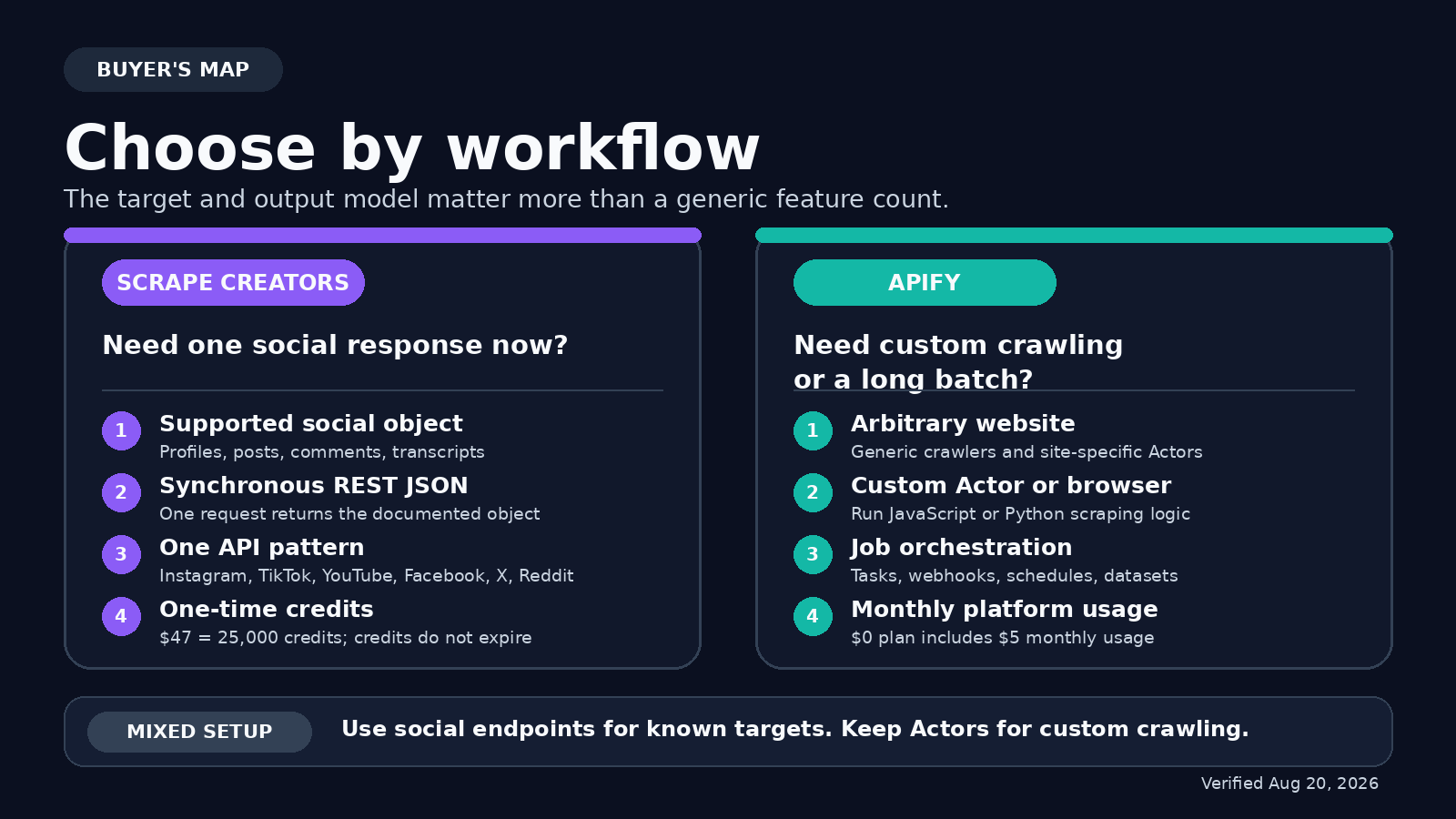
Apify and Scrape Creators solve different scraping jobs. Scrape Creators is the simpler Apify alternative when you need public social profiles, posts, comments, transcripts, searches, or ad-library data through a normal REST API. Apify is the better choice for arbitrary websites, custom browser automation, scheduled Actor runs, and dataset workflows.
I run Scrape Creators, so treat my recommendation with that disclosure in mind. I would choose Scrape Creators for supported social data inside an application. I would choose Apify when the target needs a custom crawler or the workflow already depends on Actors, schedules, and datasets.
Quick decision table
Prices and product details in this table were checked against each company’s primary pages on August 20, 2026.
| Your job | Better fit | Why |
|---|---|---|
| Get one supported social profile, post, or comment page as JSON | Scrape Creators | One synchronous HTTP request and a predictable endpoint contract |
| Crawl an arbitrary website | Apify | Generic web crawlers, browser automation, and custom Actor code |
| Run a scraper on a schedule and export a dataset | Apify | Tasks, schedules, webhooks, datasets, and export formats are built into the platform |
| Add social data to an app with irregular usage | Scrape Creators | One-time credit packs and credits that do not expire |
| Pick from a large marketplace of specialized scrapers | Apify | The Apify Store has community and Apify-maintained Actors |
| Use one API across supported social platforms | Scrape Creators | The same authentication and docs pattern covers Instagram, TikTok, YouTube, Facebook, X, Reddit, and more |
| Build and publish your own scraper | Apify | Crawlee, Actor development, storage, and marketplace distribution |
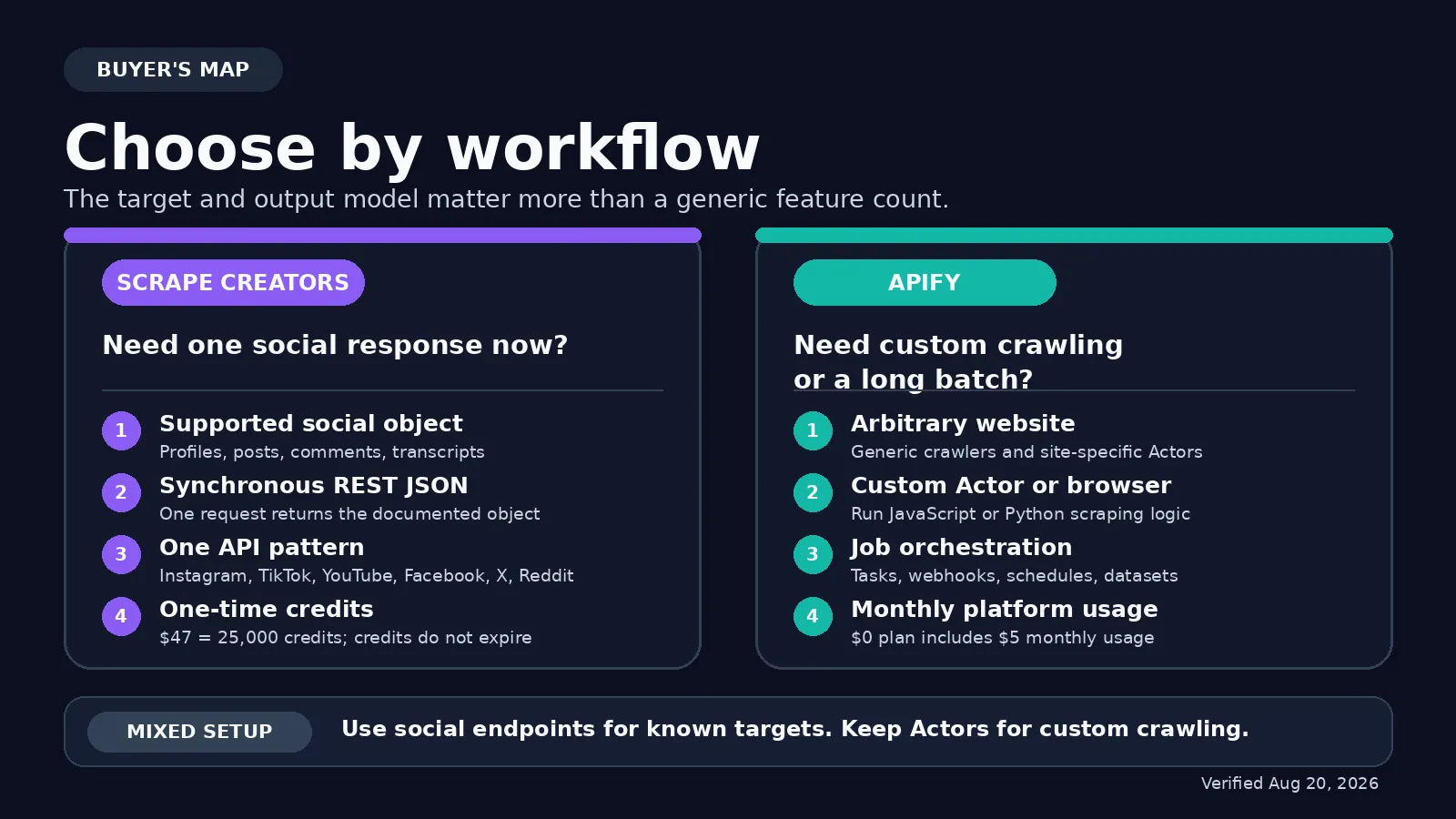
These products start from different jobs
An Apify Actor is a cloud program. It accepts input, runs for as long as the job needs, and can write records to a dataset. You can use a ready-made Actor, change its configuration, or build your own in JavaScript or Python. The platform also handles schedules, storage, proxies, webhooks, and integrations.
That flexibility is Apify’s advantage. It also means pricing and output can vary by Actor. One Actor might charge per result. Another might charge for events or platform resources. Input schemas and response fields can differ because each Actor is its own product.
Scrape Creators starts with an endpoint contract instead. You call a route such as the Instagram Profile API and receive a synchronous JSON response. The service owns the scraper, proxy path, parser, and public response shape. This is less flexible than running arbitrary code, but it is easier to put behind a button, enrichment job, or customer-facing API.
The boundary matters. Scrape Creators cannot take any URL on the web and execute custom browser logic against it. Apify can. Apify’s marketplace also contains many targets that Scrape Creators does not cover. On the other hand, an application that only needs a supported social object may not need an Actor run, polling, dataset storage, and a second request to collect the output.
How the API workflows differ
A Scrape Creators profile request looks like a normal API call:
curl --get "https://api.scrapecreators.com/v1/instagram/profile" \
  -H "x-api-key: $SCRAPE_CREATORS_API_KEY" \
  --data-urlencode "handle=mrbeast"
I ran that exact request on August 20, 2026. It returned HTTP 200 in 4.33 seconds, charged one credit, and returned a 69-field public profile object. A short response excerpt was:
{
  "success": true,
  "credits_charged": 1,
  "data": {
    "user": {
      "id": "2278169415",
      "username": "mrbeast",
      "is_private": false,
      "is_verified": true
    }
  }
}
That was one smoke test, not a reliability benchmark. Public fields and counters can change between calls.
An Apify Actor usually starts a run, then exposes its results through a dataset. The direct run request for the official Instagram Scraper follows this pattern:
curl -X POST \
  "https://api.apify.com/v2/acts/apify~instagram-scraper/runs?token=$APIFY_TOKEN" \
  -H "Content-Type: application/json" \
  -d '{
    "directUrls": ["https://www.instagram.com/p/SHORTCODE/"],
    "resultsType": "posts",
    "resultsLimit": 1
  }'
Your code can poll the run and read its dataset, use a synchronous run endpoint for short jobs, or let Apify call a webhook when the run finishes. The Apify API docs cover those run and dataset operations.
This is not a question of good API versus bad API. The asynchronous job model is useful for long crawls and large exports. The synchronous endpoint model is useful when a user or agent is waiting for one social object right now.
Pricing compared
The pricing units are different, so a plan table needs context.
| Product | Entry point | Paid options checked August 20, 2026 | What expires? |
|---|---|---|---|
| Scrape Creators | 100 free credits | $47 for 25,000 credits; $497 for 500,000 credits | Purchased credits do not expire |
| Apify | $0 plan with $5 of monthly usage | Starter $29/month; Scale $199/month; Business $999/month, each with matching monthly usage | Unused monthly usage expires at the end of the billing cycle |
Most Scrape Creators endpoints cost one credit per successful live request, although some routes cost more and the docs show the exact charge. A valid cache hit on a supported endpoint costs zero credits. The $47 pack works out to $1.88 per 1,000 one-credit requests. The $497 pack works out to about $0.994 per 1,000.
Apify combines plan usage with Actor pricing. Its official pricing page describes pay-per-event and pay-per-usage Actors. The official Instagram Scraper page showed $2.70 per 1,000 results on Free, $2.30 on Starter, $1.90 on Scale, and $1.50 on Business when checked. Other Actors can use different rates and billing events.
This is why “Which is cheaper?” needs a workload. Apify’s free $5 monthly usage can be enough for occasional small runs. A paid plan can also make sense if you use many Actors and platform features every month. Scrape Creators is easier to budget when each useful social response maps to a documented credit charge and usage is irregular.
What buyers keep asking
The search results say “alternatives,” but the underlying questions are more specific.
I reviewed five full YouTube transcripts about Apify, its alternatives, and its API workflow. I also reviewed 61 unique YouTube comments, 10 reply threads, four Reddit discussions with 30 comment nodes, and 43 comments across three relevant TikTok videos. These are qualitative examples, not a poll.
Three questions kept coming up:
- Do I need to poll the Actor? An n8n and Apify tutorial used a wait between starting an Actor and reading its dataset. The most useful comments pointed to synchronous run endpoints and webhooks as cleaner options, especially when dataset size varies. If your app needs one immediate object, the simpler Scrape Creators request can remove that orchestration.
- Can I scrape my exact target without building anything? Comments under Apify’s Web Scraper tutorial asked about multi-page crawling, selectors, login, custom Python, Etsy, and extracting specific fields. The answers depended on glob patterns, page functions, purpose-built Actors, or custom code. Apify gives you those tools. Scrape Creators only wins when the target and fields already have a supported endpoint.
- What happens when usage is occasional or grows into a SaaS? A public pay-per-use Apify discussion focused on a 4,000 to 5,000-result job every six months. TikTok commenters asked whether an Actor-backed product could serve thousands of users. The right cost model depends on result count, Actor events, retries, storage, and whether unused monthly usage is wasted.
Those questions changed this comparison. The useful dividing line is not “no-code versus developers.” It is job orchestration versus response retrieval, and arbitrary targets versus supported endpoint contracts.
The Instagram benchmark
We also have a real head-to-head result for one narrow workload.
On August 19, 2026, I sent the same 1,000 public Instagram post and Reel URLs through Apify’s official Instagram Scraper and Scrape Creators. Apify returned 1,000 of 1,000 matched items on the first attempt. Scrape Creators returned 996 on the first attempt, and all four uncharged failures succeeded on the first retry.
At the tested rates, Apify cost $2.2977. Scrape Creators cost $1.8725 on the $47 pack rate. At concurrency 100, Scrape Creators processed the 997-URL batch in 50.8 seconds, or 58.7 seconds including one retry wave. Apify took 147.0 seconds and needed no retry.
The result is mixed in a useful way. Scrape Creators was cheaper and faster for that post-detail workload. Apify had the cleaner first pass. The full 1,000-URL benchmark includes the corpus, method, cost math, retry results, and downloadable normalized data.
Do not apply that result to arbitrary websites or every Actor. It tested one official Apify Actor against one Scrape Creators endpoint on a dated public-Instagram corpus.
Choose Scrape Creators if
Use Scrape Creators when all of these are true:
- the target has a documented Scrape Creators endpoint
- your application wants JSON from a synchronous HTTP request
- usage is irregular and non-expiring credits matter
- you want one authentication and documentation pattern across supported social platforms
- you would rather rely on a maintained endpoint contract than configure an Actor
The strongest fit is a product that enriches profiles, monitors public posts, reads comments, pulls transcripts, or researches ad libraries. Start with the API docs and confirm the exact fields before you design the feature. You can create an account with 100 free credits and test your own public fixtures.
Scrape Creators is the wrong choice when you need arbitrary HTML, custom selectors, authenticated browser sessions, a crawler for an unsupported site, or code that runs inside the scraping platform.
Choose Apify if
Use Apify when one or more of these are true:
- you need to crawl arbitrary websites
- a ready-made Actor already solves the target well
- you want scheduled runs, webhooks, datasets, and exports in one platform
- you need Crawlee or custom JavaScript or Python scraper code
- you want to publish or monetize your own Actor
- the workload is a long batch rather than one response a user is waiting for
Apify is also the safer choice when your scope changes every week. A marketplace and general crawling platform can absorb new targets that a fixed endpoint catalog cannot.
The tradeoff is operational. Review the exact Actor’s owner, last update, issue response, input schema, pricing events, and output before building on it. “Runs on Apify” does not mean every Actor has the same maintenance, billing, or response contract.
A safe migration plan
Do not replace a working Apify system in one step.
- List the Actors, fields, schedules, webhooks, and downstream dataset assumptions you use today.
- Match only the supported social calls to current Scrape Creators documentation.
- Run a representative fixture set through both products. Compare useful records, not HTTP status alone.
- Record credits or Actor charges, first-attempt failures, retry behavior, and end-to-end latency.
- Keep Apify for unsupported sites, custom browser logic, and long dataset jobs.
- Move one production path at a time and keep a rollback route until the new response mapping is proven.
A mixed setup is reasonable. You can use Scrape Creators for supported social records and Apify for the rest of the web.
Sources and verification
Product and pricing claims were checked on August 20, 2026 against:
- Apify pricing
- Apify API v2 documentation
- Apify Instagram Scraper
- Scrape Creators pricing
- Scrape Creators Instagram Profile API
- Scrape Creators API introduction
- Our broader social scraping API comparison
- Our web scraping API comparison
Pricing, Actor terms, endpoint costs, fields, and public-platform behavior can change. Recheck the live pages before committing a large workload.