
The short answer
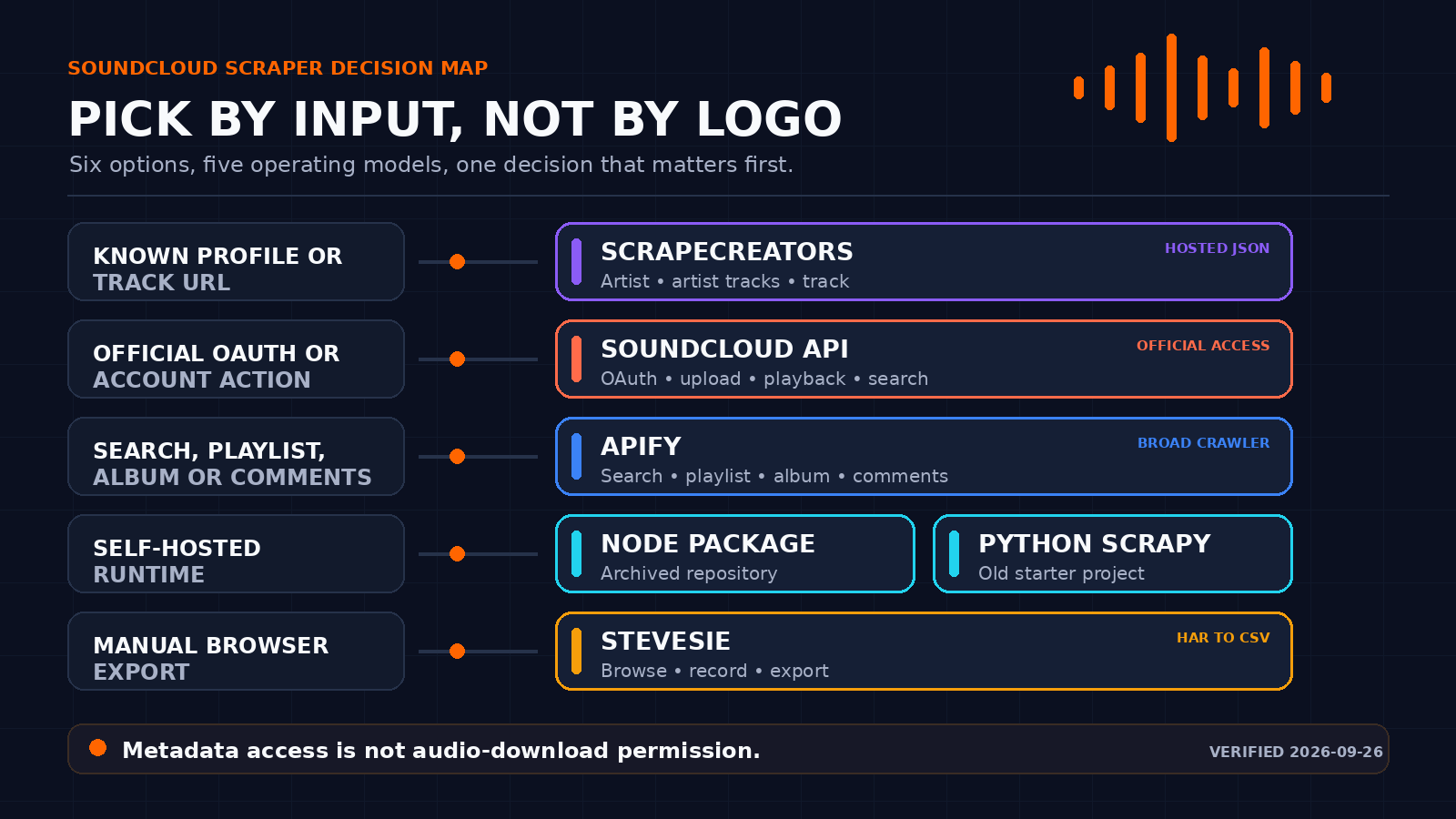
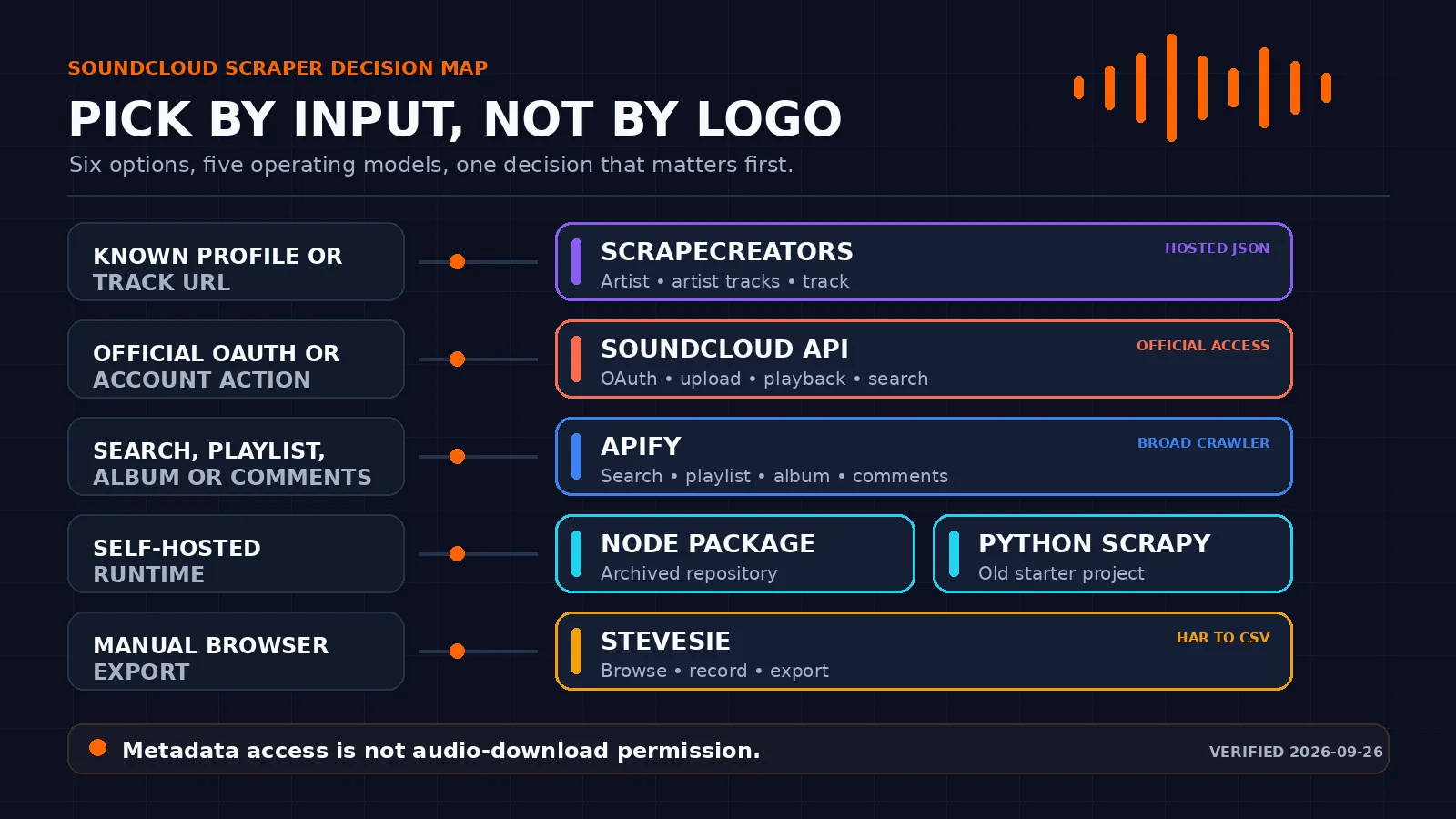
For developers who need public SoundCloud artist profiles, artist tracks, and individual track metrics as ready JSON, ScrapeCreators is my practical default. I run ScrapeCreators, so that recommendation is not neutral. SoundCloud’s official API is better for approved apps and user-authorized features. Apify is better when you need broad search, albums, playlists, comments, or dataset output. Stevesie is easier for a one-off CSV.
Do not choose a tool until you separate metadata from audio. This guide covers public profile and track data, not ripping songs. Product, pricing, repository, and API claims were checked on September 26, 2026.
Decide what scraping means
“SoundCloud scraper” describes several different jobs. Most tools do only part of this list.
| Job | Typical input | Useful output | Common trap |
|---|---|---|---|
| Read an artist profile | Handle or profile URL | Username, follower count, track count, city, links, badges | A current count is not a historical trend |
| List an artist’s tracks | Handle or profile URL, then a cursor | Track IDs, titles, dates, plays, likes, reposts, comments | One page is not the artist’s full catalog |
| Inspect one track | Track URL or ID | Duration, genre, engagement counts, artist, artwork, public metadata | A media URL is not permission to copy the audio |
| Search SoundCloud | Keyword plus content type | Tracks, users, albums, or playlists | Search order can change and may not be exhaustive |
| Export a file | A browser session, search page, or API response | CSV or JSON | Manual exports do not make a reliable backend |
| Download audio | Track or playlist URL | Audio files | Metadata access and download rights are separate questions |
That last distinction matters. One recent YouTube tutorial targeted playlist metadata first, then told viewers to obtain high-quality audio through official stores or artist channels. That is a much safer mental model than treating every stream field as a download license.
Comparison table
The prices use each vendor’s own unit. A hosted API request, Apify result, monthly plan, and self-hosted run are not equivalent.
| Option | Best for | SoundCloud coverage | Published starting point | Main catch |
|---|---|---|---|---|
| ScrapeCreators | Hosted JSON with a small, named contract | Artist profile, paginated artist tracks, and individual track details | $47 for 25,000 pay-as-you-go credits; the six checks for this guide cost 1 credit each | No SoundCloud search, playlist, album, or comments route today |
| SoundCloud API | Official integrations and user-authorized apps | Official public resources plus OAuth features, uploads, playback, and search | API access is currently free; app registration requires Artist Pro | You must register an app, handle tokens, follow strict content rules, and fit SoundCloud’s commercial-use terms |
| Apify | Broad crawling, search pages, datasets, and Actor workflows | Tracks, users, playlists, albums, search, and optional comments | $25/month plus Apify platform usage on September 26; a pay-per-result change is scheduled for October 1 | Wider input surface, but it is one community Actor with its own schema and billing lifecycle |
| SoundCloud Scraper for Node | Small self-hosted Node projects | Search and basic track, artist, and playlist methods advertised by the package docs | MIT package with no vendor fee | Latest npm release was in June 2022 and the repository is archived |
| SoundCloud Scraper for Python | A simple Scrapy starting point | User and track records from a Scrapy spider | No vendor fee | Last code push was in February 2020, no license is declared, and you own repairs |
| Stevesie | Manual browser-to-CSV research | Whatever SoundCloud data loads while you browse and record a HAR file | Free tier with a 10-row daily limit; Basic is $89.99/month | Manual capture, sensitive HAR files, and no fixed SoundCloud response contract |
1. ScrapeCreators
ScrapeCreators’ SoundCloud API is my pick when a developer wants a hosted endpoint and predictable object types. The current SoundCloud catalog has three routes:
GET /v1/soundcloud/artistaccepts a handle or profile URL and returns public artist metadata;GET /v1/soundcloud/artist/tracksreturns up to 20 tracks per page plus an opaque cursor;GET /v1/soundcloud/trackreturns one public track by URL.
I ran both artist routes for Kehlani and ODESZA, followed Kehlani’s next cursor, and looked up one Kehlani track directly. All six requests returned 200 and charged one credit each. The two track pages contained 20 unique IDs apiece with no overlap. The direct track response included playback_count, likes_count, reposts_count, comment_count, duration, genre, and artist metadata.
The pricing section lists 25,000 credits for $47 and 500,000 credits for $497. Credits do not expire. A cache hit costs zero credits; a live fetch uses the endpoint’s normal price. You can create an account and get the current free-credit offer without a credit card. The six calls in this review were live point-in-time checks, not a reliability benchmark.
The limitation is simple. ScrapeCreators does not currently offer SoundCloud keyword search, playlists, albums, comments, or audio downloads. Pick Apify or the official API if one of those is central to the job.
2. SoundCloud API
The official SoundCloud API belongs near the top of any shortlist. It is the right choice when you need an official integration, OAuth, uploads, user consent, or documented SoundCloud behavior.
The current guide says app registration requires an Artist Pro account. Public-resource apps can use the client-credentials flow. User-scoped actions use OAuth 2.1 with PKCE. The API is currently free, although SoundCloud reserves the right to charge later.
Its rate-limit page is more specific than many summaries online. SoundCloud says it does not currently enforce a global aggregate call limit. Stream requests to /tracks/:id/stream are limited to 15,000 per 24-hour window. Client-credentials token exchanges are limited separately, so applications should reuse and refresh tokens rather than requesting a new one for every call.
The official path also carries rules that a scraper comparison should not wave away. The API terms restrict persistent storage and offline access to user content, require privacy controls for personal data, and allow only certain commercial uses. If your project involves audio, training data, follower outreach, or a commercial catalog, read the terms and get legal advice for the actual use case.
Choose SoundCloud’s API when official access matters more than setup speed. Choose a hosted metadata API when you only need public objects and do not want to maintain application credentials and token flows.
3. Apify
Apify’s SoundCloud Scraper is the broadest ready-made crawler in this comparison. It accepts SoundCloud URLs and search pages, then writes structured items to an Apify dataset. Its example input covers individual tracks, profiles, playlists, and filtered searches for sets, people, albums, and sounds. Comments are optional.
The Actor was active when I checked it. Apify’s public metadata showed 61 runs in the prior 30 days, all successful, and a 4.996 rating across nine reviews. Those platform statistics are useful maintenance signals, but they are not proof that every input produces complete data.
Pricing needs a date attached. The live page listed $25 per month plus platform usage on September 26, 2026. The Actor metadata also announced a move on October 1 to pay-per-event pricing at $0.0016 per dataset result plus a small Actor start event. Check the page again before budgeting a production crawl.
Choose Apify when you need search discovery, playlist or album inputs, comments, and dataset workflows. Choose ScrapeCreators when three named artist-and-track endpoints cover the job and you would rather buy credits than rent and operate an Actor.
4. SoundCloud scraper for Node
The soundcloud-scraper npm package is the most visible Node option in the current search results. Its documentation advertises search plus track, artist, and playlist methods. A small app can call the library directly and keep all processing in its own runtime.
There is no vendor fee, and npm lists an MIT license. The maintenance picture is the reason I would not make it the default in 2026. Version 5.0.3 was published on June 26, 2022. Its repository now redirects to twlite/soundcloud-scraper, which GitHub marks as archived. The latest code push shown by GitHub was June 30, 2023.
That does not make the package useless. It does make it a codebase you should pin, test against representative URLs, and be prepared to fork. Choose it for a low-risk Node prototype where owning the runtime is a benefit. Do not assume an archived package will absorb the next SoundCloud source change for you.
5. SoundCloud scraper for Python
zacheberhart/Soundcloud-Scraper is a compact Scrapy project for user and track information. Ahrefs placed it first for soundcloud scraper in its August 15 snapshot. It was third in my final live US check on September 26. That says as much about the thin search results as it does about current maintenance.
GitHub showed 34 stars, three forks, no declared license, and a last code push on February 4, 2020. I would treat it as readable reference code, not a maintained dependency. Review every selector and request, add tests, confirm what you are allowed to collect, and decide how failures should affect downstream jobs.
Choose this project when you specifically want a small Python/Scrapy starting point and are comfortable taking ownership. If you need a service-level contract, retries, monitoring, and someone else handling source drift, use a hosted option.
6. Stevesie
Stevesie’s no-code SoundCloud scraper records the network traffic generated while you browse SoundCloud. You export a HAR file from browser developer tools, upload it to Stevesie’s parser, group related requests, and download flattened CSV data.
This is useful for a person who wants a spreadsheet from a search session. It can expose fields such as track ID, duration, genre, license, URL, play count, repost count, tags, and waveform URL. It does not give your application a stable, scheduled SoundCloud endpoint.
The free tier allows paid features with a 10-row daily download limit. Basic is $89.99 per month and advertises unlimited HAR-to-CSV extracts, subject to throughput and third-party limits. Plus is $149.99 per month and adds workflow automation and the Stevesie API.
HAR files can contain much more than the response you meant to export, including request headers and session data. Inspect and redact them before uploading. Stevesie says its method complies with SoundCloud’s terms, but that vendor statement is not legal advice and does not settle your own use, retention, or redistribution obligations.
What buyers actually ask for
I searched YouTube in a US context for the primary query and three close variants, then reviewed four available transcripts. I also read top and newest comments, seven YouTube reply threads, current Reddit discussions, TikTok results, and TikTok replies.
The recurring questions were more useful than the phrase “SoundCloud scraper”:
- Can I export profile and track metrics to CSV?
- Can I follow the full catalog rather than stop at the first page?
- Can I collect play counts now and compare them later?
- Can I search many artists, playlists, or tags?
- Can I download the songs too?
- Do I need an official API key, browser automation, or a proxy?
- Who repairs the integration when SoundCloud changes?
A recent Node and Playwright walkthrough showed how much browser work sits behind a DIY playlist export: proxy configuration, asset blocking, consent handling, repeated scrolling, hover interactions, fallback selectors, and CSV cleanup. An older HAR-file workflow showed the manual alternative and drew follow-up questions about email extraction, daily listen history, and exporting other track-list sites.
A current Reddit profile-analyzer thread centered on public profile metadata, track tags, upload dates, and engagement ratios. Another discussion raised the obvious business constraint: official API terms, scale limits, and whether a middleman product is allowed. TikTok results were dominated by audio downloads and playlist transfer tools. That noise is why this comparison keeps metadata collection separate from audio ripping.
How to choose
Use these questions in order.
1. Is the job metadata, audio, or an account action?
Use this guide for public metadata. Use SoundCloud’s official API and OAuth for uploads or deliberate user actions. Do not treat a metadata endpoint as an audio license or an account-automation permission slip.
2. Do you need known objects or discovery?
Use ScrapeCreators if you already have an artist handle, profile URL, or track URL. Use Apify if the input is a keyword search, playlist, album, or broad discovery page. Use Stevesie when a human can browse the exact page and wants a file.
3. Is one current count enough?
Every option here returns a snapshot. If you need play-count growth, save dated measurements on your own schedule. Store the stable track ID, observation time, source URL, and metric together. Do not infer a growth rate from one response.
4. Who owns breakage?
A hosted API owns more of the retrieval work. An Apify Actor packages a crawler but still has its own releases, run settings, and billing. An archived Node package or old Scrapy project puts source changes directly on your team.
5. What does the price unit buy?
| Billing model | Cost formula to model | Options here |
|---|---|---|
| Pay-as-you-go credits | Requests x credits per route x price per credit | ScrapeCreators |
| Official access | Engineering, compliance, and token operations | SoundCloud API |
| Subscription plus platform usage | Monthly Actor fee plus compute, proxy, storage, or result charges | Apify on the verification date |
| Self-hosted software | Infrastructure, proxy, maintenance, and incident time | Node and Python projects |
| Monthly export software | Plan price plus the human time to record and inspect HAR files | Stevesie |
Real request and output
This request returns up to 20 current public tracks for one artist. Keep the cursor opaque and pass it back unchanged for the next page.
curl --get "https://api.scrapecreators.com/v1/soundcloud/artist/tracks" \
  --header "x-api-key: YOUR_API_KEY" \
  --data-urlencode "handle=kehlanimusic"
A shortened response from my September 26 check looked like this:
{
  "success": true,
  "credits_charged": 1,
  "tracks": [
    {
      "id": 2306956232,
      "title": "Lights On (feat. Big Sean)",
      "playback_count": 84645,
      "likes_count": 3298,
      "reposts_count": 33,
      "comment_count": 25,
      "duration": 179351,
      "genre": "R&B",
      "permalink_url": "https://soundcloud.com/kehlanimusic/lights-on-feat-big-sean"
    }
  ],
  "cursor": "2026-04-23T00:00:00.000Z,tracks,00000000002319251642"
}
Those engagement values are a dated observation. They will change. The next-page request uses the returned cursor:
curl --get "https://api.scrapecreators.com/v1/soundcloud/artist/tracks" \
  --header "x-api-key: YOUR_API_KEY" \
  --data-urlencode "handle=kehlanimusic" \
  --data-urlencode "cursor=2026-04-23T00:00:00.000Z,tracks,00000000002319251642"
The second call returned 20 more track IDs with no overlap with page one. For production code, deduplicate on id, persist the observation time, and stop when the cursor is null.
If you are comparing other music-data options, the Spotify scraper guide uses the same object-versus-page framework. For a wider vendor view, see the social media scraping API comparison.
What I verified
On September 26, 2026, I checked:
- the live ScrapeCreators SoundCloud product page, docs, production handlers, and current backend source;
- two artist lookups, two first-page track lookups, one cursor page, and one direct track lookup through the production API;
- SoundCloud’s current API guide, app-registration requirements, rate limits, and API terms;
- the Apify Actor page and public Actor metadata, including its scheduled pricing change;
- npm and GitHub metadata for the Node package;
- GitHub metadata for the Python/Scrapy project;
- Stevesie’s SoundCloud workflow and pricing page;
- live US search results for
soundcloud scraperand three close variants; - YouTube, Reddit, LinkedIn, and TikTok search results, four transcripts, 21 unique YouTube comments, seven YouTube reply threads, 19 top-level Reddit comments with nested replies, 14 TikTok comments, and three fetched TikTok reply rows.
I did not run the paid Apify Actor, execute the archived Node package, run the Python spider, upload a HAR file to Stevesie, or benchmark the official API. Their feature and price descriptions come from their current primary pages and repository metadata.
Limitations
Public does not mean consequence-free. Artist profiles can contain names, locations, links, and contact details. Collect the minimum fields you need, set retention limits, secure the data, and honor deletion or access obligations that apply to your project.
No tool here proves that a play, like, repost, or comment came from a real person. SoundCloud metrics can include promotion, spam, and other activity that needs separate analysis. A scraper returns the source’s current value. It does not validate the audience.
ScrapeCreators covers only public artist and track data today. It cannot replace SoundCloud’s OAuth flows, upload endpoints, private account access, search, playlist retrieval, comments, or audio rights. Apify’s wider crawler is a better fit for some of those public-page jobs. SoundCloud’s official API is the right place for approved account features.
Finally, avoid building around a single screenshot or example response. Test several representative artists and tracks, follow at least one cursor, record nullability, and decide what your application should do when a metric disappears.
FAQ
What is the best SoundCloud scraper in 2026?
ScrapeCreators is my practical default for hosted public artist and track JSON. Use SoundCloud’s API for official integrations, Apify for broad search and dataset workflows, Stevesie for manual CSV exports, or open-source code when your team wants to own the runtime.
Can I scrape SoundCloud play counts?
Yes. Public track data can include playback_count, likes, reposts, and comments. Save dated snapshots if you need a trend. One response only tells you the current value.
Does SoundCloud have an official API?
Yes. The current API supports public resources, OAuth features, search, playback, uploads, and more. App registration currently requires Artist Pro, and your use must fit SoundCloud’s API terms.
Can a SoundCloud scraper download audio?
Do not assume so. Metadata access, playback, and download rights are different. SoundCloud’s API terms restrict persistent storage and offline access to user content. Check the source rights and get legal advice for audio collection or model training.
Is Apify or ScrapeCreators better for SoundCloud?
ScrapeCreators is simpler for artist profiles, artist tracks, and direct track lookups. Apify has a wider public crawling surface, including search, playlists, albums, and optional comments. Choose based on the input and output your application actually needs.
How much does a SoundCloud scraper cost?
ScrapeCreators starts at $47 for 25,000 non-expiring credits. The reviewed Apify Actor listed $25 per month plus platform usage on the verification date, with a pay-per-result change scheduled. Stevesie has a limited free tier and paid plans from $89.99 per month. Open-source tools replace vendor fees with your own infrastructure and maintenance.