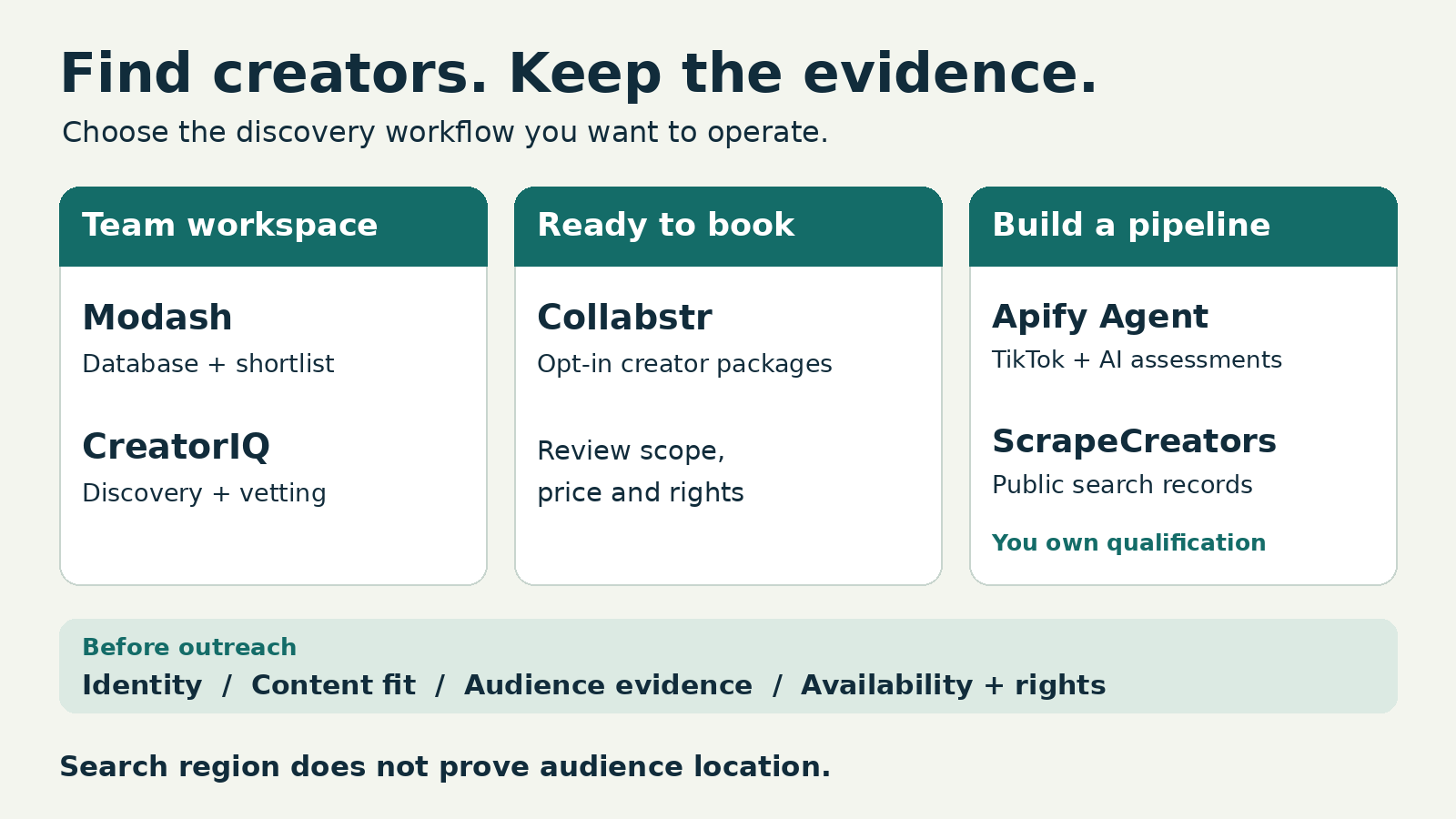
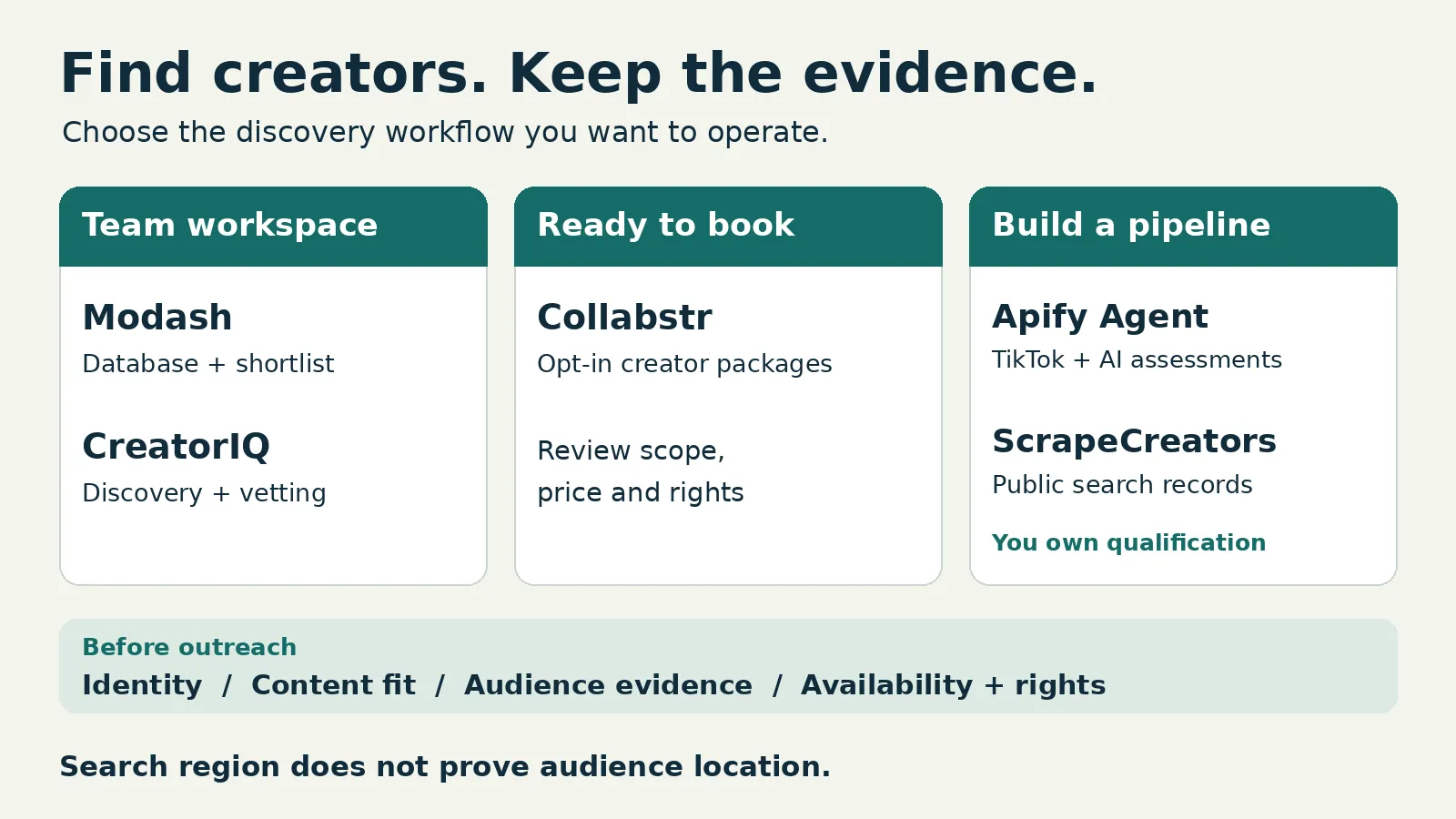
Choose Modash for a ready-made influencer database and campaign workflow, Collabstr for creators already offering paid packages, or CreatorIQ for an enterprise program that needs discovery and vetting together. Apify’s Influencer Discovery Agent fits TikTok searches with AI-written assessments. ScrapeCreators fits developers building their own content-led shortlist from public search results.
Those are different purchases. A list of relevant videos is not a list of available partners, and a creator’s location is not their audience’s location.
I run ScrapeCreators. We called its YouTube endpoints for this article. The other recommendations use primary documentation, not a claimed five-tool benchmark. Capabilities and purchase terms were checked on November 4, 2026.
Choose the discovery workflow before the tool
An influencer discovery tool should help a brand find people whose work fits a campaign, then preserve enough evidence to decide whether to approach them. Start with a brief: the product, content topic, market, language, format, and budget. Keep requirements you can verify separate from things you still need to ask the creator.
| Tool | Best starting point | What you get | Cost unit and important boundary |
|---|---|---|---|
| Modash | A campaign brief, reference creator, or content example | Searchable creator profiles, audience filters, lists, and campaign tools | Essentials: $299 monthly, or $199/month equivalent paid yearly; opened-profile allowance matters |
| Collabstr | A brief and a budget for a creator package | An opt-in marketplace with portfolios, packages, and ordering | Free profile browsing; paid filter gates and a separate order fee; not an index of every public creator |
| CreatorIQ | An established program with several stakeholders | Content-first discovery, recommendations, and brand-safety vetting | Request pricing; confirm the required networks, seats, and modules in the quote |
| Apify Influencer Discovery Agent | A written description of the desired TikTok creator | Exportable profile rows with AI fit assessments | $100 per 1,000 profile events, platform usage included; TikTok-only for this specific Actor |
| ScrapeCreators | Content keywords and a developer-owned workflow | Public search records you turn into a candidate list | YouTube search normally costs 1 credit per successful live request, not per qualified creator |
The useful denominator is creators your team would seriously consider, not profiles in a vendor’s headline database. Ask each tool to handle the same brief before comparing its price.
1. Modash for a searchable database and working shortlist
Modash’s discovery product combines Instagram, TikTok, and YouTube discovery with audience filters, lookalikes, and content search. Its current pricing page also lists natural-language and reference-image search. That makes it a sensible first trial when a marketer needs a workspace rather than raw records.
The distinction between creator and audience filters matters. A creator based in your target country can still reach viewers elsewhere. Modash’s own discovery walkthrough demonstrates switching between those filter types. Ask which audience fields are measured or estimated, how recently they were updated, and whether they cover the network you need.
The Essentials plan showed $299 with monthly billing, or $199 per month equivalent with $2,388 paid yearly. It includes 300 opened profiles per month and two team members. That is an allowance for opening detailed profiles, not 300 guaranteed campaign matches. The current trial lasts 14 days and includes 20 profile views.
Choose Modash if you want to find, evaluate, and organize creators without building the surrounding software. Choose a smaller workflow if you only need a few candidates. Confirm a separate API purchase rather than assuming a dashboard subscription includes a developer data contract.
2. Collabstr for creators already offering packages
Collabstr answers a more immediate question: who is offering the kind of work I want to buy?
Its search documentation describes a marketplace of creators who actively signed up. You can filter by platform, niche, location, followers, price, and content type. The price filter finds creators with at least one package in that range, so check the actual deliverable before assuming the displayed budget buys a Reel, a video, or usage rights.
Browsing profiles is free. Age, ethnicity, and language filters require Pro or above. These are creator-search attributes; do not silently read them as verified audience demographics. The marketplace also searches one selected platform at a time.
The ordering guide states a $50 minimum order and a standard 10% brand-side checkout fee that can be reduced by a subscription. Payments are captured upfront. Usage rights are not automatically included in every package. Check the live checkout and current plan terms before paying; the main pricing page blocked our anonymous verification, so we are not quoting subscription prices here.
Choose Collabstr when availability, package scope, and booking are the main obstacles. Choose a broader database when you want creators who have not joined that marketplace. A portfolio match still needs a discussion about audience fit, deadlines, revisions, and rights.
3. CreatorIQ for enterprise discovery and vetting
CreatorIQ’s discovery product puts creator posts inside search results, supports brand-name and keyword searches, and recommends similar creators. Its New Mentions feed is designed to surface creators already talking about a brand. The same product page describes audience filters and brand-safety assessment.
That is a different buying decision from downloading a spreadsheet. An established program may need several people to review suitability, retain relationship history, and carry a discovery decision into campaign work.
The pricing route leads to a request form rather than a public self-serve price. Ask for a written quote that identifies the included networks, discovery and evaluation modules, user access, exports, onboarding, and renewal terms. Do not compare an unspecified enterprise contract with an API’s marginal request cost.
Choose CreatorIQ when discovery must fit a larger team process. Choose a simpler tool if one person is assembling a small shortlist. We did not access a paid account or benchmark its audience-authenticity assessments. A vendor’s safety or authenticity label is a reason to inspect the supporting evidence, not permission to skip human review.
4. Apify for a TikTok discovery job with AI assessments
The specific Apify Influencer Discovery Agent is more than a generic profile scraper. It accepts a written description, generates TikTok search keywords, collects candidates, and produces a fit score and explanation. Its README says this Actor currently supports TikTok only. Other Actors on Apify have different scopes.
The input schema requires influencerDescription. It also allows supplied usernames, up to five generated keywords, and up to ten profiles per keyword. These are search controls, not a promise of fifty unique, qualified creators. Queries can overlap or return poor matches.
Its pricing grid lists $100 per 1,000 Profile events, with platform costs included. Do not add compute and proxy charges again for that listed event model. Apify account allowances and purchase terms are separate from the Actor’s consumption rate.
Choose it when you want an exportable TikTok job and are comfortable checking AI explanations against the original posts. Choose a different workflow for cross-platform discovery, a booking marketplace, or a team campaign workspace. A high fit score is a model judgment, not proof of audience geography, buying intent, availability, or future sales. We reviewed the schema and pricing but did not run this paid Actor.
5. ScrapeCreators for building content-led candidate lists
ScrapeCreators is useful when your starting question sounds like “who makes detailed trail-running shoe reviews?” and you want the evidence in your own app.
The YouTube search endpoint accepts content keywords and returns typed search records. type=videos finds video evidence; type=channels searches for channels directly. You own the grouping, qualification, storage, and follow-up. This is not a finished influencer database or campaign manager.
Our November 4 fixture searched trail running shoe review with type=videos and region=US. Two pages returned 20 video rows each, with no overlapping video IDs. Those forty hits contained 17 distinct channel IDs, plus five video rows without a channel ID. Some results came from retailers or publications, not necessarily individual creators available for sponsorship.
That missing identity matters. Several rows carried combined channel labels. Merging by display name would turn an ambiguous credit into a supposedly identified partner. Preserve the video and resolve its owner before outreach instead of guessing.
A separate type=channels call returned 20 channel rows and available subscriber fields. It did not establish those channels’ audience location or willingness to work with a brand. region=US sets the search proxy location; it does not filter creators or viewers to US residents.
Each of those three successful fixture calls charged one credit. A deliberate invalid-type request returned an uncharged 400. The current handler charges a successful live search even when its result is empty. A cache hit costs zero credits only when a cached result actually serves the request.
Pricing starts at $47 for 25,000 non-expiring credits, with 100 free signup credits. That is prepaid request capacity, not a price for 25,000 qualified influencers. Choose another tool when you need ready-made demographic filters, booking, or campaign administration. Use the YouTube API overview when public evidence collection is the part you want to build yourself.
A bounded example that does not invent creator identities
This Python example makes at most two searches, groups videos only when they contain a stable channel ID, and saves unresolved records separately. It leaves qualification and audience location unknown. Run it with Python 3 and SCRAPE_CREATORS_API_KEY set in your environment.
import json
import os
import urllib.parse
import urllib.request
from datetime import datetime, timezone
from pathlib import Path

query = "trail running shoe review"
base_params = {"query": query, "type": "videos", "region": "US"}
creators, unresolved, seen_videos = {}, [], set()
responses, credits, cursor = [], 0, None
observed_at = datetime.now(timezone.utc).isoformat()

for page in range(2):  # A bounded sample, not a complete creator database.
    params = dict(base_params)
    if cursor:
        params["continuationToken"] = cursor
    request = urllib.request.Request(
        "https://api.scrapecreators.com/v1/youtube/search?"
        + urllib.parse.urlencode(params),
        headers={"x-api-key": os.environ["SCRAPE_CREATORS_API_KEY"]},
    )
    with urllib.request.urlopen(request, timeout=60) as response:
        data = json.load(response)
    if data.get("success") is not True:
        raise RuntimeError("Search did not succeed")
    responses.append(data)
    credits += data.get("credits_charged", 0)
    for video in data.get("videos", []):
        video_id = video.get("id")
        if not video_id or video_id in seen_videos:
            continue
        seen_videos.add(video_id)
        channel = video.get("channel") or {}
        evidence = {"video_url": video.get("url"), "title": video.get("title")}
        channel_id = channel.get("id")
        if not channel_id:
            unresolved.append({"channel_label": channel.get("title"), **evidence})
            continue  # Do not merge creators by display name.
        creator = creators.setdefault(channel_id, {
            "channel_id": channel_id, "name": channel.get("title"),
            "query": query, "observed_at": observed_at,
            "audience_location": None, "qualified": None, "evidence": [],
        })
        creator["evidence"].append(evidence)
    cursor = data.get("continuationToken")
    if not cursor:
        break

for filename, rows in [("creator-candidates.jsonl", creators.values()),
                       ("unresolved-videos.jsonl", unresolved)]:
    Path(filename).write_text("".join(json.dumps(row) + "\n" for row in rows))
print(json.dumps({"unique_video_hits": len(seen_videos),
                  "identified_channels": len(creators),
                  "unresolved_video_hits": len(unresolved),
                  "more_pages_available": bool(cursor), "credits_charged": credits}))
Path("search-pages.json").write_text(json.dumps(responses, indent=2))
The exact script ran separately from the fixture calls. Its two pages produced 40 unique video hits, 20 identified channels, and three unresolved video hits, charged two credits, and still had another page available. Search results changed between the fixture and example; these are separate observations, not conflicting counts to average together.
The JSONL files are candidate evidence, not a complete export or an approved outreach list. The script saves the returned pages so you can audit what was observed. It does not enrich profiles, verify audience quality, run an AI scoring model, or contact anyone. Repeat query, type, region, and any other chosen search options when you request another page; a continuation token does not replace those stateless options.
For collector selection and broader pagination choices, use our YouTube search scraper comparison. If you already have qualified handles and the remaining job is contact discovery, that belongs in the separate influencer email finder comparison.
Give every tool the same acceptance test
Before buying, prepare a small set of creators you know fit the brief and another set you know does not. Include a retailer, a relevant creator outside the target market, and an account with one viral but otherwise unrelated post. This is a proposed trial procedure, not a benchmark we ran across these tools.
For every candidate, record:
- A stable platform identity and the exact content that explains the match.
- Whether location refers to the creator, the audience, or only the search region.
- Recent content consistency, rather than one isolated view spike.
- Any audience-quality estimate, its date, and what evidence you can inspect.
- Availability, package scope, rights, and the work still needed before hiring.
Public discussion about influencer search tools repeatedly separates finding accounts from trusting their metrics. It also contains vendor promotion, so it is useful for buyer questions, not a representative performance survey. Our research found a similar distinction in discovery tutorials and their comments: content relevance, audience fit, and campaign administration are separate tasks.
Measure the time to a defensible shortlist. Count duplicates and unresolved identities as extra work. Ask whether you can export the evidence before a trial ends. Buy the workflow that removes your actual bottleneck, even if its cost per raw row looks higher.
If you want to build the public-data part, create a ScrapeCreators account and try one narrow brief. Keep the candidate list small until you have checked the identities and evidence yourself.
Questions buyers ask
What is the best influencer discovery tool?
Modash is a practical first trial for a searchable database and campaign workspace. Collabstr suits package-based hiring, CreatorIQ suits enterprise discovery and vetting, Apify’s named Agent suits TikTok AI-assessment jobs, and ScrapeCreators suits a custom public-data workflow. The right choice depends on whether you need a finished shortlist workspace, a booking path, or records for your own system.
Can I find influencers for free?
You can start with native social search and inspect the creators behind relevant posts. Collabstr offers free profile browsing, while Modash and ScrapeCreators offer bounded trials or starter credits. Free discovery still costs research time and does not establish audience quality or a creator’s availability.
Does a US search return creators with a US audience?
Not necessarily. Search region, creator location, and audience location are different fields. In our ScrapeCreators example, region=US selects the proxy location. It does not establish where the creator or viewers live. Use the appropriate audience data or request a current media kit when that requirement matters.
Can AI pick the right influencers automatically?
AI can suggest candidates and explain content matches. It cannot turn missing evidence into verified demographics, confirmed availability, agreed rights, or guaranteed sales. Check each recommendation against its source content and the campaign brief before treating it as qualified.