
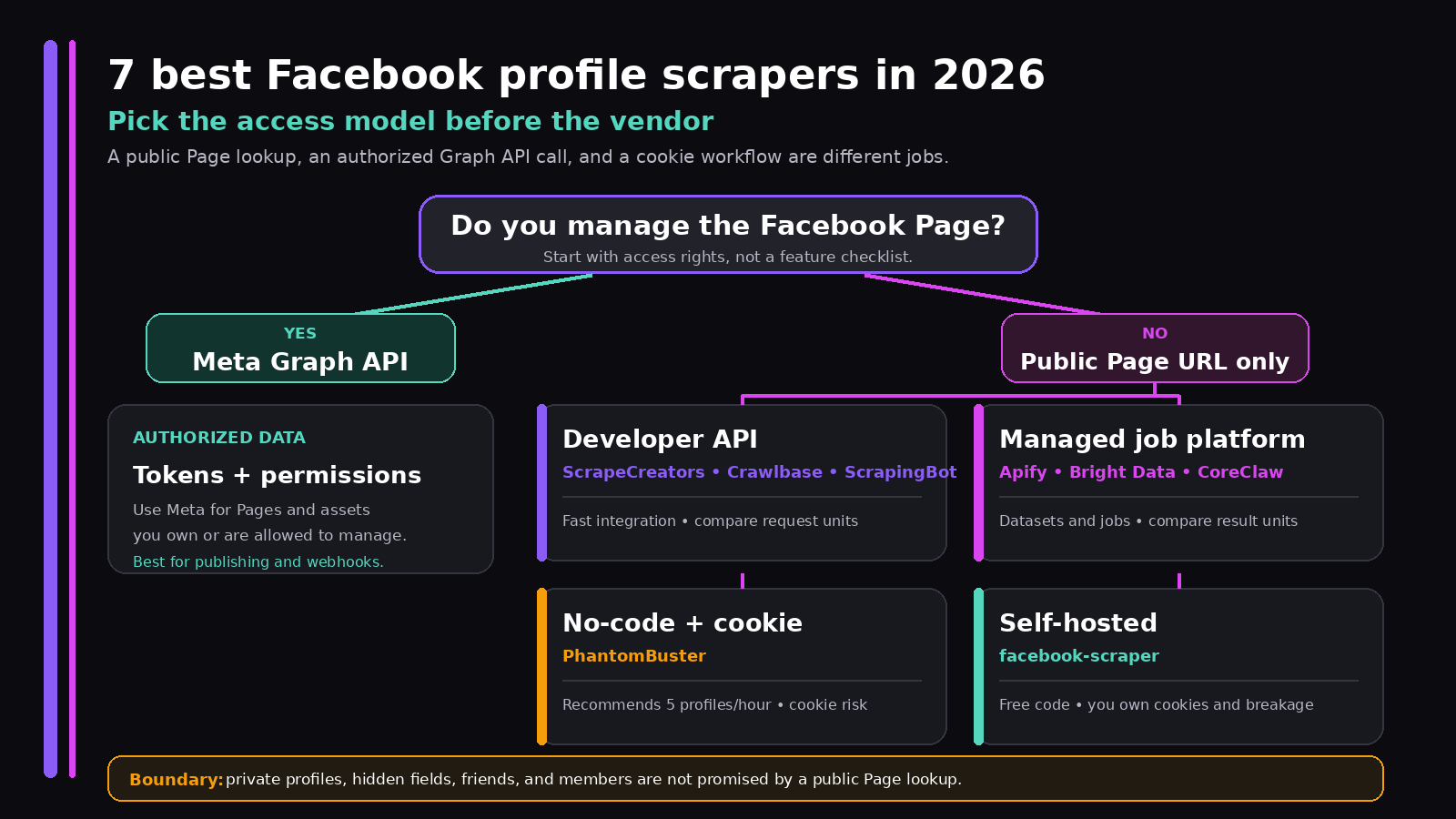
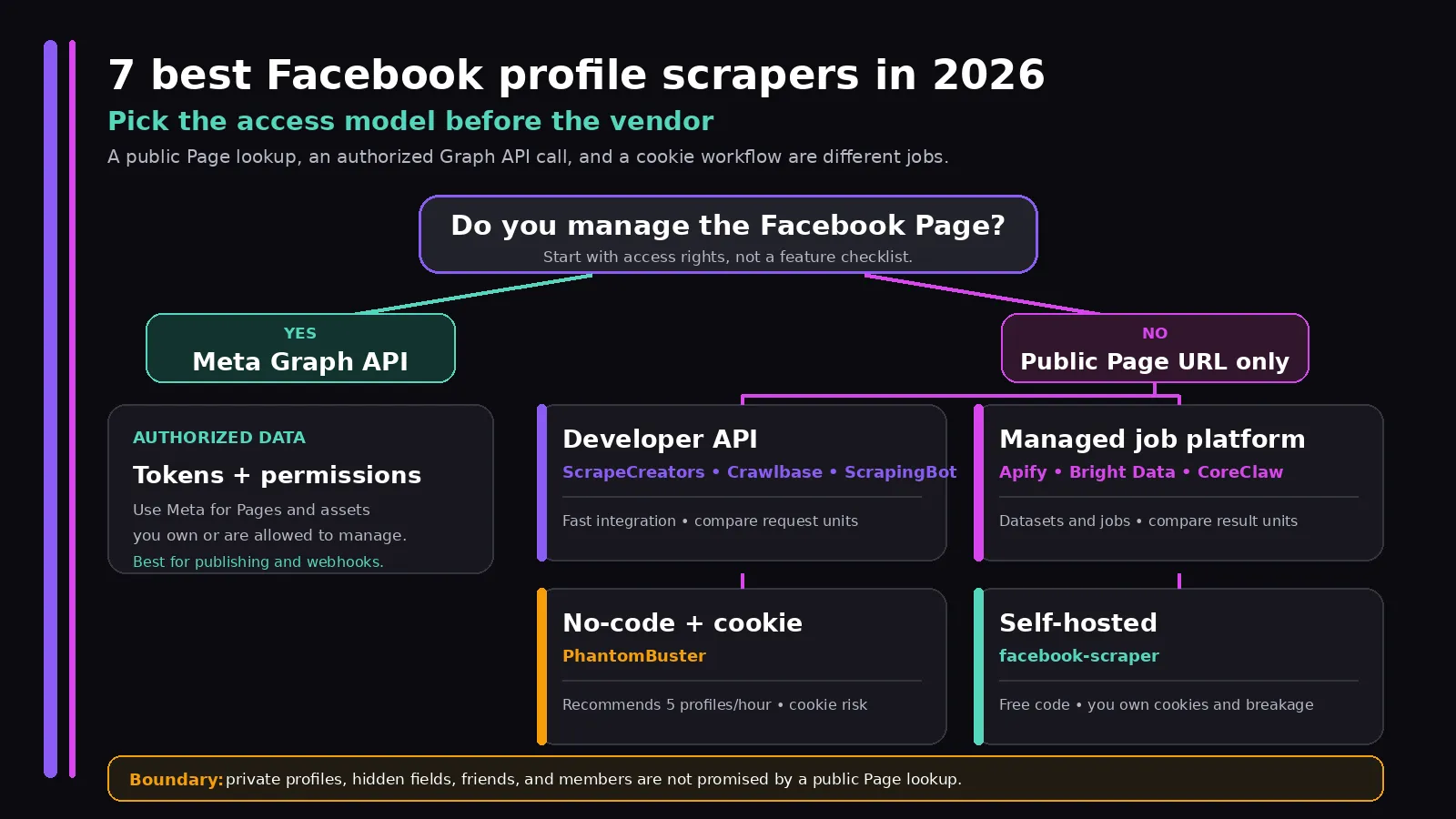
For developers who need public Facebook Page or profile fields from a URL, ScrapeCreators is the best focused Facebook profile scraper in this list. Apify and Bright Data make more sense when you want managed jobs and stored datasets. PhantomBuster is the no-code pick, but it requires a Facebook cookie and recommends a slow profile rate. If you manage the Page, start with Meta’s Graph API instead of a scraper. None of these routes should be treated as a way to retrieve private profiles or hidden fields.
I run ScrapeCreators, so my first-place recommendation comes with an obvious bias. I checked product pages, prices, and limits against primary sources on September 19, 2026. I ran four live requests through ScrapeCreators, but I did not run a controlled benchmark across all seven vendors.
Quick comparison
| Rank | Facebook profile scraper | Choose it if | Public starting point checked September 19, 2026 | Main limitation |
|---|---|---|---|---|
| 1 | ScrapeCreators | You want a focused API for public Page and profile fields from a URL | 500 credits for $10; the profile call costs 1 credit per request | It is a hosted data API, not a browser or private-profile tool |
| 2 | Apify Facebook Pages Scraper | You want Actors, runs, datasets, exports, schedules, and integrations | The Actor card lists pricing from $5.40 per 1,000 pages; Apify gives $5 of monthly platform usage free | Actor pricing and platform usage are separate things to verify |
| 3 | CoreClaw Facebook Profile Scraper | You want batch URLs, CSV/JSON, REST, webhooks, or MCP with result pricing | The worker lists pricing from $0.60 per 1,000 successful results; its free plan lists $1.50 per 1,000 | The worker page displayed a 66.34% success rate, so test your own URL mix |
| 4 | Crawlbase Facebook Scraper | You want one managed API for profiles, pages, groups, events, and hashtags | Pay as you go starts at $3 per 1,000 successful standard requests; difficulty and JavaScript multipliers can apply | A request is not necessarily one complete normalized profile |
| 5 | ScrapingBot Facebook Profile | You want Facebook profile output inside a broader social scraper catalog | Free plan has 500 API credits; Starter is EUR 22/month for 100,000 credits | The visible pricing page does not equate API credits with Facebook profile rows |
| 6 | PhantomBuster Facebook Profile Scraper | You want a no-code CSV workflow and accept using your Facebook session | Start is $56/month billed annually with 20 execution hours per month | It needs a Facebook cookie and recommends only 5 profiles per hour |
| 7 | Bright Data Facebook Scraper API | You want managed scraper jobs and record delivery for broader Facebook data | 5,000 free records per month; Scraper APIs advertise rates from $0.75 per 1,000 records | Records, requests, and complete profiles are different billing units |
These numbers are not normalized. A request, result, page, record, credit, Actor event, and execution hour buy different work. A vendor table that turns them into one neat “cost per profile” without a fixed workload is giving you false precision.
What Facebook profile scraper means in this guide
The phrase is messy. Search results mix personal profiles, public Pages, Page posts, group members, browser automations, hosted APIs, and open-source libraries.
This guide focuses on tools that can accept a public Facebook profile or Page URL and return structured public fields such as:
- stable Facebook ID and canonical URL
- name, category, bio, or Page intro
- public follower, like, rating, and talking-about counts when Facebook exposes them
- profile and cover images
- public website and social links
- business hours and public contact fields when available
A profile lookup is not a post-history scraper. It is also not a group-member exporter, a people search engine, or a private data service. If you need comments, use a Facebook comments endpoint and pagination workflow. If you need short-form video metadata, compare the dedicated Facebook Reels scrapers.
That separation matters because several ranking pages blur all Facebook data into one promise. A useful buyer guide should tell you the input shape, output fields, access method, and failure behavior for the exact job.
1. ScrapeCreators for a focused public profile API
ScrapeCreators’ Facebook Profile endpoint takes one url parameter. It returns structured public Page or profile fields without asking you to supply your own Facebook cookie. The current response can include ID, name, category, Page intro, follower count, like count, talking-about count, images, website, links, rating, address, and business hours when Facebook exposes them.
Choose ScrapeCreators if your application already has Facebook URLs and needs a simple request-response API. The same account also covers separate Facebook endpoints for posts, comments, Reels, events, groups, Marketplace, and the Ad Library. That is useful when the profile lookup is only the first step in a larger public-data workflow.
A real request looks like this:
curl --get 'https://api.scrapecreators.com/v1/facebook/profile' \
  --header 'x-api-key: $SCRAPE_CREATORS_API_KEY' \
  --data-urlencode 'url=https://www.facebook.com/Meta/'
The September 19 live response included this shape. I removed image CDN URLs to keep the example readable:
{
  "success": true,
  "id": "100080376596424",
  "name": "Meta",
  "url": "https://www.facebook.com/Meta/",
  "category": "Company",
  "pageIntro": "Connect with what you love to make things happen.",
  "website": "https://www.meta.com/connect/",
  "talkingAboutCount": 182586,
  "followerCount": 106000000
}
I tested NASA, Meta, Pace Morby, and Mantra Indian Cuisine on September 19. NASA, Meta, and Pace Morby returned HTTP 200 with structured profile fields in 3.45 to 3.89 seconds. Mantra returned a generic HTTP 500 after 1.17 seconds. That 3-of-4 fixture result is not a reliability benchmark, but it is a useful warning: test the exact mix of global brands, local businesses, personal profiles, and restricted pages you expect to process.
The pricing page lists 500 credits for $10, 2,500 for $47, 20,000 for $297, 100,000 for $1,337, and 1,000,000 for $11,337. The profile endpoint costs one credit per request. ScrapeCreators also says cached responses cost zero credits when a matching result is already in cache. Confirm the actual charge in the response rather than assuming every call was a cache hit.
The main limitation is scope. This is a public lookup. Do not choose it because you expect private personal data, complete friend lists, hidden contact details, or guaranteed availability for every URL.
2. Apify for Actors, jobs, and datasets
Apify’s Facebook Pages Scraper is the strongest relevant Apify product for this query. It accepts one or more Facebook Page URLs and returns Page details plus optional posts, reviews, and related output. You can run it in Apify’s console or call the Actor through an API, then keep results in datasets and export them.
Choose Apify if the Actor model already fits your stack. Runs, schedules, datasets, integrations, and a large marketplace are the attraction. The product page says profile details can include title, URL, Facebook ID, verification status, likes, followers, categories, address, phone, email, website, creation date, and business hours when available.
The pricing deserves a careful read. The current Actor card displays “from $5.40 / 1,000 pages,” while descriptive copy lower on the same page still says $10 per 1,000 pages. Treat the live pricing card and run estimate as the working source, then check the price shown in your account before a large job. Apify also gives $5 of monthly platform usage free, but platform usage is not the same thing as unlimited Actor results.
The other caveat is ownership. Apify is a marketplace, so schemas, billing events, support, and maintenance vary by Actor. The generic “Scrape Facebook profiles” landing page that ranks for this query points back to Facebook Pages Scraper. Inspect the actual Actor, not only the SEO wrapper.
3. CoreClaw for result-priced batch runs
CoreClaw’s Facebook Profile Scraper accepts one or more profile URLs and exports CSV or JSON. Its page also lists REST API, callback webhooks, MCP, and eight export formats. That is a useful middle ground for people who want a job runner but do not need the breadth of Apify’s marketplace.
Choose CoreClaw if successful-result pricing and batch exports matter more than a minimal synchronous API. The page lists names, bios, avatars, cover photos, work, education, location, verification, follower counts, public email, and website fields. It says invalid, private, or otherwise unreachable links produce no row.
The current worker card says “from $0.60/1,000 successful results.” CoreClaw’s pricing page shows that rate on the $199/month Business plan, while the free plan starts at $1.50 per 1,000 and pay as you go starts at $0.90 per 1,000. Keep those plan conditions attached to the number.
There is one unusually useful disclosure on the worker page: it showed a 66.34% success rate and an August 14, 2026 update date when I checked it. That does not predict your workload, but it is a reason to run a representative batch before committing.
4. Crawlbase for one API across Facebook objects
Crawlbase’s Facebook Scraper puts profiles, Pages, groups, events, and hashtags behind the same managed API. Its profile route says it can return a public profile’s name, bio, friend count, about details, and photos. The Page route has a different schema for audience counts, business hours, posts, images, and related Pages.
Choose Crawlbase if you want one crawling account that can switch among several Facebook object types. This is particularly useful when your pipeline starts with a URL classifier and routes each object to a specialized scraper.
Pay-as-you-go pricing starts with the first 1,000 successful requests at $3 per 1,000, then falls through graduated volume brackets. Crawlbase bills only successful requests, but site-difficulty and JavaScript-rendering multipliers can increase credit use. Its pricing page labels JavaScript rendering as 2x and lists site-difficulty multipliers from 1x through 20x.
The limitation is that a successful crawl request and a normalized profile row are not automatically equivalent. Verify the exact scraper parameter, output shape, and multiplier for Facebook instead of applying the base rate to every job.
5. ScrapingBot for a social scraper catalog
ScrapingBot’s Facebook Profile API shows a structured JSON example with profile identity, visibility, type, followers, posts, reactions, comments, photos, intro, websites, following, and a timestamp. It sits in a broader catalog of social-media and general web scraping APIs.
Choose ScrapingBot when you want several scraper products under one credit plan and its Facebook output matches your data model. The page is unusually concrete about the returned JSON, which makes schema review easier before signup.
The monthly pricing page lists 500 credits on Free, EUR 22 for 100,000 credits on Starter, EUR 45 for 250,000 on Pro, EUR 102 for 750,000 on Growth, and EUR 171 for 1.5 million on Business. Do not read those numbers as profiles. The visible page does not say how many credits a Facebook profile request consumes, and social APIs may have a different multiplier than basic HTML requests.
The sample response also includes posts and comments, which may be more output than a profile-only job needs. Ask whether you can control that depth because extra records can change latency, cost, and storage.
6. PhantomBuster for no-code cookie-based workflows
PhantomBuster’s Facebook Profile Scraper is the clearest no-code option in this list. You connect Facebook through its browser extension, provide one or more profile URLs, run the Phantom in the cloud, and export results.
Choose PhantomBuster if a marketer or operations team wants CSV output and chained automations without writing API code. Its page says it can collect available public profile details such as name, profile URL, location, education, work, interests, and public contact fields.
The tradeoff is your session. PhantomBuster lists a Facebook cookie as an input. It recommends a maximum of 5 profiles per hour and warns that moving faster can require more frequent cookie updates. It also notes that Facebook may ask you to confirm your identity when the cloud session appears from a different location.
The Start plan was $56/month billed annually with 20 execution hours, five automation slots, and unlimited exports on September 19. Trial exports are limited to 10 rows. That is an execution-time subscription, not a price per profile.
This route fits a slow, human-operated lead workflow better than a high-throughput backend service. Use a dedicated approved account and understand the platform and privacy risk before handing any session cookie to an automation provider.
7. Bright Data for record delivery at larger scale
Bright Data’s Facebook Scraper API covers posts, profiles, Pages, comments, Reels, events, and Marketplace listings. Its page is organized around managed scrapers and delivered records rather than one tiny endpoint.
Choose Bright Data when your team wants larger managed jobs, delivery options, and broad data-acquisition infrastructure. The Facebook page advertises 5,000 free records per month with no credit card. Bright Data’s pricing navigation lists Scraper APIs from $0.75 per 1,000 records.
That price is a starting rate across Scraper APIs, not a promise that every Facebook profile costs $0.00075. One input can yield several records, and different Facebook scrapers return different units. Get a quote or run estimate for your exact scraper, volume, and delivery mode.
Bright Data is probably more platform than a small developer needs for occasional lookups. It becomes more attractive when Facebook profiles are one feed inside a broader enterprise data pipeline.
When Meta’s Graph API is the better answer
Use Meta’s Graph API first when you manage the Page or asset and can obtain the required token and permissions. Meta describes Graph API as the primary way apps get data into and out of Facebook. It uses nodes, edges, and requested fields, and almost all endpoints require an access token.
That is a different access model from sending an arbitrary public URL to a scraper. Graph API is the right route for authorized app data, Page management, publishing, webhooks, and workflows where consent and permissions are part of the product.
It is not a free public people-search API. Access depends on the object, token, app mode, permissions, version, and review requirements. If your product claim is “paste any public Page URL,” test that claim separately from an authorized /me or managed-Page flow.
The self-hosted option
The MIT-licensed facebook-scraper Python project can extract public Page posts and has a get_profile function for about-section data. It had about 3,292 GitHub stars when checked, but its repository’s last push was June 22, 2024 and it had 446 open issues on September 19, 2026.
Choose it when free code and local control matter more than maintenance time. The README documents optional credentials and cookies, warns that fields may be None, and says Facebook may temporarily ban an IP if you scrape too much.
That makes it useful for experiments and teams that can repair parsers. It is a poor fit when a nontechnical team expects a support contract and stable production schema.
What builders actually ask for
The public research was more useful than generic “best scraper” pages.
I searched YouTube in a US context for facebook profile scraper, best facebook profile scraper, facebook profile scraping tool, and facebook profile scraper api. Those four searches returned 79 rows and 77 unique videos. I read six available English transcripts, including tutorials about Apify Actors, PhantomBuster, browser automation, Python libraries, and Facebook profile APIs. I also reviewed 124 unique top/new YouTube comments and 19 fetched reply rows.
The recurring questions were practical:
- Does the workflow need a login cookie?
- Does it work for Pages, personal profiles, or both?
- Can it process a list of URLs rather than one profile?
- Can the result go to CSV, Google Sheets, n8n, Make, or an API?
- Can it return posts as well as top-level profile fields?
- What happens when Facebook changes the page or blocks the session?
Several older tutorials still showed flows that depend on browser sessions, Graph API tokens, or HTML selectors. That pushed me to make the access model the first decision in this guide instead of burying it in each vendor section.
I also searched Reddit, TikTok, and LinkedIn through ScrapeCreators. Reddit returned 78 rows across four searches, with 76 unique posts. I fetched four relevant Reddit threads and read 38 top-level comments plus 23 nested reply items. Builders repeatedly described a familiar tradeoff: official API access can be narrow or permission-heavy, while page scraping creates maintenance, cookie, proxy, and account-risk work.
TikTok returned 52 rows across two searches and 45 unique videos, while LinkedIn returned 56 unique posts across two searches. Those results were noisier and included vendors promoting their own workflows. I used them as qualitative evidence about integration demand, not as proof that any tool ranks better or works more reliably.
How to evaluate a Facebook profile scraper
Run the same fixture set through every finalist. A useful test has at least these groups:
- a global public Page
- a local business Page with hours and an address
- a creator or public-figure profile
- a Page with a custom username
- a numeric
profile.php?id=URL if you expect it - a restricted, unavailable, or private input
- a malformed URL
Score the output field by field. Do not stop at HTTP 200. Check canonical ID, name, Page type, counts, URL, images, website, address, hours, and explicit status classification. A clean private or not found result is more useful than a success envelope full of nulls.
Then measure cost using one fixed workload:
complete usable profiles
÷
(total vendor cost + proxy cost + runtime + failed retries + engineering time)
That denominator is why the advertised units in the comparison table cannot be compared directly.
For production, record response time, retries, empty 200s, field drift, and failures by input class. Pin the fields your application needs and alert when their types change. Images and other CDN URLs can expire, so store only what your use case and policy allow.
Limitations and responsible use
Public does not mean consequence-free. Confirm that your use complies with Facebook’s terms, applicable law, your vendor’s terms, and the privacy expectations around the people or businesses in the data.
Do not use these tools to promise private-profile access, defeat access controls, collect sensitive hidden fields, or build harassment and discrimination workflows. Collect the minimum data you need. Set retention limits. Protect API keys, tokens, cookies, and exported files.
Facebook output also changes. Counts can be abbreviated or stale, fields can disappear by country or profile type, and a public Page can become restricted. No vendor can make a source field exist when Facebook does not expose it.
The honest choice is usually simple:
- Use Meta’s Graph API for authorized Pages you manage.
- Use a hosted URL-to-JSON API for public Page lookups in an application.
- Use a managed job platform for larger datasets and delivery workflows.
- Use no-code cookie automation only when its slow, session-based operating model is acceptable.
- Self-host only when your team wants to own breakage.
Sources checked
I checked these primary sources on September 19, 2026:
- ScrapeCreators Facebook API, Facebook Profile documentation, pricing, and current backend route behavior
- Apify Facebook Pages Scraper and profile-scraper landing page
- CoreClaw Facebook Profile Scraper and pricing
- Crawlbase Facebook Scraper and pricing
- ScrapingBot Facebook Profile and pricing
- PhantomBuster Facebook Profile Scraper and pricing
- Bright Data Facebook Scraper API
- Meta Graph API overview
facebook-scraperon GitHub- Audience research from six YouTube transcripts, including Apify’s Facebook profile tutorial, a Facebook profiles and Pages automation walkthrough, and a Python scraper tutorial
- Reddit discussions about reliable Facebook Page scraping, profile and post collection, and official API access limits
You can check the live ScrapeCreators endpoint documentation, see current pricing, or create an account before building your fixture test.