
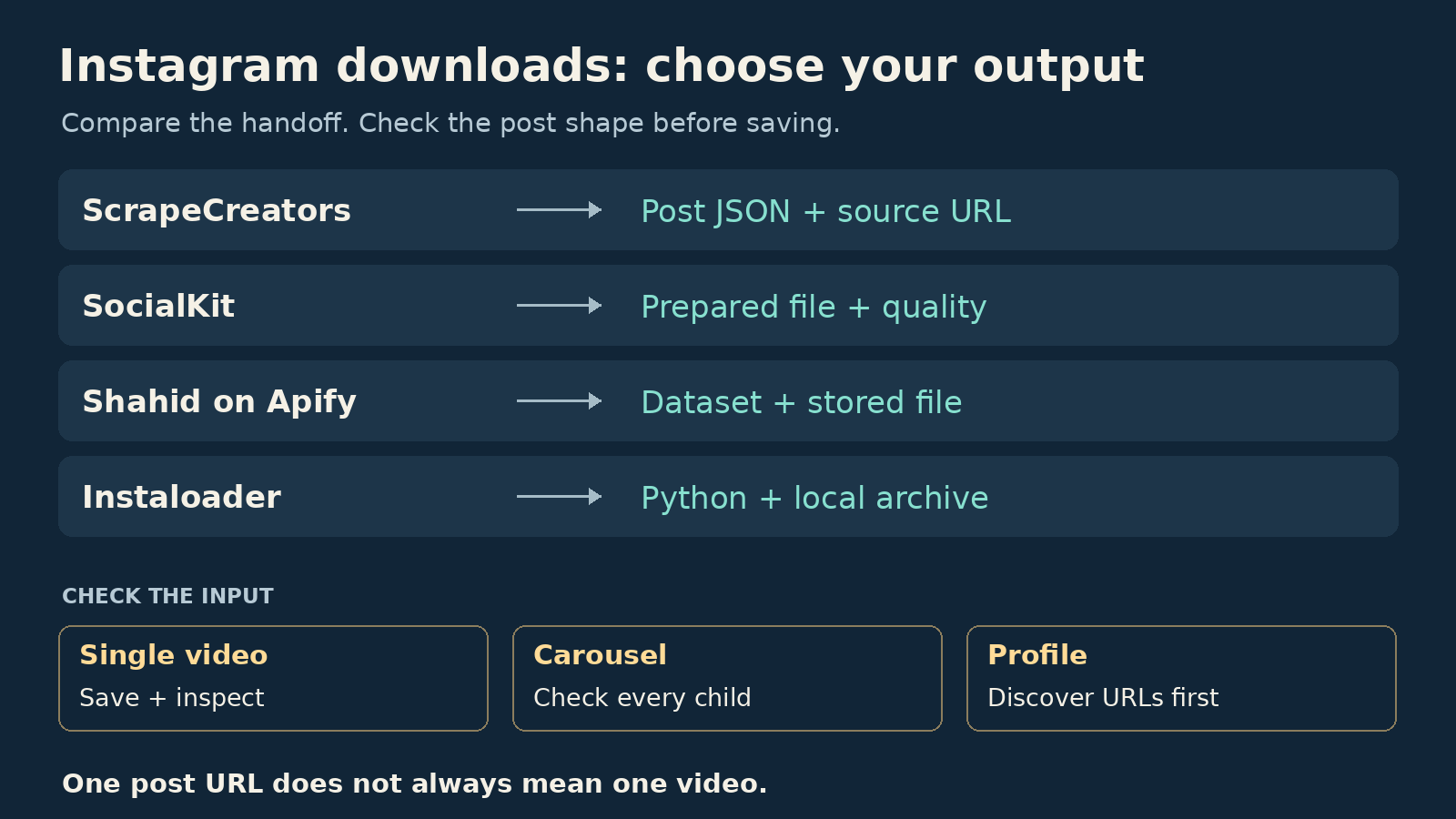
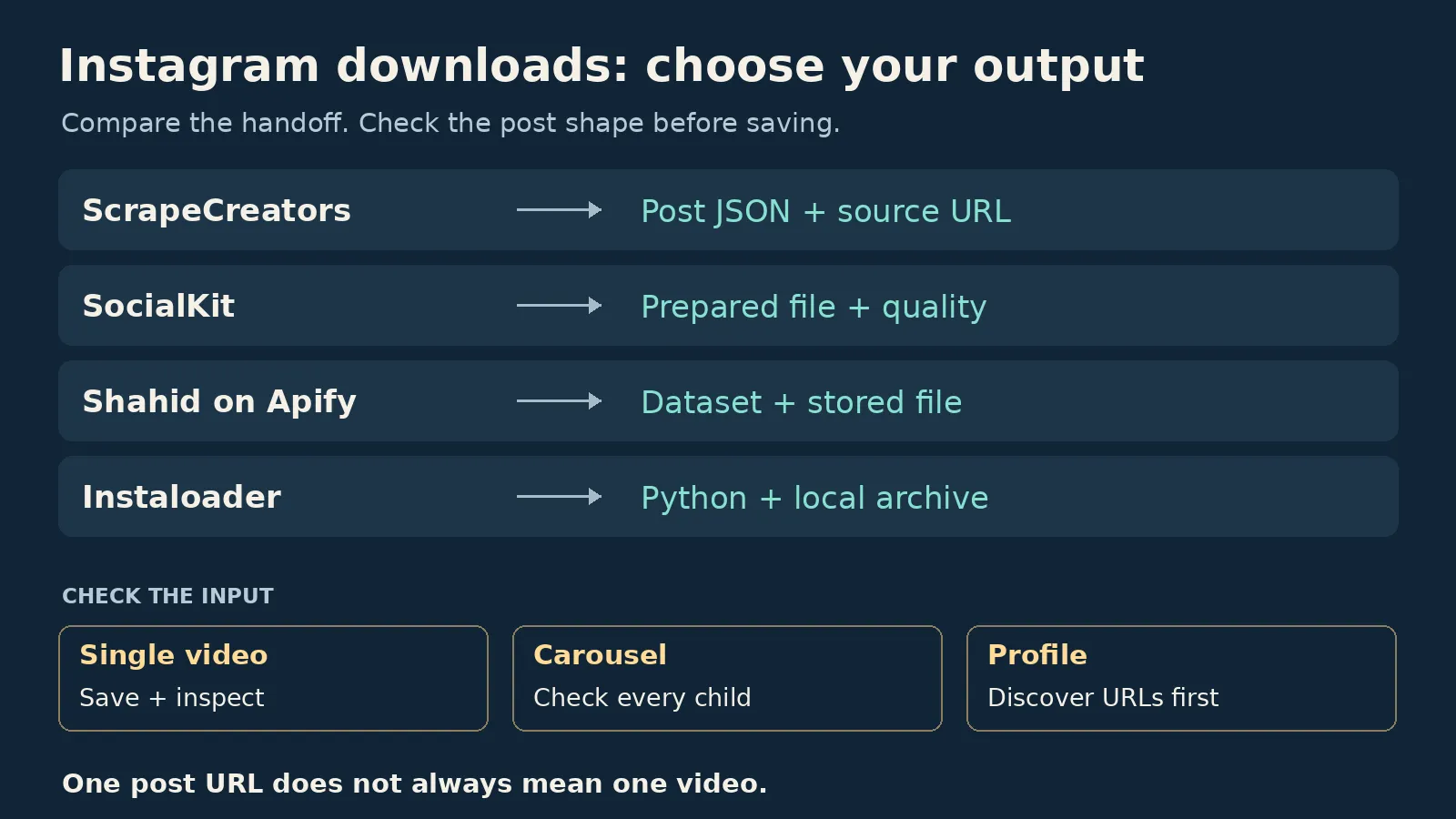
For an Instagram video downloader API, choose ScrapeCreators if you want public-post metadata and a source video URL in your own pipeline. Choose SocialKit if you want a prepared file, format conversion and a minimum-quality setting. Choose Shahid Irfan’s downloader on Apify if you prefer batch jobs with datasets and stored files. Choose Instaloader if you want a Python library you operate yourself, rather than a hosted REST API.
Start with the input: one Reel, a carousel and an entire profile are different jobs. A service that downloads one video has not necessarily exported every item in a post.
I run ScrapeCreators. I checked the linked sources and prices on November 26, 2026. I ran the Python example below and inspected the saved MP4. I did not execute competing paid services or benchmark Instaloader.
Pick the output you need
| Option | Actual handoff | Billing unit | Choose it for |
|---|---|---|---|
| ScrapeCreators | Post JSON and an available source video URL; optional hosted-media output | Normally 1 credit for live post details; hosted-media option has separate pricing | Adding public media and metadata to an application |
| SocialKit | A prepared download URL, or a job that reports measured output quality | Credits per started minute, with a higher HD tier | Conversion and explicit minimum-quality requirements |
| Shahid Irfan on Apify | Dataset records plus files in the run’s Key-Value Store | This Actor is pay per usage, not a fixed price per video | A supplied list of URLs, scheduled jobs and dataset workflows |
| Instaloader | Files and metadata on infrastructure you control | Open-source software; your compute, transfer, storage and maintenance | A customizable Python archive or collection script |
An API credit, a billable minute and an Actor’s platform usage are not the same unit. Compare the work completed, including the transfer, before comparing the bill.
This article is about choosing a provider after you have an Instagram post URL. Our Instagram scraper comparison covers broader collection choices. The Instagram scraping guide covers profiles, posts and collection workflows. Use those when discovery and collection, rather than file delivery, are your main job.
1. ScrapeCreators for source media and public metadata
The Instagram API fits an app that needs the source record beside its video: media ID, shortcode, creator, caption and available public metadata. The post endpoint accepts a post or Reel URL. For a single video, the useful field is video_url on xdt_shortcode_media.
That URL is a source-media handoff. Your application still retrieves the bytes and decides where to store them. Do not save only the CDN link and treat it as a permanent archive.
The current endpoint also accepts download_media=true. Its documentation describes hosted video/image URLs at 10 credits total when media is found, 1 credit otherwise. I did not run that option here. The executed example uses the ordinary source URL, so it does not establish hosting lifetime, upload performance or complete carousel coverage.
Normal live post retrieval costs one credit. Requests actually served from cache cost zero. Prepaid pricing starts at $47 for 25,000 credits, without a subscription. You can create an account to get an API key and try the request below. The purchase buys API credits, not 25,000 verified local video files. Your own transfer, storage and any failed ingestion work are separate.
For a downloader that does not need play counts, the documented include_play_count=false option skips that additional metric lookup. The example also sets trim=true. On the live response I received, the trimmed media object was at top-level xdt_shortcode_media, rather than under the data wrapper shown in some reference examples. The code below follows that observed body.
Choose ScrapeCreators if you want public metadata and media URLs through one API and already control file ingestion. Choose SocialKit instead if the service must convert to MP3 or enforce a minimum delivered resolution. This post endpoint is not a user-selectable 1080p transcoding service, and it does not unlock private posts.
2. SocialKit for a prepared file and a quality floor
SocialKit’s Instagram download API accepts a URL, output format and quality. The synchronous endpoint documents a prepared downloadUrl, file size and a one-hour signed-link lifetime, with a 30 MB file limit. Its default video target is 480p.
There is an important Instagram-specific restriction: the synchronous video downloader does not choose an item from a mixed carousel. The current docs say a confirmed mixed carousel containing video returns HTTP 422 without a charge, as does a verified photo-only post. A post that contains a video is not automatically an accepted single-video input.
For longer or larger media, the v2 async API supports Instagram jobs, a 2 GB file limit and video up to 1080p. Submit once, retain jobId, and poll for data.status. HTTP 200 from a status lookup can still describe a failed job.
V2 separates requestedQuality from measured quality, width and height. A useful editing setup is a 1080p target with min_quality=720p. According to its quality guide, output below the minimum fails without charging rather than being enlarged to satisfy the setting. Quality follows the shorter dimension for portrait and landscape files.
Current v2 billing is 1 credit per started minute for audio or the lower video tier, and 4 credits per started minute when both requested and delivered video qualify for HD. Failed jobs and repeated status polls use zero credits. A new successful job has its own charge even if it reuses a cached file; polling an existing paid job refreshes access to that same file without charging again.
SocialKit’s pay-as-you-go pricing currently lists $30 for 3,000 credits, $49 for 15,000, or $249 for 150,000. Those pack credits do not expire and do not require a subscription. Monthly subscriptions are also available. Do not compare the pack’s credit count directly with ScrapeCreators’ request count: the completed video’s duration and quality determine SocialKit’s usage.
Choose SocialKit if conversion and measured output matter more than a detailed post record. Check the current Instagram restrictions before choosing it for carousels; the documented single-video route is not an album exporter.
3. Shahid Irfan on Apify for supplied-URL batch jobs
Apify is a marketplace, so choose an exact Actor rather than assuming every Instagram downloader works alike. Shahid Irfan’s Instagram Video Downloader documents direct post, Reel, IGTV and story URL inputs, structured Dataset output, and downloaded files in the run’s Key-Value Store.
Its short marketing description mentions entire profiles. The detailed README and current input schema say profile and hashtag discovery are not supported. For planning, use the narrower input contract: supply the media URLs yourself.
The urls input is an array. downloadMode selects videos or metadata_only; quality supports best, 720p, 1080p or audio_only. maxItems defaults to 10 supplied URLs, with zero documented as processing all supplied URLs. That is a real batch-default check, not a guarantee that all videos in a profile will be discovered.
The README says image and carousel posts have no video-file output in this workflow and recommends metadata-only collection for their captions, counts and thumbnails. It also documents per-URL error records while other URLs continue. Reconcile successful file records against your submitted list; a completed run or an exported CSV does not mean every source produced an MP4.
This Actor’s pricing page currently says pay per usage. Apify’s platform pricing explains that this model bills compute, transfer, storage and applicable proxies. The Free plan includes $5 of platform usage; Starter is $19 per month plus overage. Apify also documents a separate accountless agent-payment route. A subscription is not the only way to try or access its platform, and this Actor does not publish a universal cents-per-completed-video price.
Choose this Actor if you already work with Apify runs, schedules and datasets. Choose a simpler request/response API if you do not need that workflow. Public stories and restricted content can require an authorized session under the Actor’s documented access rules. Do not interpret that as a private-content bypass or as support for the same inputs in every competing service.
4. Instaloader for Python and a local archive
Instaloader is an open-source Python downloader, not a hosted API subscription. Its Python interface exposes download and metadata methods, and its command-line tool can maintain a local archive.
The usage guide documents individual-post shortcodes, profile downloads, Reels, filenames and metadata files. It also documents --fast-update and --latest-stamps for recurring archive work. If your buyer question is actually “how do I keep my own archive current?”, that is a different fit from receiving one signed download link.
You own the operational work: deployment, file paths, storage, session handling, request pacing and error review. An HTTP service around the library would be your service, not an official hosted Instaloader REST endpoint.
Be careful with quick video filters. Instaloader’s guide explicitly says sidecar posts have is_video=False at the parent level even when they contain videos. Filtering only on the parent’s video flag can discard the carousel you meant to save. Enumerate the children when the job includes mixed posts.
Its troubleshooting guide explains request accounting, 429s and login-related limits. “Open source” does not mean unlimited collection or guaranteed anonymous access to every public-looking page. Some targets need a valid session, and the session must actually have access.
Choose Instaloader if Python customization and archive control are worth the maintenance. Choose a hosted provider if you want someone else to own retrieval changes. I reviewed the current documentation but did not run an Instaloader collection for this article.
An executed one-Reel download
This standard-library Python example saves one public Reel and a receipt. Set SCRAPE_CREATORS_API_KEY in your environment first. It deliberately rejects a non-video parent instead of pretending to export an entire carousel. The 50 MiB cap is an example safeguard, not a ScrapeCreators endpoint limit.
import hashlib
import json
import os
from pathlib import Path
from urllib.parse import urlencode
from urllib.request import Request, urlopen

source_url = "https://www.instagram.com/reel/DcMXl1IPNtB/"
shortcode = "DcMXl1IPNtB"
params = urlencode({
    "url": source_url,
    "trim": "true",
    "include_play_count": "false",
})
request = Request(
    "https://api.scrapecreators.com/v1/instagram/post?" + params,
    headers={"x-api-key": os.environ["SCRAPE_CREATORS_API_KEY"]},
)
with urlopen(request, timeout=40) as response:
    payload = json.load(response)
# The trimmed live response places this object at the top level.
media = payload.get("xdt_shortcode_media") or {}
if payload.get("success") is not True or media.get("shortcode") != shortcode:
    raise RuntimeError("Request failed or returned a different source")
if media.get("is_video") is not True or not media.get("video_url"):
    raise RuntimeError("Expected one video; handle carousel children separately")

filename = Path(shortcode + ".mp4")
partial = filename.with_suffix(".part")
size_limit = 50 * 1024 * 1024  # Example safeguard, not an API limit.
size = 0
hasher = hashlib.sha256()
try:
    # Do not forward the ScrapeCreators API key to Instagram's CDN.
    with urlopen(media["video_url"], timeout=40) as stream:
        content_type = stream.headers.get_content_type()
        if not content_type.startswith("video/"):
            raise RuntimeError("CDN did not return a video response")
        with partial.open("wb") as output:
            while chunk := stream.read(1024 * 1024):
                size += len(chunk)
                if size > size_limit:
                    raise RuntimeError("Example file-size safeguard reached")
                output.write(chunk)
                hasher.update(chunk)
    if size == 0:
        raise RuntimeError("Empty media response")
    partial.replace(filename)
except Exception:
    partial.unlink(missing_ok=True)
    raise

receipt = {
    "source_url": source_url,
    "shortcode": media["shortcode"],
    "media_id": media["id"],
    "api_credits_charged": payload.get("credits_charged"),
    "source_has_audio": media.get("has_audio"),
    "saved_file": str(filename),
    "bytes": size,
    "content_type": content_type,
    "sha256": hasher.hexdigest(),
}
Path(shortcode + ".receipt.json").write_text(json.dumps(receipt, indent=2))
print(json.dumps(receipt, indent=2))
On November 26, the exact script retrieved public NASA Johnson Reel DcMXl1IPNtB, matching media ID 3966649126543481665, and saved 5,862,095 bytes as video/mp4. The API charged 1 credit. An independent ffprobe inspection found 720 × 1280 H.264 video and an AAC audio stream, with container duration 50.315 seconds.
The response’s has_audio=true was source metadata. The separate file inspection established that an audio stream was present in the downloaded file. Neither check establishes that every second is audible, that every frame has a particular quality, or that all Instagram URLs work.
A second example URL copied from the API reference returned 404 and zero credits during the same run. That is why I would not turn this one successful file into a reliability percentage or a promise about every older post. No paid competitor download, hosted-media upload, bulk export or full-profile archive was executed.
Check the post, the file and the batch separately
The Munch Dine tutorial and its discussion offer a useful caution: an initial missing-audio report was corrected by the same commenter, who said the editor was not playing the audio. A playback problem is not automatically a missing track. Inspect the actual file before blaming retrieval or promising a fix.
Questions in this public bulk-Reels discussion also separate “all Reels” from “one combined audio/video file.” They are different acceptance checks. Public comments are qualitative questions, not proof of any provider’s current performance.
Before increasing volume, use a small acceptance checklist:
- Identity: preserve the submitted URL, returned shortcode and media ID. Treat a mismatch as an error, even if bytes download.
- Post shape: distinguish a single video, still image and mixed carousel. Record the child index for any extracted carousel item.
- Transfer: save to a temporary file, reject empty or non-video responses, then rename only after the transfer finishes.
- Media: inspect dimensions, duration and stream types. Keep requested quality separate from measured quality.
- Completeness: reconcile every submitted URL with a file, a deliberate skip or a useful error. A dataset row can describe failure.
- Continuity: retain receipts and job IDs so retries do not silently create duplicate files or new paid jobs. Store bytes when long-term access matters.
That receipt is the comparison unit I would take into a trial: one identified source, one explicit outcome, and enough evidence to know what arrived.
Frequently asked questions
What is the best Instagram video downloader API?
Choose ScrapeCreators for public metadata and source media URLs, SocialKit for prepared files and minimum-quality requirements, or Shahid Irfan’s Apify Actor for supplied-URL batch jobs and stored-file records. Choose Instaloader when you want a Python library and local archive rather than a hosted REST API. The best fit depends on who should complete and maintain the download.
Can an Instagram download API export every video in a carousel?
Do not assume it. SocialKit’s synchronous video route documents mixed-carousel rejection, and the reviewed Apify Actor recommends metadata-only mode for carousel posts. A raw post response can expose child media, but your workflow must enumerate and verify those children. The executed example here downloads one Reel, not a carousel export.
Does requesting 1080p guarantee an original-quality Instagram video?
No. A target resolution does not establish the source’s original upload quality. SocialKit v2 documents measured output fields and an optional minimum; the reviewed Actor records its requested and downloaded formats. Inspect the saved file and keep target quality separate from delivered dimensions. The ScrapeCreators example produced a 720 by 1280 file, not a 1080p guarantee.
Is Instaloader a free hosted Instagram downloader API?
No. Instaloader is open-source Python software that you run. You pay for your infrastructure and maintenance, and some collection targets require a valid Instagram session. You can build a REST service around it, but then you also own that service’s authentication, queue, storage and request handling.