
The quick answer
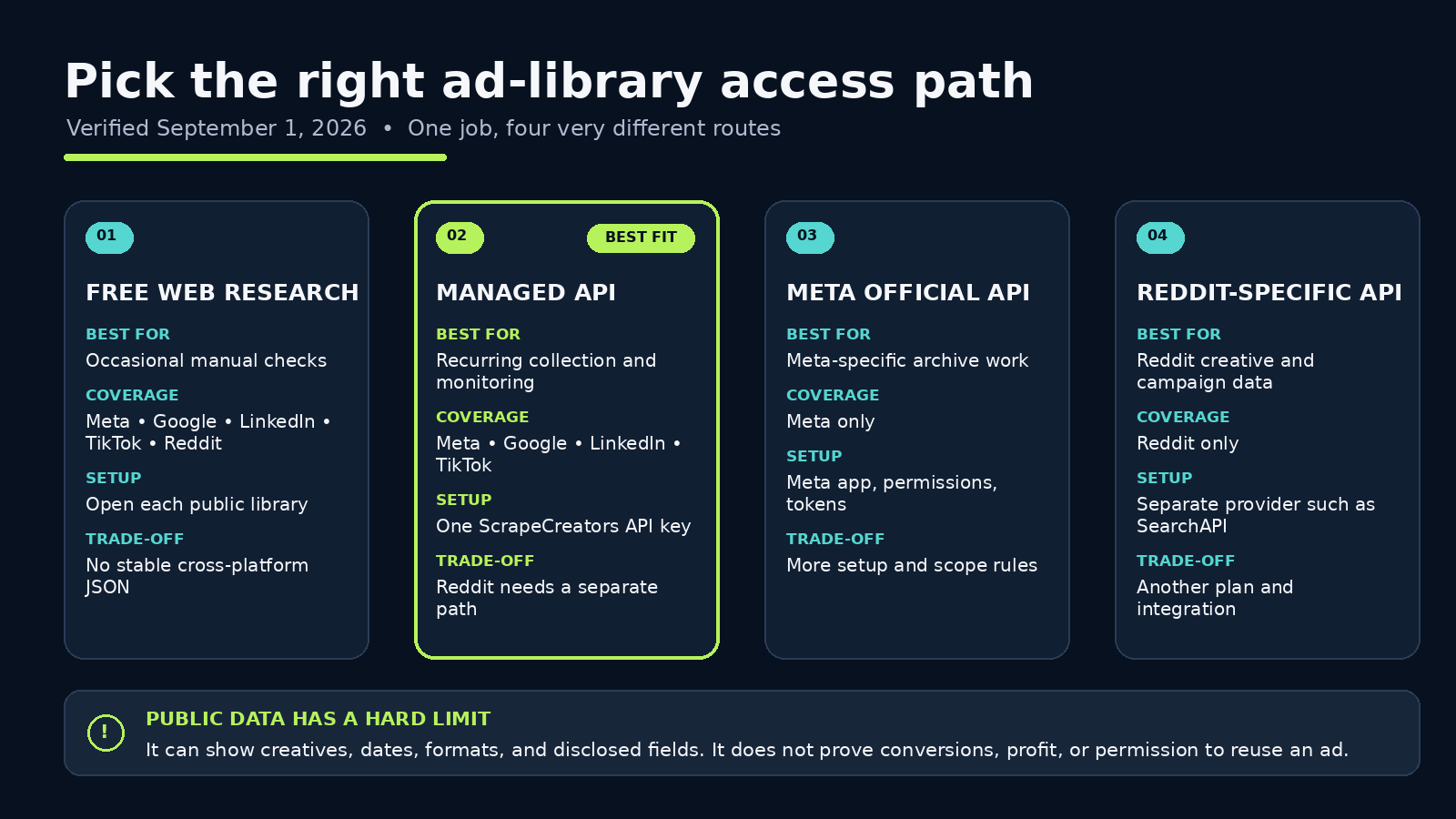
If you need public ad data in code, use the free libraries for occasional research and a managed API for recurring collection. ScrapeCreators is the simplest fit when one workflow needs Meta, Google, LinkedIn, and TikTok. It does not currently expose Reddit Ad Library data, so Reddit needs its public library or a separate provider. Meta’s official API is still the right choice when you specifically need Meta’s supported archive interface and can handle its app, permission, and token setup.
I run ScrapeCreators, so that recommendation comes with an obvious bias. The access, prices, endpoint behavior, and limitations below were checked on September 1, 2026.
Decision table
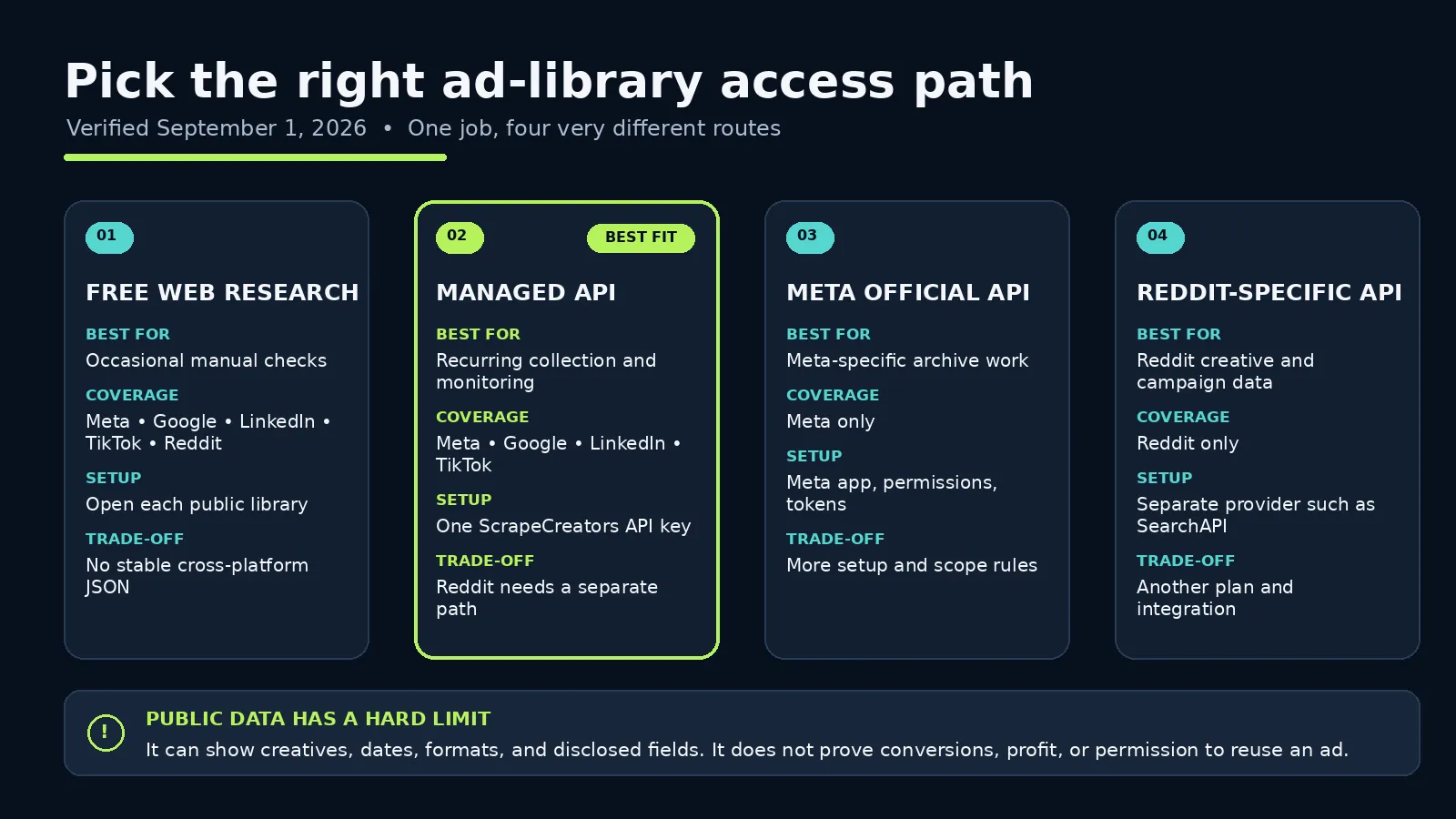
There is no universal “best” ad library API. The best option depends on whether you are doing a one-off creative review, building a monitoring job, working only with Meta, or collecting Reddit ads.
| Access path | Best for | Platform coverage | Setup | Current cost checked September 1, 2026 | Main limitation |
|---|---|---|---|---|---|
| Public browser libraries | Occasional manual research | Meta, Google, LinkedIn, TikTok, Reddit | Open each platform’s library | Free | Manual work and no stable cross-platform JSON |
| ScrapeCreators | Recurring collection, databases, alerts, and agents | Meta, Google, LinkedIn, TikTok | One API key | 100 free credits; $47 for 25,000 credits; most endpoints use 1 credit | No Reddit Ad Library endpoint today |
| Meta’s official Ad Library API | Meta-specific archive projects | Meta | Meta app, permissions, verification, and token management | No per-request fee published by Meta | More setup, plus Meta’s current archive scope and access rules |
| SearchAPI Reddit Ad Library API | Programmatic Reddit creative research | Separate SearchAPI account | Developer plan is $40/month for 10,000 searches | Another plan and integration for one platform |
The prices are not perfectly comparable. ScrapeCreators sells credits across more than 37 APIs, and some expensive endpoints use more than one credit. SearchAPI prices successful searches on a monthly plan. Free public libraries cost no money, but repeated manual collection has a real labor cost.
What the data can prove
An ad library API can usually answer questions such as:
- Which public creatives did an advertiser run?
- When was an ad first and last shown?
- Was it an image, video, carousel, or text ad?
- What copy, call to action, destination URL, and public media did the platform expose?
- Which countries, targeting fields, or impression ranges were publicly disclosed?
It usually cannot tell you whether the ad made money.
That distinction matters because a long-running ad is a clue, not a conversion report. Public libraries generally do not expose ordinary commercial ads’ CTR, CPA, ROAS, profit, or complete spend. In the YouTube comments reviewed for this update, people repeatedly asked for likes, comments, spend, reach, CTR, and exact targeting. Those fields are either unavailable, limited to specific disclosure regimes, or different by platform.
Public media URLs also do not grant permission to reuse an ad. One video comment asked whether a downloaded competitor video could be republished. The safe answer is no, not without permission or another valid legal basis. Use public creatives for research, classification, and inspiration. Do not treat the library as a stock-media catalog.
Platform-by-platform access
Meta: the most mature choice, with two very different routes
Meta has both the public Ad Library and an official Ads Archive API reference. The official route makes sense when your work fits Meta’s documented archive scope and you are comfortable managing a Meta app, permissions, verification, and tokens.
That setup is a real constraint. Recent public questions include delayed identity verification, missing ads_read permission, expiring user tokens, country mismatches, and invalid-parameter errors. Those are not reasons to avoid the official API, but they are reasons to budget for authentication and maintenance rather than treating it like an anonymous endpoint.
ScrapeCreators’ Meta Ad Library API is the managed route. It can search ads by keyword, retrieve a company’s ads, search companies, return one ad by ID, and fetch video transcripts when available. The search response includes public creative data, dates, active status, platform placement, media, and cursor pagination.
If Meta is your only platform and official access is mandatory, use Meta’s API. If you want JSON quickly or need the same account for other platforms, use the managed endpoint.
For a deeper Meta-only comparison, read the Facebook Ad Library scraper guide.
Google: useful public data, but not a simple public API
Google’s Ads Transparency Center lets people search verified advertisers and view their ads. Google’s advertiser-verification documentation says the center provides context about an advertiser and its ads, including the advertiser name, location, name-change history, and dates and locations where ads served.
I could not find a general public Ads Transparency Center API in Google’s current help or developer documentation on September 1, 2026. ScrapeCreators fills that gap with a managed Google Ad Library API.
The company-ads endpoint accepts a domain or advertiser ID plus optional region, date, platform, format, and political-topic filters. A basic request costs 1 credit and returns advertiser and creative IDs. Setting get_ad_details=true costs 25 credits and requests the richer creative details. Only public ads are available, and some ads require a Google login that the endpoint cannot access.
LinkedIn: strong filters and a clear retention window
LinkedIn’s official Ad Library help page says the browser library can search by company or advertiser name, keyword, country, and date range. Ads remain in the library for one year after their last impression. For ads targeted to the European Union, LinkedIn also shows extra targeting, impression, and run-date information.
Its separate targeting and impressions reference documents fields such as language, job, education, company, location, audience, age, and gender targeting. It also notes that EU impression totals are estimates and country shares are rounded.
The managed LinkedIn Ad Library API accepts company, keyword, or companyId, with optional country and date filters. Results can include creative text and media, advertiser data, ad type, disclosed targeting, impression fields, and a pagination token.
TikTok: now part of the managed multi-platform route
TikTok has a public Ads Library. ScrapeCreators also has a TikTok Ad Library API that searches by general query or advertiser name. It resolves advertiser names, returns public ad URLs and creative fields, and uses an opaque cursor for pagination.
This matters because the old version of this article covered Meta, Google, LinkedIn, and Reddit but missed TikTok’s current programmatic route. In a live check on September 1, 2026, an advertiser-name request for Gymshark returned 12 public ads and a cursor.
The social research was noisy here. Relevant TikTok posts focused more on using ad libraries for creative research and AI-assisted workflows than on API contracts. Comments also showed a common trap: people jump from “I can see the creative” to “I can reuse the creative.” Those are different rights questions.
If your workflow needs public posts and profiles too, compare the wider options in the best social media scraping APIs.
Reddit: good public research, separate API path
Reddit’s official Ads Inspiration Library is the free browser route. ScrapeCreators does not currently have a Reddit Ad Library endpoint.
If Reddit coverage is required in code, a specialist provider is the honest recommendation. SearchAPI documents a reddit_ad_library engine that can search by keyword and return public creative media, campaign fields, advertiser profiles, and original Reddit post URLs. Its current Developer plan costs $40 per month for 10,000 searches, and its pricing page says only successful 200-status searches are billed.
That makes SearchAPI a sensible addition when Reddit is non-negotiable. It also means there is no truthful “one endpoint covers all five” claim in this guide.
Current costs
Here is the practical cost picture checked on September 1, 2026:
- The official browser libraries are free to use manually.
- ScrapeCreators starts with 100 free credits. Its $47 pay-as-you-go pack includes 25,000 credits, and the $497 pack includes 500,000 credits. Credits do not expire. Most endpoints cost 1 credit, while the docs show higher costs where they apply.
- ScrapeCreators’ basic Google company-ads request costs 1 credit.
get_ad_details=truecosts 25 credits. - SearchAPI’s Developer plan is $40 per month for 10,000 searches. Larger monthly plans lower the listed cost per 1,000 searches.
- Meta does not publish a per-request fee for its official Ad Library API, but setup and ongoing token work still cost engineering time.
Do not compare only the lowest price per 1,000. Compare the returned fields, platform coverage, pagination, failed-request policy, and the number of separate systems your workflow has to maintain.
A tested request
This request was run against production on September 1, 2026:
curl --get 'https://api.scrapecreators.com/v1/facebook/adLibrary/search/ads' \
  --header 'x-api-key: YOUR_API_KEY' \
  --data-urlencode 'query=scraping' \
  --data-urlencode 'country=US' \
  --data-urlencode 'status=ACTIVE' \
  --data-urlencode 'trim=true'
It returned HTTP 200, success: true, 30 ad rows, a cursor, and credits_charged: 1. One public result looked like this after shortening the media fields:
{
  "ad_archive_id": "1391449545948280",
  "is_active": true,
  "page_name": "Silent Castle: Survive",
  "snapshot": {
    "body": {
      "text": "At 3 AM, I heard some scraping sounds outside the door..."
    },
    "cta_text": "Install now",
    "display_format": "VIDEO"
  }
}
The same-day checks also returned 40 Google ad rows plus a cursor for lululemon.com, 24 LinkedIn ad rows plus a pagination token for company=Microsoft&countries=US, and 12 TikTok ad rows plus a cursor for advertiser_name=Gymshark. These are one-day verification results, not uptime or completeness guarantees.
Who should choose what
Choose ScrapeCreators if:
- You need Meta, Google, LinkedIn, or TikTok ad data under one API key.
- Your workflow writes JSON to a database, spreadsheet, agent, or alerting system.
- You want to avoid maintaining separate browser scrapers and token flows.
- Pay-as-you-go credits fit better than another monthly subscription.
Choose Meta’s official API if:
- You only need Meta and its documented archive scope fits the project.
- Official access is a policy or procurement requirement.
- Your team can manage app review, permissions, and token rotation.
Choose a separate Reddit provider if:
- Reddit ads are part of the required dataset.
- You need structured creative and campaign fields instead of manual browsing.
- A second account and monthly plan are acceptable.
Choose the free browser libraries if:
- You review only a few advertisers.
- A human needs inspiration, not a historical dataset.
- You do not need scheduled snapshots or alerts.
A Reddit discussion reviewed for this update captured the dividing line well. A spreadsheet can work for five or ten competitors. Once people monitor many brands or clients, the repeated scrolling, screenshots, and forgotten links become the real bottleneck. That is when an API starts earning its keep.
A useful monitoring workflow
The useful output is not a pile of ads. It is a short list of changes worth reviewing.
- Pick the advertiser IDs, company names, domains, or queries you care about.
- Fetch the first page on a schedule and follow cursors when you need a full snapshot.
- Store stable ad IDs, first-seen and last-seen dates, status, format, copy, media references, and destination URLs.
- Compare each snapshot with the previous run.
- Alert on new ads, stopped ads, new formats, or repeated messaging themes.
- Keep human judgment in the loop before turning a competitor pattern into a creative brief.
This workflow comes directly from the pain people described in public comments: manual researchers lose track of what they saved, no-code users struggle when nested media arrays change, and teams want to know what changed since last week. A recurring snapshot solves that better than another unorganized swipe file.
Limitations
Ad libraries are transparency products, not analytics products. Field coverage can vary by platform, country, ad category, and disclosure regime. A value may be missing because the platform did not publish it, not because the API failed.
Schemas also change. Carousel ads, video ads, and image ads can expose different nested fields. Build defensively, retain the stable ad ID, and do not assume every result contains the same media object.
Finally, public engagement is not search-volume evidence. The YouTube, Reddit, and TikTok research used in this update helped identify setup friction, missing performance fields, manual-monitoring pain, and reuse confusion. It did not decide the target keyword or prove ranking potential. Fresh GSC data, live Google results, current URL ownership, and product fit made that decision.
Frequently asked questions
What is the best ad library API for multiple platforms?
ScrapeCreators is the simplest fit when one workflow needs public Meta, Google, LinkedIn, and TikTok ad data as JSON. It does not currently cover Reddit Ad Library data, so a Reddit-specific provider is required for full five-platform coverage.
Is the Meta Ad Library API free?
Meta provides a free public library and an official API without a published per-request fee. The API still requires developer setup, permissions, verification, and token management. A managed provider charges for requests but removes much of that work.
Can an ad library API show winning or profitable ads?
It can show clues such as how long an ad has run, its format, copy, and disclosed impression fields. It cannot prove that an ad is profitable because ordinary public libraries do not expose complete conversion, revenue, and cost data.
Does ScrapeCreators support Reddit Ad Library data?
No, not as of September 1, 2026. Use Reddit’s public Ads Inspiration Library for manual research or a separate provider such as SearchAPI when you need JSON.
Can I download and reuse competitor ads?
An API may expose a public media URL, but public visibility is not permission to republish the creative. Get permission or legal advice appropriate to your use case before reusing somebody else’s ad.