
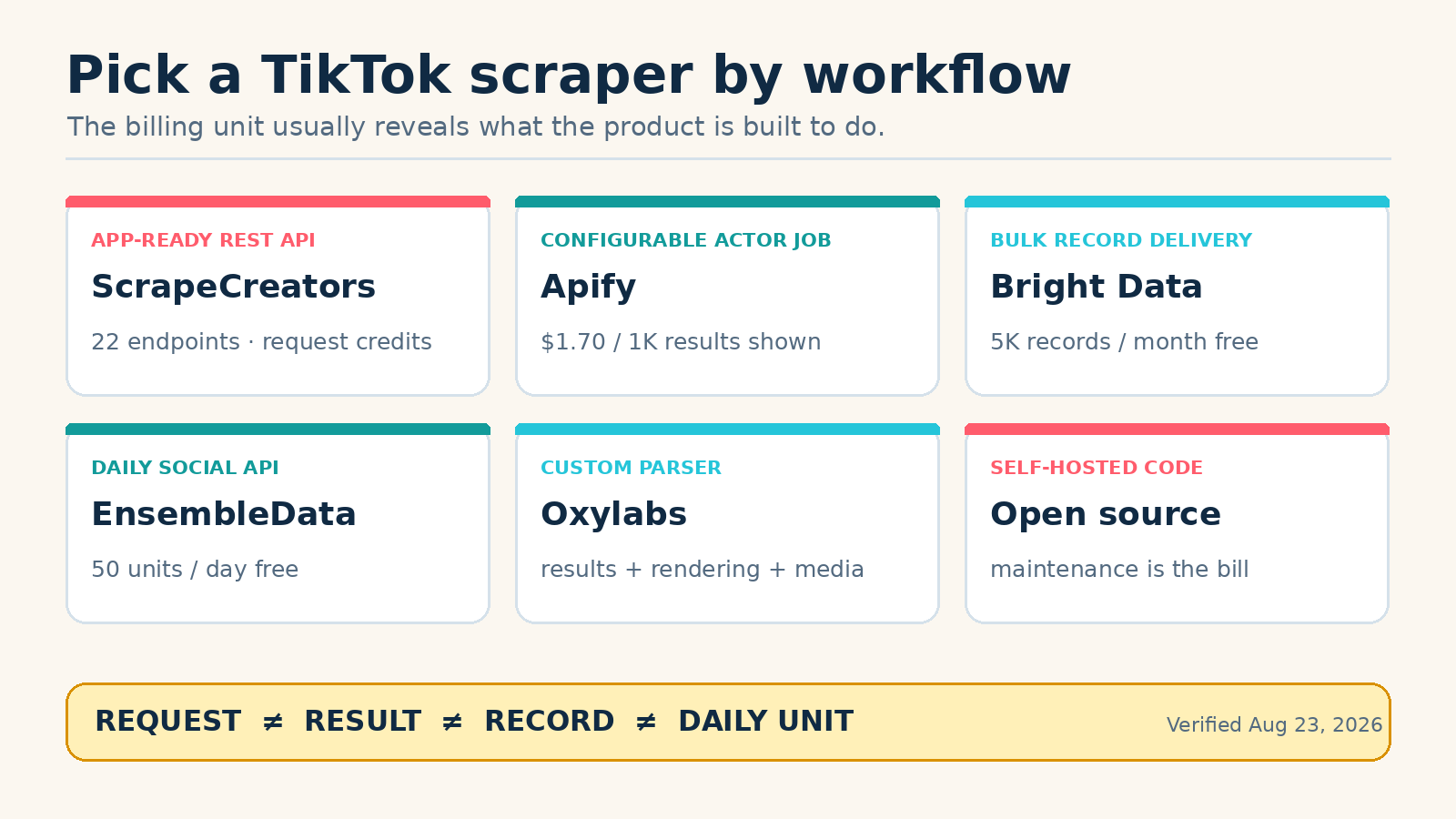
The best TikTok scraper depends on the workflow, not the smallest price on a landing page. ScrapeCreators is my pick for developers who want public profiles, videos, search, comments, replies, and transcripts through one REST API. Apify is better for configurable Actor jobs and exports. Bright Data fits bulk record delivery. EnsembleData suits steady daily usage, Oxylabs gives teams more parser control, and the drawrowfly project is a self-hosted option for developers willing to own maintenance.
I run ScrapeCreators, so take that ranking with the obvious disclosure. I checked each provider’s own product, pricing, documentation, or repository on August 23, 2026. I also made one live ScrapeCreators request. I did not run a controlled reliability benchmark across all six products.
Quick comparison
| Rank | TikTok scraper | Best for | Price basis checked August 23, 2026 | Main tradeoff |
|---|---|---|---|---|
| 1 | ScrapeCreators | App-ready TikTok and social data | 100 free credits; $47 for 25,000 credits; most endpoints cost 1 credit | Fixed public-data endpoints, not an arbitrary browser |
| 2 | Apify | Configurable Actor runs, schedules, downloads, and exports | Actor page shows pricing from $1.70 per 1,000 results | Runs and datasets add moving parts to an app integration |
| 3 | Bright Data | Bulk records and enterprise delivery | 5,000 records monthly free; $1.50 per 1,000 records pay as you go | Record pricing does not equal request pricing |
| 4 | EnsembleData | Steady daily usage through a social API | 50 units daily free; $100 monthly for 1,500 units daily | Unused daily units reset instead of rolling over |
| 5 | Oxylabs | Custom TikTok parsers, schedules, and cloud delivery | Free trial up to 2,000 results; paid plans from $49 monthly | More control means defining and maintaining the extraction contract |
| 6 | drawrowfly/tiktok-scraper | Self-hosted experiments and code study | Source is free to inspect; infrastructure and maintenance are yours | Latest repository push was May 2023 and GitHub reports no recognized license |
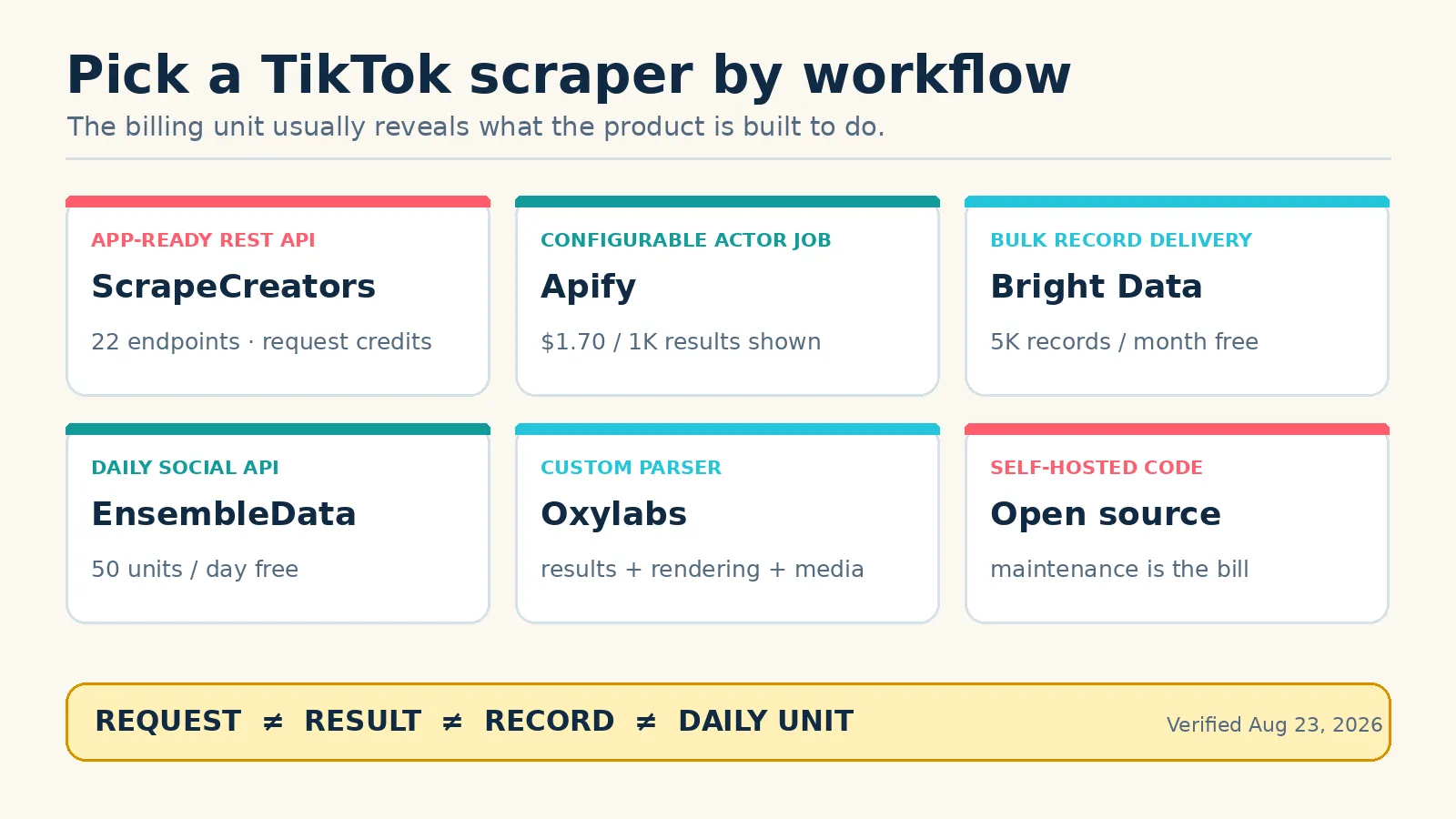
The price rows do not share a denominator. One endpoint request can return a page of videos. An Actor can bill per result. A delivered record may be one video or profile. A daily unit can have a different cost by endpoint. Compare a complete job, including pagination, retries, transcripts, comments, and storage.
How I ranked these TikTok scrapers
I used six practical questions:
- Does the product return useful TikTok data, or does the buyer still need to parse a page?
- Can it cover the resources developers ask for, such as search, profiles, posts, comments, replies, and transcripts?
- Is the price basis clear enough to estimate a real workflow?
- How much infrastructure and maintenance remain after signup?
- Does it support freshness, pagination, and repeat collection without pretending that polling is a live stream?
- When is another service the better choice?
The live US Google results for best tiktok scraper on August 23, 2026 favored comparison articles. Results for tiktok scraper api and tiktok data scraper leaned toward product pages from Apify, Bright Data, Outscraper, Clay, and other vendors. This article owns the buyer comparison. The existing ScrapeCreators TikTok API page keeps product intent, so there is no reason to turn that page into a listicle or create a second generic TikTok API URL.
Search results were only one input. I also searched YouTube, TikTok, Reddit, and X for the same topic. The recurring questions were much more useful than generic feature lists. Buyers asked how keyword results are ordered, whether date and geography filters really affect the results, how often anti-bot changes break a scraper, whether comments and replies are both available, and how close polling can get to real time. Transcript availability also separated broad metadata tools from products that can support research and AI workflows.
The six best TikTok scrapers
1. ScrapeCreators
ScrapeCreators’ TikTok API is the direct REST option in this list. The current product page lists 22 TikTok endpoints. They cover public profiles, profile videos, individual videos, keyword and hashtag search, comments, comment replies, transcripts, followers, following, live data, collections, search suggestions, products, and related jobs.
A developer calls a specific route and receives JSON. There is no Actor run to start or custom selector to maintain. The keyword search endpoint supports a query, date window, sort order, region, cursor, and trimmed response. The documentation is candid about region: it places the request in a country but does not guarantee that every returned post belongs to users in that country.
New accounts get 100 free credits. The $47 pack includes 25,000 credits, or $1.88 per 1,000 one-credit requests. The $497 pack includes 500,000 credits, or about $0.99 per 1,000 one-credit requests. Most routes cost one credit, a few cost more, valid cache hits cost zero when caching applies, and credits do not expire.
Choose it when the product needs a stable public-data API and may add Instagram, YouTube, Facebook, Reddit, or another social platform later. Do not choose it for private account data, arbitrary logged-in browser automation, or a custom selector against any website. ScrapeCreators supports defined social endpoints. It is not a general web browser.
2. Apify
Apify’s TikTok Scraper is a configurable Actor on Apify’s cloud platform. It accepts hashtags, profiles, search terms, and video URLs. Its product page lists video, profile, music, engagement, hashtag, followers, and following data, plus optional downloads for videos, subtitles, thumbnails, slideshow images, avatars, and sound covers.
The workflow is different from a synchronous resource endpoint. You configure an Actor input, run it, then read the dataset or export it as JSON, CSV, Excel, XML, or HTML. Scheduling, monitoring, API access, and integrations are built into the platform. That is useful for recurring research jobs and bulk exports.
The Actor page showed pricing from $1.70 per 1,000 results when checked. Apify also has a free platform plan with $5 of usage and a $29 monthly Starter plan with $29 of prepaid usage. Actor charges and platform usage still need to be modeled together.
Choose Apify when the job needs configurable inputs, stored datasets, downloads, schedules, and exports. Choose a direct API when the application expects one request and one immediate domain-specific response without managing runs.
3. Bright Data
Bright Data’s TikTok Scraper is built around delivered records and higher-volume collection. Its TikTok page lists profile collectors and discovery by search URL and country, with API or no-code access. The broader Scraper API provides batch requests and structured delivery.
The free tier included 5,000 records per month. Pay-as-you-go pricing was $1.50 per 1,000 successfully delivered records. The pricing page also displayed a $499 monthly tier with 384,000 included records and $1.30 per 1,000 additional records. Bright Data says failed deliveries are not charged and lists unlimited concurrency on the pay-as-you-go plan.
Choose Bright Data when the unit that matters is a large batch of records and the team wants spend limits, no-code collectors, or enterprise delivery controls. It can be more platform than a small application needs for one video or profile object.
The common pricing mistake is to compare one Bright Data record with one ScrapeCreators request. One request can return many records, so neither headline rate wins without a real workload.
4. EnsembleData
EnsembleData’s TikTok API returns public social data as JSON. Its current TikTok page lists profiles, posts, videos, likes, followers, comments, replies, hashtags, music information, shares, and dates. It sits beside APIs for Instagram, YouTube, Threads, Reddit, Twitch, X, and Snapchat.
Pricing uses daily units. The free plan includes 50 units per day. The $100 monthly Wood plan includes 1,500 units per day. Bronze is $200 for 5,000 units per day, with higher tiers above it. The pricing page says endpoint costs vary and daily units reset at 00:00 UTC. Failed requests caused by internal errors are not charged.
That model works for a pipeline with predictable daily volume. It is less convenient for a product that needs a large launch-day burst and little traffic for the rest of the month. Unused units do not become a permanent balance.
Choose EnsembleData when its response shapes fit the product and you can use the daily allocation consistently.
5. Oxylabs
Oxylabs’ TikTok Scraper API page describes a different kind of product. Instead of offering only a fixed catalog of social resources, its Web Scraper API can fetch TikTok pages, render JavaScript, apply custom parsing logic with XPath or CSS selectors, schedule jobs, and deliver data through an API, Amazon S3, or Google Cloud Storage.
The page listed a free trial of up to 2,000 results. Paid plans started at $49 monthly. The detailed price table separated successful results without JavaScript, successful results with JavaScript, and media downloads. For the catch-all “Other” category, the displayed Micro-plan rates were $1.15 per 1,000 results without JavaScript, $1.35 per 1,000 with JavaScript, and $3 per GB for media.
Choose Oxylabs when a team wants infrastructure, rendering, scheduling, cloud delivery, and control over its own extraction schema. Skip it when the product team does not want to write or maintain selectors and would rather call a defined comments or profile endpoint.
6. drawrowfly/tiktok-scraper
The drawrowfly TikTok Scraper is a popular open-source Node.js project that can collect user, hashtag, trend, music, and video metadata and download media. It has CLI, module, batch, proxy, session, CSV, and JSON examples. GitHub showed about 5,170 stars when checked.
This is the self-hosted choice, but it needs a large warning. GitHub’s API showed the latest push on May 19, 2023. It did not report a recognized repository license. The README itself says it is an unofficial scraper using TikTok’s web API, and its to-do list includes more tests and proxy improvements.
Use it to study an implementation, run a controlled experiment, or understand the maintenance surface. Do not assume old scraping code is production-ready in 2026. Review licensing with counsel before using or modifying it, and expect to own breakage, proxies, sessions, retries, observability, and schema changes.
Questions buyers keep asking
Public discussions expose selection criteria that vendor pages tend to bury.
Can I sort by views, date, language, or country?
People repeatedly asked about date cutoffs, keyword order, top posts, and country filters in the comments on Apify’s TikTok scraper tutorial. The answer depends on the collection mode. A profile feed may have different sorting controls from hashtag or keyword search. A proxy region is not the same thing as filtering every creator by residence or every caption by language.
Write the exact requirement before buying: “return the latest 100 posts for this query from the last seven days” is testable. “Supports filters” is not.
Can I collect fresh comments in real time?
A Reddit n8n discussion about TikTok comments landed on polling every few minutes, comparing the new page with stored IDs, then appending unseen comments. That is near-real-time polling, not a guaranteed event stream.
The design needs a cursor, stable comment IDs, deduplication, and a schedule that respects cost and upstream behavior. If replies matter, verify that the provider has a separate reply route and does not stop at the top-level comment count.
Will I still maintain things after paying a provider?
Yes, just less of the scraper itself. In a Reddit API comparison thread, people called out a useful test: confirm that comments, replies, transcripts, and parsed fields really exist before assuming a generic “TikTok API” covers them. They also pointed out that provider schema changes and outages become part of the dependency.
A managed API should remove proxy rotation, browser fingerprints, selector repairs, and most upstream breakage from your backlog. Your application still needs timeouts, retries, nullable fields, source URLs, contract tests, and an incident plan.
Do transcripts change the shortlist?
Often. A metadata scraper may return captions, view counts, and video URLs but not spoken-word transcripts. In the YouTube and TikTok research for this article, builders kept asking how to turn videos into transcripts for content analysis and AI workflows. ScrapeCreators has a dedicated TikTok transcript endpoint. Other vendors should be checked with real videos rather than inferred from the word “video” on a feature page.
The TikTok transcript brief workflow shows how to keep source URLs beside extracted themes and handle missing transcripts without inventing text.
What the pricing numbers actually mean
| Provider | Published unit | Useful question before buying |
|---|---|---|
| ScrapeCreators | Credits per endpoint request | How many credits does each route cost, how many rows come back, and can a valid cache hit cost zero? |
| Apify | Results produced by an Actor | How many inputs, runs, results, downloads, and stored datasets does the job create? |
| Bright Data | Successfully delivered records | How many records will each collector or target produce? |
| EnsembleData | Units that reset daily | What is the unit cost of each route, and can the workload use the daily allocation? |
| Oxylabs | Results, JavaScript rendering, and media transfer | Does TikTok need custom parsing or rendering, and how much media will be downloaded? |
| Self-hosted code | Infrastructure and engineering time | What will proxies, sessions, monitoring, breakage, and on-call work cost? |
For a trend-monitoring product, calculate keyword-search pages, detail calls, transcript calls, comment pages, reply pages, retries, and refresh frequency. For a creator database, calculate profile discovery, profile details, recent videos, pagination, and refreshes. For a media archive, include transfer and storage.
The cheapest number in a pricing table can produce the most expensive system if it excludes the fields that matter.
A tested TikTok API request
I ran this request against ScrapeCreators on August 23, 2026. The API key comes from an environment variable:
curl --get "https://api.scrapecreators.com/v1/tiktok/search/keyword" \
  -H "x-api-key: $SCRAPE_CREATORS_API_KEY" \
  --data-urlencode "query=wireless earbuds" \
  --data-urlencode "date_posted=this-month" \
  --data-urlencode "sort_by=most-liked" \
  --data-urlencode "region=US" \
  --data-urlencode "trim=true"
The call returned HTTP 200 in 4.26 seconds, charged one credit, and returned 30 results plus cursor: 30. This is an abbreviated excerpt from the first item:
{
  "success": true,
  "credits_charged": 1,
  "cursor": 30,
  "search_item_list": [
    {
      "aweme_info": {
        "aweme_id": "7670313840764013844",
        "desc": "AI Noise Cancellation: Built-in AI technology...",
        "author": {
          "unique_id": "kjrpresent"
        },
        "statistics": {
          "play_count": 11067102,
          "digg_count": 42166,
          "comment_count": 255,
          "share_count": 2674
        }
      }
    }
  ]
}
Counts and result order change. Do not use this object as a permanent expected fixture. The verified contract is more useful: the request accepted the documented query, time, sort, region, and trim parameters and returned a cursor plus public video metadata. One successful call is not a reliability benchmark.
The TikTok creator research workflow shows how keyword search, transcripts, profiles, and recent videos can become a reviewable creator shortlist instead of a pile of JSON.
Scraper API vs official TikTok Research API
TikTok has an official Research API, but it is not a general commercial alternative to the products above.
TikTok says qualifying researchers in the United States, Europe, and Brazil can apply for public account and content data. Eligibility depends on region and organization. Applicants need a defined public-interest research proposal, relevant expertise, funding disclosure, data-security commitments, ethics review, and independence from commercial interests. TikTok says applicants can typically expect a response within four weeks, though review can take longer.
Approved researchers can use the official video query endpoint with date ranges, selected fields, and query conditions. That is the right first path for eligible non-commercial research because it is TikTok’s supported access route.
Use a managed scraper API for commercial products and public-data workflows that the official eligibility gate does not serve. A scraper still does not grant permission to ignore TikTok’s terms, privacy law, copyright, or data-retention duties.
Which TikTok scraper should you choose?
Choose ScrapeCreators if you want a normal REST API for several public TikTok resources, expect to add other social platforms, and prefer pay-as-you-go credits that do not expire. Start with the free credits and test the exact routes your product needs.
Choose Apify if the job belongs in an Actor with configurable inputs, schedules, datasets, downloads, and exports.
Choose Bright Data if the workload is measured in large batches of delivered records and enterprise controls matter.
Choose EnsembleData if usage is steady each day and its endpoint shapes already match the application.
Choose Oxylabs if your team wants managed fetching and rendering but still wants to define custom parsing logic and delivery.
Choose self-hosted code only if scraper maintenance is part of the product advantage or the project is a controlled experiment. A free repository does not make the production system free.
Use TikTok’s Research API first if your organization and project qualify for official research access.
For vendors that span several networks, the social media scraping API comparison compares the broader platform decision.
Limits to plan for
TikTok data changes constantly. Videos disappear, counts move, accounts rename themselves, comments get deleted, and responses vary by region. Search order can shift between two identical requests. Transcripts can be null. A valid terminal page can have data without another cursor.
A production integration should handle:
- pagination and deduplication by stable IDs
- missing or deleted videos without treating every null as an outage
- comments and replies as separate collections
- region restrictions and ambiguous filter semantics
- freshness based on polling intervals, not a fake real-time promise
- retries that stop before your own request timeout
- schema changes, nullable fields, and contract tests
- source URLs so a person can verify a record
- retention and deletion rules for public personal data
Public data is not consequence-free data. Collect the smallest dataset that supports the product. Do not scrape private content. Do not turn a public email or ordinary comment into an invasive profile. Talk to a lawyer when the use involves employment, credit, health, children, surveillance, or sensitive inferences.
Sources checked
I checked these primary pages on August 23, 2026:
- ScrapeCreators TikTok API, pricing, keyword search documentation, and the live request above
- Apify TikTok Scraper and Apify pricing
- Bright Data TikTok Scraper and Scraper API pricing
- EnsembleData TikTok API and EnsembleData pricing
- Oxylabs TikTok Scraper API
- drawrowfly/tiktok-scraper on GitHub, including repository metadata from GitHub’s API
- TikTok Research API eligibility and video-query documentation
Prices, quotas, endpoint costs, output fields, and repository status can change. Recheck the provider page with your real inputs before committing a production budget.